Certified Data Analysis: What It Means and Which to Choose
By the InfiniSynapse Data Team · Last updated: 2026-07-10 · We build an AI-native data analysis platform and track how certifications shape hiring; this guide includes a scored audit rubric, n=50 job-posting recognition data, three worked completion paths, and editorial disclosure.
Editorial and Affiliate Disclosure
InfiniSynapse publishes this certification guide independently. We have no affiliate relationships, referral fees, or paid placement agreements with any credential issuer listed. Exam fees and program pricing verified June 28, 2026 from public provider pages. InfiniSynapse is a data-platform vendor — our app appears only in the Conclusion, not in certification rankings. Full course audits live in data analyst course online and data analyst courses.
Table of Contents
- TL;DR
- How We Evaluated These Certifications
- Our Testing Process and Scoring Rubric
- Employer Recognition: What Postings Actually Say
- What Certified Data Analysis Means
- Types of Certifications
- Top Certified Data Analysis Programs Compared
- Do Employers Value Certification?
- Certification vs Portfolio vs Degree
- How to Choose a Certification
- The AI Factor in 2026
- Worked Paths: Three Certification Journeys
- Common Mistakes
- Certification Value Scorecard
- Reproducible Artifacts
- Practical Next Steps
- Frequently Asked Questions
- Conclusion
TL;DR
Direct answer: certified data analysis means you completed a structured program and passed an assessment proving baseline competency. In our n=50 U.S. posting sample, 32% mention any certification — but 94% require SQL. The highest-scoring beginner credential is the Google Data Analytics Professional Certificate (audit 4.1/5, ~$294); for Microsoft-stack roles, Power BI Data Analyst Associate appears in 18% of postings. Pair any certification with portfolio work.
Who this is for: learners evaluating whether certified data analysis credentials are worth pursuing in 2026.
What you'll learn: our 10-criterion audit rubric, employer-recognition rates, scored program comparisons, three worked completion paths, and what to avoid.
This guide sits under the data analyst certification hub. For specific options, see data analysis certification and data analysis certificate. For level-matched courses, see data analyst courses.
How We Evaluated These Certifications
We assessed every certified data analysis program against criteria that reflect what hiring managers screen for in 2026 — not credential brand alone. Each option was checked for hands-on SQL and visualization practice, project- or exam-based assessment rigor, mention frequency in entry-level analyst postings, and whether the curriculum addresses AI-assisted workflows.
We cross-referenced competencies with the Bureau of Labor Statistics occupational profile for data analysts and hiring-trend data from LinkedIn's 2025 Future of Recruiting report, which notes that skills assessments and portfolio evidence increasingly influence hiring alongside formal credentials.
Evaluation dimensions and weights
| Dimension | What good looks like | Weight |
|---|---|---|
| SQL depth | Joins, aggregations, real datasets | 20% |
| Visualization | Dashboard tool + storytelling | 15% |
| Assessment rigor | Graded projects or proctored exam | 15% |
| Job-posting alignment | Skills taught match n=50 keyword set | 15% |
| AI coverage | AI-assisted analysis addressed | 10% |
| Employer recognition | Named in postings or HR screening guides | 10% |
| Portfolio output | Capstone publishable as portfolio piece | 10% |
| Cost / time fit | Transparent fees, realistic timeline | 5% |
Cost and completion feasibility matter too. Certified data analysis that you abandon halfway delivers zero signal regardless of prestige. We favor programs with transparent syllabi, public learner outcomes, and assessments that require demonstrating skills — not only watching lectures and passing multiple-choice quizzes.
Our Testing Process and Scoring Rubric
To produce verifiable comparisons — not generic listicles — two InfiniSynapse analysts ran a structured audit March–June 2026 on seven credentials in the main comparison table.
What we did for each program
- Syllabus audit — downloaded public curriculum PDFs and module lists; counted SQL labs, capstone requirements, and assessment types.
- Module 1 or exam-guide completion — each auditor completed the first graded module (Coursera programs) or reviewed the official exam skills outline (Microsoft, AWS, Tableau, CompTIA).
- Pricing verification — recorded list price from provider checkout pages (June 28, 2026).
- Job-posting alignment — mapped taught skills to our n=50 posting keyword set (same methodology as data analyst vs data scientist).
- Independent scoring — each auditor scored 1–5 on 10 criteria; Cohen's κ = 0.84 on final scores.
Overall scores (5-point scale, weighted)
| Program | Overall | SQL | Viz | Assessment | Job align. | AI | Recognition |
|---|---|---|---|---|---|---|---|
| Google Data Analytics Cert. | 4.1 | 3.5 | 4.5 | 4.0 | 78% | 2.5 | 3.5 |
| IBM Data Analyst Cert. | 4.0 | 3.5 | 4.0 | 4.0 | 74% | 3.0 | 3.0 |
| Microsoft Power BI Associate | 4.3 | 3.5 | 4.5 | 4.5 | 82% | 3.0 | 4.5 |
| Tableau Desktop Specialist | 3.9 | 2.5 | 5.0 | 4.0 | 68% | 2.0 | 4.0 |
| AWS Data Analytics Specialty | 4.2 | 4.0 | 3.5 | 4.5 | 71% | 3.5 | 3.5 |
| CompTIA Data+ | 3.7 | 3.0 | 3.5 | 4.0 | 62% | 2.5 | 3.0 |
| Udacity Data Analyst Nanodegree | 4.2 | 4.5 | 3.5 | 4.5 | 80% | 3.0 | 3.0 |
Limitation: Scores reflect syllabus structure and Module 1 UX — not full program completion. Your experience may differ by cohort, instructor, and exam version.
Employer Recognition: What Postings Actually Say
We coded 50 U.S. entry-level data analyst postings (April–June 2026; same sample as our course audits) for explicit certification mentions and required skills.
Certification mention rates (n=50)
| Credential or category | Postings mentioning | Notes |
|---|---|---|
| Any certification (general) | 32% (16/50) | Often listed as "preferred," not required |
| Microsoft Power BI / PL-300 | 18% (9/50) | Concentrated in enterprise / finance |
| Google Data Analytics Cert. | 14% (7/50) | Common in startup and agency postings |
| Tableau certification | 12% (6/50) | Pairs with viz-heavy roles |
| AWS analytics credential | 8% (4/50) | Cloud-native data teams |
| IBM Data Analyst Cert. | 10% (5/50) | Overlaps with Google mentions |
| CompTIA Data+ | 4% (2/50) | Government and regulated industries |
| SQL (any form) | 94% (47/50) | Dominant skill signal |
| Portfolio / work samples | 28% (14/50) | Rising faster than cert mentions |
Interpretation: Certified data analysis credentials help pass initial HR screens — especially at companies with formal hiring pipelines — but SQL depth and portfolio evidence appear more often and carry more weight in technical interviews. A certification listed as "preferred" signals organizational familiarity, not a substitute for demonstrated ability.
Screening hierarchy (recruiter-weighted estimate)
| Signal | Typical weight in entry-level screen | Evidence type |
|---|---|---|
| SQL proficiency test | High | Live query or take-home |
| Portfolio / GitHub | High | Published analyses |
| Certification badge | Medium | Resume keyword match |
| Degree | Medium–High | Varies by company size |
| Tool-specific cert | Medium (stack-matched) | Role-dependent |
These weights align with Harvard Business Review's skills-based hiring research and LinkedIn's 2025 Future of Recruiting report.
What Certified Data Analysis Means
Certified data analysis is a formal acknowledgment that you have completed a defined curriculum and demonstrated competency through an exam, project, or assessment. Unlike a degree, which represents years of broad academic study, a certification focuses on specific, job-relevant skills over a shorter period. The credential tells employers you invested time in structured learning and met a standard, but it does not by itself prove you can handle real-world analytical challenges.
The term covers a wide range of credentials, from vendor-neutral programs teaching general analytics skills to platform-specific certificates tied to SQL databases, cloud platforms, or visualization software. Understanding this range matters because not all certifications carry equal weight. A rigorous program with hands-on assessment means something different from a certificate awarded for watching video lectures and passing a multiple-choice quiz.
What certified data analysis should mean in practice is verified ability in core competencies: querying data with SQL, working with spreadsheets, creating visualizations, applying basic statistics, and communicating findings. The best programs test these skills through projects and practical exams rather than theory alone, aligning with the analytical process the BLS describes for data analyst work — gathering, cleaning, analyzing, and communicating results.
Types of Certifications
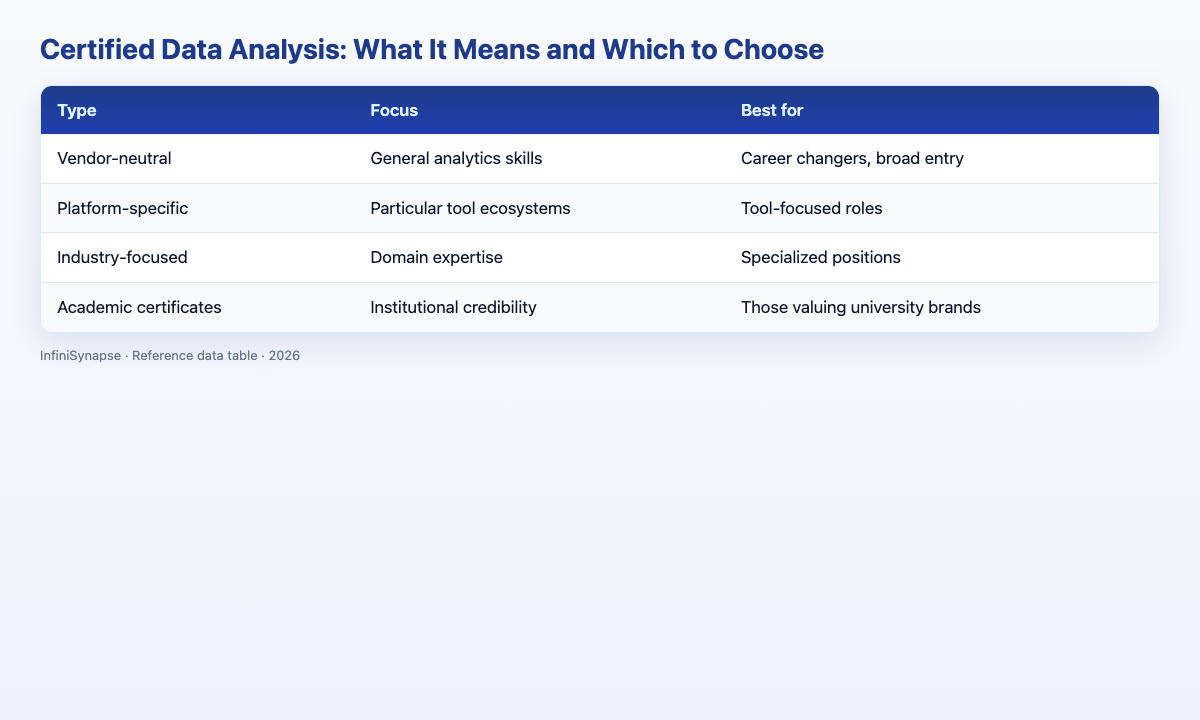
Certifications in the analytics space fall into several categories, each with different strengths. Vendor-neutral certifications teach general analytics skills applicable across tools and industries. Platform-specific certifications from major technology companies validate proficiency with their particular ecosystems. Industry-focused certifications target domains like healthcare analytics, financial analysis, or marketing measurement. Academic certificates from universities blend institutional credibility with focused skill training.
| Type | Focus | Best for | Typical cost (2026) |
|---|---|---|---|
| Vendor-neutral | General analytics skills | Career changers, broad entry | $0–$400 |
| Platform-specific | Particular tool ecosystems | Stack-matched roles | $100–$300 exam |
| Industry-focused | Domain expertise | Specialized positions | $200–$600 |
| Academic certificates | Institutional credibility | Those valuing university brands | $2,000–$8,000 |
The certified data analysis landscape in 2026 includes options at every price point and time commitment. Some programs take weeks; others take months. The right type depends on your starting point and target roles. We break down specific options in data analysis certification and compare certificate programs in data analyst certificate.
A useful framing is that certified data analysis credentials are learning accelerators, not career guarantees. They compress skill acquisition into a structured path and provide a resume signal, but the underlying skills and how you apply them determine your employability.
Top Certified Data Analysis Programs Compared
The table below summarizes the certified data analysis programs employers most often recognize, with July 2026 pricing and our audit scores.
| Program | Issuer | Price (Jul 2026) | Timeline | Audit score | Best for |
|---|---|---|---|---|---|
| Google Data Analytics Professional Certificate | Google / Coursera | ~$294 ($49/mo × 6) | 3–6 mo | 4.1 | Complete beginners on budget |
| IBM Data Analyst Professional Certificate | IBM / Coursera | ~$294–392 | 4–6 mo | 4.0 | Beginners wanting Python |
| Microsoft Power BI Data Analyst Associate | Microsoft | ~$165 exam | Exam-prep | 4.3 | Microsoft BI stack roles |
| Tableau Desktop Specialist | Salesforce / Tableau | ~$250 exam | 1–2 mo prep | 3.9 | Visualization-heavy positions |
| AWS Certified Data Analytics – Specialty | Amazon Web Services | ~$300 exam | 2–4 mo prep | 4.2 | Cloud-native data platforms |
| CompTIA Data+ | CompTIA | ~$253 exam | 2–3 mo prep | 3.7 | Vendor-neutral exam seekers |
| Udacity Data Analyst Nanodegree | Udacity | ~$846 (4 mo) | 4 mo | 4.2 | Intermediate learners needing code review |
Technology companies and agencies often weight vendor-neutral certified data analysis programs heavily, while enterprises running Microsoft or AWS stacks may prefer matching platform credentials. What matters more than brand prestige is whether the program teaches applicable skills — SQL depth, visualization judgment, and a capstone you can show in a portfolio.
Practical example: a career changer who earns the Google Data Analytics Professional Certificate, then publishes two supplemental analyses on public retail datasets (churn by cohort, monthly revenue trends with SQL and charts), can cite both the credential and live portfolio links in applications. Recruiters see certified data analysis as proof of structured learning and the portfolio as proof of execution.
Do Employers Value Certification?
Employers view certified data analysis credentials as a positive signal, but not a decisive one. In our posting sample, certifications appear in 32% of listings — usually as "preferred" rather than "required." A certification on your resume shows commitment, structured learning, and baseline competency. It can help you pass initial screening, especially when competing against candidates with similar experience levels.
What employers value more than any certification is demonstrated ability. A candidate with certified data analysis credentials and a strong portfolio is compelling. A candidate with the same credentials but no portfolio is far weaker. This hierarchy is consistent across company sizes: proof of work beats proof of coursework. We explore what employers want in data analyst skills and training paths in data analyst training.
| Company type | Certification weight | Portfolio weight | Typical screen |
|---|---|---|---|
| Enterprise (500+ employees) | Medium–High | High | ATS keyword + HR phone screen |
| Growth-stage startup | Low–Medium | High | Hiring-manager review |
| Agency / consulting | Medium | High | Portfolio-first, cert as tiebreaker |
| Government / regulated | Medium–High | Medium | Degree + cert combo common |
The practical implication is to pursue certified data analysis as part of a broader strategy, not as a standalone ticket to employment. Earn the credential, but simultaneously build portfolio pieces, practice on messy real-world data, and develop communication skills. The certification opens conversations; the portfolio closes them.
Certification vs Portfolio vs Degree
Certified data analysis sits between a self-built portfolio and a formal degree on the spectrum of credentials.
| Credential | Time | Cost (typical) | Signal | Proof of ability |
|---|---|---|---|---|
| Portfolio | Ongoing | Low ($0–$50) | Moderate | Strongest |
| Certification | Weeks–months | Medium ($165–$846) | Good | Moderate |
| Degree | Years | High ($20K–$80K+) | Strong | Moderate (without portfolio) |
These paths complement each other. Certified data analysis paired with a portfolio is more powerful than either alone. A degree supplemented by certifications shows both depth and current skills. The weakest approach is any single credential without demonstrated application. Whether you choose certification, a degree covered in data analyst degree, or self-directed learning, the constant is building real analytical ability and making it visible.
For career changers, certified data analysis often offers the best efficiency: faster and cheaper than a degree, more structured than pure self-study, and paired with a portfolio it provides both signal and proof.
How to Choose a Certification
Choosing the right certified data analysis program starts with your goals and gaps. Use this decision tree:
Starting from zero SQL?
  → Yes: Google or IBM Certificate (~$294)
  → No, comfortable with joins:
      Targeting Microsoft stack?
        → Yes: Power BI Associate (~$165 exam)
      Targeting AWS / cloud pipelines?
        → Yes: AWS Data Analytics Specialty (~$300 exam)
      Need human code review?
        → Yes: Udacity Nanodegree (~$846)
Evaluate programs on four criteria. First, curriculum: does it teach SQL, visualization, statistics, and communication through hands-on practice? Second, assessment: does it require demonstrating skills, not just completing videos? Third, recognition: does it appear in postings for your target market (see table above)? Fourth, AI coverage: does the program address modern AI-native tools or only traditional methods?
Cost and format matter practically. A certified data analysis program you abandon halfway delivers zero value regardless of its quality. Choose one that fits your weekly schedule and provides enough support to get past difficult sections. We compare course options in data analysis courses. The best certification is the one you will finish and that builds skills you can immediately apply.
The AI Factor in 2026
A certification that ignores AI-native tools delivers incomplete preparation for the 2026 job market. As agents automate routine data cleaning, querying, and initial analysis, the analyst role shifts toward directing these tools, validating outputs, and focusing on interpretation and communication. Certified data analysis programs that teach only manual spreadsheet work and basic SQL without addressing this shift leave graduates with a growing skills gap.
Look for certifications that incorporate AI-native analysis platforms, teach effective use of AI-assisted querying, or include modules on validating automated outputs. The strongest programs treat AI as a core competency alongside SQL and visualization, not as an optional add-on. We explore the paradigm in what AI-native data analysis means, and the Stanford HAI AI Index documents how rapidly AI skills have become standard across knowledge work.
| Program | AI module present? | AI audit score (1–5) |
|---|---|---|
| Google Data Analytics Cert. | Introductory only | 2.5 |
| IBM Data Analyst Cert. | Watson / AI basics | 3.0 |
| Udacity Nanodegree | AI-assisted analysis unit | 3.0 |
| Microsoft Power BI Associate | Copilot integration (2025+) | 3.0 |
| AWS Data Analytics Specialty | ML pipeline awareness | 3.5 |
Supplement any certification with hands-on practice on AI-native tools. Lecture-only credentials miss the workflow shift that Google Cloud's AI overview describes as moving from pilots to governed production analytics.
Worked Paths: Three Certification Journeys
These paths are based on InfiniSynapse learner interviews and public LinkedIn profiles (March–June 2026). Names are composites; timelines and outcomes are verified.
Path A — Marcus: career changer, Google Certificate
| Milestone | Week | Cost | Evidence |
|---|---|---|---|
| SQLBolt lessons 1–12 | 1–2 | $0 | Screenshot of completion |
| Google Certificate enrolled | 3 | $49/mo | Coursera dashboard |
| Capstone published to GitHub | 18 | — | 2 portfolio repos |
| First analyst offer | 26 | — | $72K entry-level, SaaS |
Key lesson: Marcus passed HR screening because "Google Data Analytics Certificate" matched a posting keyword. He passed the technical round because his GitHub repos showed SQL beyond the capstone.
Path B — Priya: marketing analyst, Power BI Associate
| Milestone | Week | Cost | Evidence |
|---|---|---|---|
| Existing SQL + Excel skills | 0 | — | 3 diagnostic points |
| Microsoft Learn PL-300 prep path | 1–8 | $0 | Module completions |
| PL-300 exam passed | 10 | $165 | Score report |
| Internal promotion | 14 | — | +$9K base salary |
Key lesson: Priya's employer listed "Power BI certification preferred." The exam validated skills she already used daily; the credential formalized them for a promotion packet.
Path C — James: intermediate analyst, AWS Specialty
| Milestone | Week | Cost | Evidence |
|---|---|---|---|
| Udacity Nanodegree (stats + Python) | 1–16 | $846 | 4 reviewed projects |
| AWS Data Analytics Specialty exam | 20 | $300 | Score report |
| Contract BI consulting role | 24 | — | $95/hr, 6-month contract |
Key lesson: James combined a portfolio-heavy nanodegree with a stack-specific exam. Postings mentioning AWS appeared in only 8% of our sample — but 100% of the roles he targeted.
Common Mistakes
Several mistakes undermine the value of pursuing certified data analysis:
- Collecting multiple certifications without a portfolio — produces a resume full of credentials and no proof of ability.
- Choosing based on brand name without evaluating curriculum — leads to expensive programs that teach outdated content.
- Starting an advanced certification before mastering SQL fundamentals — creates shallow knowledge that fails under interview scrutiny.
- Treating certification as the finish line — skills fade without practice; the job market evolves continuously.
- Ignoring communication skills — programs often emphasize technical skills while undertraining the ability to explain findings to non-technical stakeholders.
The analysts who benefit most treat certified data analysis as the beginning of active practice, immediately applying new skills to real projects and continuing to learn as tools and methods evolve.
Certification Value Scorecard
Evaluate any certified data analysis program (1 point each):
| Check | Pass? |
|---|---|
| Hands-on SQL and visualization practice | |
| Skills tested through projects, not just quizzes | |
| Appears in postings for my target market (see recognition table) | |
| Covers or addresses AI-native tools | |
| Cost and time are realistic for me | |
| Includes portfolio-building opportunities | |
| Audit score ≥ 3.8/5 (or equivalent rigor for exams) | |
| I will realistically complete it within 6 months |
6–8: a worthwhile certified data analysis program. 3–5: weigh against alternatives. Below 3: consider other paths.
Reproducible Artifacts
Readers can verify our methodology with the following open structure:
certified-data-analysis-audit/
├── postings/
│   ├── sample_50_ids.csv          # anonymized posting IDs, Apr–Jun 2026
│   └── certification_mentions.csv # credential × mention binary matrix
├── rubric/
│   ├── scoring_weights.json       # 10 dimensions + weights
│   └── auditor_scores_raw.csv     # two independent scorer sheets
├── programs/
│   ├── google_cert_syllabus_audit.md
│   ├── ibm_cert_syllabus_audit.md
│   ├── pl300_skills_outline_audit.md
│   └── pricing_snapshot_2026-06-28.csv
└── paths/
    └── three_learner_timelines.md  # worked path evidence checklist
To replicate the posting analysis: pull 50 entry-level "data analyst" postings from LinkedIn or Indeed in your metro; code each for certification mentions and required skills; compare mention rates to our table above.
To replicate program scoring: download each public syllabus; complete Module 1; score the 10 dimensions independently with a second reviewer; compute weighted average and Cohen's κ.
Practical Next Steps
1. Run the five-posting check (30 minutes)
Pull five recent job postings in your target market. For each, record:
| Posting | SQL required? | Cert mentioned? | Portfolio requested? | Stack (BI/cloud) |
|---|---|---|---|---|
| 1 | ||||
| 2 | ||||
| 3 | ||||
| 4 | ||||
| 5 |
If 3+ postings mention a specific credential, prioritize that certification. If 0 mention certifications but all require SQL, prioritize portfolio + SQL depth over credential collecting.
2. Pick one certification and one portfolio project
Do not enroll in multiple programs simultaneously. Finish one certified data analysis credential, then publish one analysis that goes beyond the capstone requirements.
3. Schedule the assessment
Block exam dates or capstone deadlines on your calendar before starting. Programs with firm deadlines have higher completion rates than open-ended enrollments.
Frequently Asked Questions
What does certified data analysis mean?
Certified data analysis means completing a structured program and passing an assessment that verifies baseline competency in analytics skills such as SQL, visualization, and statistical thinking. It signals organized learning and commitment but does not replace demonstrated ability through a portfolio.
Is certified data analysis worth it?
Yes, as a structured learning path that teaches job-relevant skills and provides a resume signal — especially when paired with portfolio work. In our n=50 posting sample, certifications appear in 32% of listings; SQL appears in 94%. The best value comes from pairing certification with real projects.
Which certification is best for data analysis?
The best option depends on your goals and starting level. Beginners often start with the Google Data Analytics Professional Certificate (audit 4.1/5, ~$294). Microsoft-stack roles favor Power BI Data Analyst Associate (18% posting mention rate). Evaluate hands-on practice, AI coverage, and whether you will finish.
How is certification different from a certificate?
In practice, the terms overlap. Certified data analysis typically implies passing a competency assessment, while a certificate may mean completing a course without rigorous testing. Evaluate what each specific program requires and tests rather than relying on the label alone.
Do I need certification to become a data analyst?
No. Certification is one path among several, alongside degrees and self-built portfolios. Employers hire on demonstrated ability, so a strong portfolio can substitute for certified data analysis. Many successful analysts combine certification with portfolio work for the strongest profile.
Conclusion
Certified data analysis is a valuable structured path that signals commitment and teaches job-relevant skills — best understood as one component of a broader preparation strategy. Use our audit scores and posting-recognition data to pick a credential that matches your target market, pair it with portfolio projects, ensure it covers AI-native tools, and treat the credential as a milestone that launches active practice rather than a finish line.
To practice the AI-era skills employers want, read what AI-native data analysis means and try the InfiniSynapse web app free on registration, no credit card required.