Data Analysis Certification: Complete 2026 Directory
By the InfiniSynapse Data Team · Last updated: 2026-07-09 · We build an AI-native data analysis platform and maintain this directory of analytics credentials; use it to find the right data analysis certification for your goals.
Table of Contents
- TL;DR
- How We Evaluated These Certifications
- How This Directory Is Organized
- Major Data Analysis Certifications
- Vendor-Neutral Certifications
- Platform-Specific Certifications
- Industry-Focused Certifications
- How to Use This Directory
- AI Coverage Across Certifications
- Certification Selection Scorecard
- Practical Next Steps
- Frequently Asked Questions
- Conclusion
TL;DR
Direct answer: this directory maps the major data analysis certification options in 2026 across vendor-neutral, platform-specific, industry-focused, and academic categories. No single certification suits everyone; choose based on your skill level, target roles, and whether you need broad or specialized preparation. Pair any credential with portfolio work for the strongest career preparation.
Who this is for: learners who want a comprehensive map of analytics credentials rather than a single recommendation.
What you'll learn: how we evaluated certifications, how they are categorized, the major data analysis certification options in each category, how to navigate the directory, and selection criteria.
This guide sits under the data analyst certification hub; for certificate programs, see data analysis certificate and certified data analysis.
How We Evaluated These Certifications
We selected every data analysis certification in this directory against criteria that mirror what hiring managers list in 2026 job postings, not brand prestige alone. Each program was checked for SQL depth with hands-on practice, visualization and communication work, portfolio-ready capstone or project output, and whether the curriculum acknowledges AI-assisted analysis workflows. We cross-referenced skill requirements with the Bureau of Labor Statistics occupational profile for data analysts, which lists analytical, communication, and technical skills as core competencies regardless of which credential you hold, and hiring-trend data from LinkedIn's 2025 Future of Recruiting report, which notes that skills assessments and portfolio evidence increasingly influence hiring alongside formal credentials.
How We Evaluated These: In Practice
Assessment rigor and employer recognition matter too. A certification that tests only multiple-choice recall delivers less career value than one requiring project completion or a practical exam. We favor programs with transparent syllabi, public learner reviews from working analysts, and curricula aligned with tools employers actually list — SQL, Excel or Google Sheets, a BI platform, and basic statistical reasoning.## How This Directory Is Organized The certification landscape is fragmented across dozens of providers, credential types, and skill levels. This directory organizes options into four categories that reflect how employers and learners actually think about analytics credentials.
Vendor-neutral certifications teach general analytics skills applicable across tools and industries. They are the most versatile data analysis certification options and suit career changers seeking broad entry-level preparation.
Platform-specific certifications validate proficiency with particular technology ecosystems such as cloud providers, database platforms, and visualization tools. They suit analysts who know their target employer's stack.
Industry-focused certifications target specific domains like healthcare, finance, or marketing analytics. They add domain credibility beyond general data analysis certification.
Academic certifications come from universities and carry institutional brand recognition. They blend academic credibility with focused skill training.
How This Directory Is: In Practice
Each data analysis certification entry in this directory is evaluated on curriculum depth, assessment rigor, employer recognition, and AI coverage. We link to detailed guides for specific categories throughout this pillar. The analytical competencies these certifications should validate are described in data analyst skills and the Wikipedia data analysis overview.## Major Data Analysis Certifications
The data analysis certification market clusters into vendor-neutral programs (broad SQL and visualization foundations) and platform-specific credentials (BI tools, cloud analytics stacks). The table below summarizes the programs employers most often recognize on résumés and job postings in 2026. For a cert-by-cert deep dive, see certifications for data analyst roles.
| Program | Issuer | Core skills covered | Typical timeline | Best for |
|---|---|---|---|---|
| Google Data Analytics Professional Certificate | Google / Coursera | Spreadsheets, SQL, R, Tableau, capstone | 3–6 months part-time | Complete beginners seeking a structured entry path |
| IBM Data Analyst Professional Certificate | IBM / Coursera | Excel, SQL, Python, Cognos, dashboards | 4–6 months part-time | Beginners who want Python in the curriculum |
| Microsoft Power BI Data Analyst Associate | Microsoft | Data modeling, DAX, Power BI dashboards | Exam-prep (varies) | Roles centered on Microsoft BI stacks |
| Tableau Desktop Specialist | Salesforce / Tableau | Visualization design, Tableau Desktop | 1–2 months prep | Visualization-heavy analyst positions |
| AWS Certified Data Analytics – Specialty | Amazon Web Services | Cloud data pipelines, analytics on AWS | 2–4 months prep | Analysts targeting cloud-native data platforms |
No single data analysis certification dominates every market. Technology companies and agencies often weight vendor-neutral programs heavily, while enterprises running Microsoft or AWS stacks may prefer matching platform credentials. What matters more than brand prestige is whether the program teaches applicable skills — SQL depth, visualization judgment, and a capstone you can show in a portfolio — because that is what hiring managers evaluate in interviews.
Practical example: a career changer who completes the Google Data Analytics Professional Certificate, then publishes two supplemental analyses on public retail datasets (churn by cohort, monthly revenue trends with SQL + charts), can cite both the certification and live portfolio links in applications. Recruiters see the credential as proof of structured learning and the portfolio as proof of execution — the combination that Harvard Business Review's skills-based hiring research describes as increasingly decisive in hiring decisions.
Vendor-Neutral Certifications
Vendor-neutral data analysis certification options teach general skills that transfer across employers, tools, and industries. They typically cover SQL, spreadsheet analysis, data visualization, basic statistics, and data cleaning through structured curricula with capstone projects.
These are the most recommended starting points for career changers because they do not lock you into a specific technology ecosystem. A vendor-neutral data analysis certification from a recognized education platform signals broad analytics competency that employers across industries understand and value.
Key evaluation criteria for vendor-neutral options: Does the program teach SQL through extensive hands-on practice? Does it include a portfolio-worthy capstone? Is the credential recognized on job postings in your target market? Does it address AI-native tools? Strong programs answer yes to all four.
We provide detailed comparisons in certifications for data analyst and data analyst certificate. Vendor-neutral data analysis certification is typically the right first credential before pursuing platform-specific or industry-focused options. Enterprise adoption patterns in Google Cloud's AI overview mirror the shift from pilots to governed analytics.
Platform-Specific Certifications
Platform-specific data analysis certification options validate your ability to work within particular technology ecosystems. Cloud providers, database vendors, and visualization platforms each offer credentials proving platform proficiency.
These certifications carry the most weight when you target roles at organizations using that specific platform. A cloud analytics data analysis certification is highly relevant for companies on that cloud; less relevant elsewhere. Pursue platform-specific data analysis certification after establishing general analytics fundamentals, not as your first credential.
| Platform category | What it validates | When to pursue |
|---|---|---|
| Cloud analytics | Cloud-based data pipelines, warehousing | Targeting cloud-native companies |
| Database | Query optimization, administration | Database-heavy roles |
| Visualization | Dashboard design, reporting | BI-focused positions |
| Programming | Python/R for analysis | Roles requiring coding |
Platform-specific data analysis certification adds specialization depth to your profile. It works best as a second or third credential after vendor-neutral fundamentals and a strong portfolio. See data analyst training for how certifications fit into broader learning paths.
Industry-Focused Certifications
Industry-focused data analysis certification options target specific domains where analytics skills meet sector-specific knowledge. Healthcare analytics certifications cover clinical metrics and regulatory constraints. Financial certifications address risk modeling and compliance. Marketing certifications focus on attribution, campaign measurement, and customer analytics.
These credentials suit analysts who know their target industry and want to demonstrate domain fluency alongside technical skills. A healthcare data analysis certification signals you understand HIPAA constraints and clinical data structures, not just SQL and charts.
Industry-focused data analysis certification is most valuable at the intermediate stage. It assumes general analytics competency and adds context that general certifications lack. Career changers entering a specific industry benefit from pairing a vendor-neutral foundation with an industry-focused second credential.
If you are exploring broadly, start with general data analysis certification. Add industry credentials once you have confirmed your target sector and built foundational skills with a portfolio to demonstrate them.
How to Use This Directory
Navigate this data analysis certification directory based on your current situation.
Complete beginner, exploring analytics: Start with vendor-neutral options in the major certifications table. Complete one program, build a portfolio project, then reassess.
Career changer with some technical skills: Identify your gaps using data analyst skills. Choose a certification that fills the biggest gap, likely SQL depth or visualization.
Working analyst seeking advancement: Pursue platform-specific or industry-focused certifications aligned with your target role. Your portfolio already exists; the credential adds specialization signal.
Budget-conscious learner: Start with free options cataloged in data analyst course free. Upgrade to a paid certification once you confirm commitment.
Regardless of path, never collect certifications without building portfolio work. One certification with three published analyses outperforms three certifications with no demonstrated ability. Use this directory to find the right credential, then invest equal effort in practice and portfolio-building.
AI Coverage Across Certifications
A growing differentiator in the certification landscape is AI coverage. Programs addressing AI-native tools, automated workflow integration, and output validation prepare you for the 2026 job market. Programs ignoring AI teach an increasingly incomplete skill set regardless of how strong their traditional curriculum is.
When using this directory, add AI coverage as a standard evaluation criterion alongside curriculum depth and employer recognition. Ask each certification provider whether AI modules are core curriculum or absent. Check whether capstone projects incorporate AI-assisted workflows.
Supplement any certification with hands-on AI practice on real datasets. We explore the paradigm in what AI-native data analysis means, and the Stanford HAI AI Index tracks how rapidly AI skills have become a universal expectation for analysts. Augmented analytics trends in IBM's augmented analytics overview show why certified analysts must keep practicing beyond the exam date.
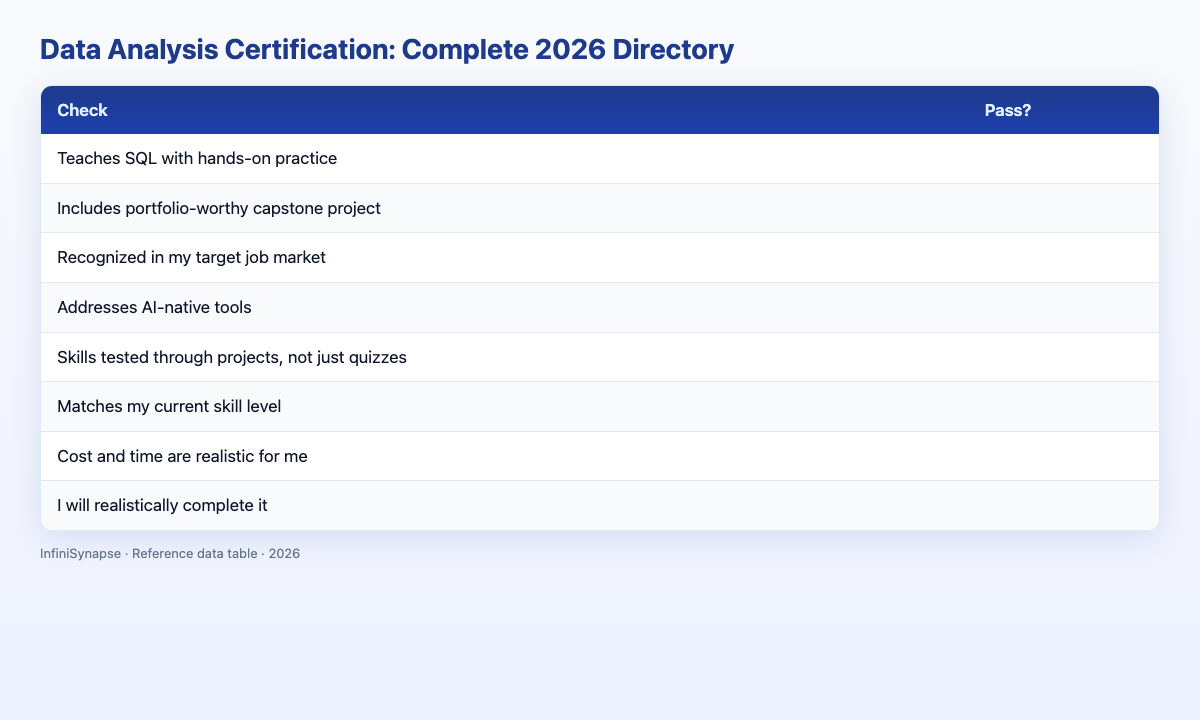
Certification Selection Scorecard
Use this scorecard when evaluating any certification from this directory (1 point each):
| Check | Pass? |
|---|---|
| Teaches SQL with hands-on practice | |
| Includes portfolio-worthy capstone project | |
| Recognized in my target job market | |
| Addresses AI-native tools | |
| Skills tested through projects, not just quizzes | |
| Matches my current skill level | |
| Cost and time are realistic for me | |
| I will realistically complete it |
6–8: pursue this certification pathway. 3–5: compare against alternatives in the directory. Below 3: keep searching or consider a different category.
Practical Next Steps
Verify against real job postings
Before committing time or budget, pull five recent job postings in your target market and list the SQL, visualization, and communication skills each repeats. Align your learning plan to those patterns rather than a generic syllabus.
Ship one portfolio artifact this month
Employers hire on demonstrated ability. Publish one finished analysis — with a clear question, reproducible queries, and a short executive summary — alongside any credential or course completion.
Frequently Asked Questions
What is the best data analysis certification?
The best certification depends on your level and goals. Beginners often start with the Google Data Analytics Professional Certificate or IBM Data Analyst Professional Certificate for broad foundations. BI-focused roles may favor Microsoft Power BI Data Analyst Associate. Evaluate based on curriculum depth, AI coverage, and employer recognition rather than brand alone.
How many data analysis certifications do I need?
One well-chosen certification paired with a strong portfolio is more effective than multiple credentials without demonstrated work. Add a second certification only when it fills a specific gap your first one left, such as platform specialization or industry domain knowledge.
Are data analysis certifications worth it?
Yes, as structured learning paths that teach job-relevant skills and provide resume signals. A data analysis certification is not worth it as a standalone job ticket without portfolio work. The best value comes from pairing certification with real projects.
How is a data analysis certification different from a certificate?
A certification typically requires passing a competency assessment, while a certificate may mean completing a program. Terms overlap in practice. Evaluate what each specific program teaches and tests. See data analysis certificate for the certificate perspective.
Where do I start in this directory?
Start with vendor-neutral certification if you are a beginner or career changer. Browse certifications for data analyst for detailed comparisons, then return to this directory for specialized options once your fundamentals are solid.
Conclusion
This data analysis certification directory maps the credential landscape in 2026 so you can find the right option for your level, goals, and target industry. No single certification suits everyone; use the category framework, major certifications table, evaluation scorecard, and linked guides to make an informed choice. Pair any certification with portfolio projects and AI-native tool practice for the strongest career preparation.
To practice the AI-era skills employers want, read what AI-native data analysis means and try the InfiniSynapse web app free on registration, no credit card required.