Data Analysis Course: How to Choose the Right One
By the InfiniSynapse Data Team · Last updated: 2026-07-09 · We build an AI-native data analysis platform and have evaluated hundreds of courses; this guide helps you pick one that actually works.
Table of Contents
- TL;DR
- How We Evaluated These Courses
- Start With Your Goals
- Essential Evaluation Criteria
- Top Data Analysis Courses Compared
- Course Formats Compared
- Free vs Paid Courses
- Common Selection Mistakes
- A Step-by-Step Selection Process
- AI Tools in Course Selection
- Course Selection Scorecard
- Practical Next Steps
- Frequently Asked Questions
- Conclusion
TL;DR
Direct answer: choosing the right data analysis course starts with your goals and skill level, then evaluates candidates on hands-on practice, curriculum relevance, portfolio potential, and AI coverage. The best data analysis course is one you will complete that teaches SQL deeply, produces portfolio pieces, and matches current job requirements.
Who this is for: anyone overwhelmed by course options who wants a clear selection framework.
What you'll learn: how we evaluated courses, how to define your needs, what criteria matter, specific program comparisons, format trade-offs, common mistakes, and a step-by-step process.
This guide sits under the data analyst certification hub. For curated lists, see data analysis courses and data analyst course. For bootcamp alternatives, see data analysis bootcamp.
How We Evaluated These Courses
We selected data analysis course options using criteria that mirror what hiring managers list in 2026 job postings, not brand prestige alone. Each program was checked against four dimensions: SQL depth with hands-on practice, visualization and communication work, portfolio-ready capstone or project output, and whether the curriculum acknowledges AI-assisted analysis workflows. We cross-referenced skill requirements with the Bureau of Labor Statistics occupational profile for data analysts and hiring-trend data from LinkedIn's 2025 Future of Recruiting report, which notes that skills assessments and portfolio evidence increasingly influence hiring alongside formal credentials.
How We Evaluated These: In Practice
Price, format, and completion rates matter too. A course you abandon halfway delivers less value than a shorter free program you finish and turn into portfolio work. We favor programs with transparent syllabi, public learner reviews from working analysts, and curricula aligned with tools employers actually list — SQL, Excel or Google Sheets, a BI platform, and basic statistical reasoning.## Start With Your Goals
Before comparing any data analysis course, clarify what you need. Are you a complete beginner entering analytics for the first time? A career changer with some spreadsheet skills wanting to add SQL? A working analyst seeking specialization in a domain or tool? Your starting point and destination determine which course criteria matter most.
Define your constraints simultaneously. How many hours per week can you study? What is your budget? Do you need a credential for resume screening? Do you learn better with deadlines or at your own pace? A data analysis course that is perfect for someone with forty hours weekly and five thousand dollars may be wrong for someone with ten hours weekly and a zero budget. The move toward augmented workflows, outlined in IBM's augmented analytics overview, frames how teams evaluate modern tooling.
Write down three sentences before researching: where I am now, where I want to be, and what I can invest in time and money. Every course evaluation should reference these sentences. Courses that do not move you from your current state toward your goal are wrong choices regardless of reviews or brand recognition. We map skill requirements in data analyst skills and career paths in how to become a data analyst.
Essential Evaluation Criteria
Five criteria predict whether a data analysis course will actually prepare you for analyst work.
Hands-on practice ratio: At least half your time should involve writing SQL, building visualizations, and working with datasets. Video-only course content without interactive practice builds passive knowledge that fails in interviews and on the job.
Curriculum alignment: Compare the syllabus against current job postings for roles you target. Does the data analysis course teach the skills employers list? SQL depth matters most, followed by visualization, basic statistics, and communication.
Portfolio potential: Capstone projects should be designed as portfolio pieces. A data analysis course whose final project you can publish, annotate, and show recruiters delivers more career value than one whose exercises you discard after submission.
Assessment rigor: Courses that test skills through projects and practical challenges produce stronger graduates than those awarding completion for watching videos. Evaluate what you must demonstrate to finish the program.
Support quality: Instructor feedback, community forums, office hours, or peer review help you past sticking points. A program without any support channel leaves you stranded when material gets difficult.
Top Data Analysis Courses Compared
The table below compares the data analysis course programs we most often recommend in 2026. All include hands-on SQL and visualization work; the right pick depends on your budget, timeline, and starting level.
| Program | Provider | Core skills | Typical timeline | Cost | Best for |
|---|---|---|---|---|---|
| Google Data Analytics Professional Certificate | Google / Coursera | Spreadsheets, SQL, R, Tableau, capstone | 3–6 months PT | ~$49/month | Complete beginners wanting structured entry |
| IBM Data Analyst Professional Certificate | IBM / Coursera | Excel, SQL, Python, Cognos, dashboards | 4–6 months PT | ~$49/month | Beginners who want Python in the curriculum |
| Springboard Data Analytics Career Track | Springboard | SQL, Python, Tableau, two capstone projects | 6 months PT | ~$8,500–$10,500 | Career changers wanting mentor support |
| General Assembly Data Analytics Bootcamp | General Assembly | SQL, Excel, Tableau, real client projects | 12 weeks FT / 24 weeks PT | ~$15,950 | Learners who thrive in cohort-based formats |
| Udacity Data Analyst Nanodegree | Udacity | SQL, Python, statistics, A/B testing | 4 months at 10 hrs/week | ~$399/month | Intermediate learners filling statistical gaps |
When evaluating a data analysis course, look beyond the brand name. Compare the curriculum against current job postings: does it teach SQL deeply, include a visualization tool, and cover statistical basics? Does it include capstone projects that become portfolio pieces? A program at a higher price point is justified only when it delivers measurably more practice and support than cheaper alternatives.
Practical example: a career changer who completes the Google Data Analytics Professional Certificate, then publishes two supplemental analyses on public retail datasets (monthly revenue trends with SQL, cohort churn with charts), can cite both the credential and live portfolio links in applications. Recruiters see the certificate as proof of structured learning and the portfolio as proof of execution — the combination that Harvard Business Review's skills-based hiring research describes as increasingly decisive in hiring decisions.
Course Formats Compared
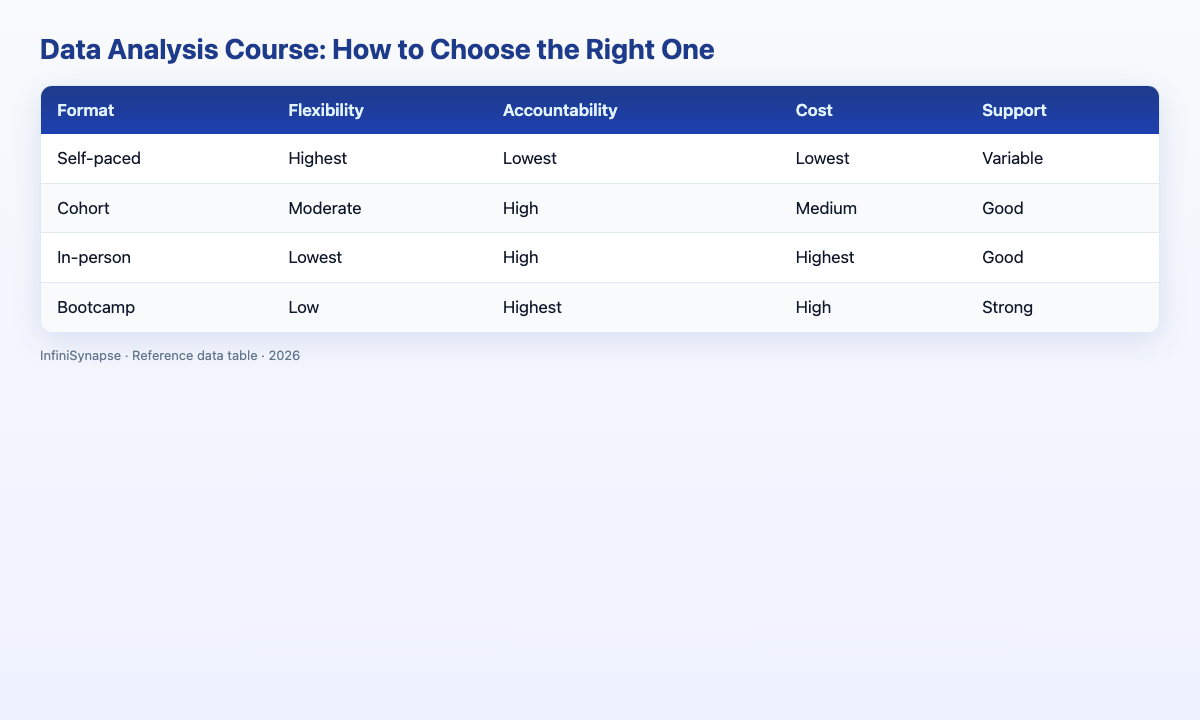
Course delivery formats each have trade-offs that matter for different learners.
Self-paced online: Maximum flexibility, lower cost, requires self-discipline. Best for working professionals with variable schedules who can create their own accountability.
Cohort-based online: Fixed schedule, peer accountability, live sessions. Best for learners who need deadlines and benefit from group momentum.
In-person: Face-to-face interaction, local networking, higher cost. Best for learners who thrive with physical presence and have quality local options.
Bootcamp-style: Intensive, compressed, career services included. Best for career changers who can commit full-time hours for several months.
| Format | Flexibility | Accountability | Cost | Support |
|---|---|---|---|---|
| Self-paced | Highest | Lowest | Lowest | Variable |
| Cohort | Moderate | High | Medium | Good |
| In-person | Lowest | High | Highest | Good |
| Bootcamp | Low | Highest | High | Strong |
No format is universally best. Choose the data analysis course format you will actually complete consistently. A self-paced course finished thoroughly beats a cohort course abandoned after three weeks. We compare online options in data analyst course online and self-paced programs in data analyst courses online.
Free vs Paid Courses
Free and paid data analysis course options can both deliver genuine skills. The difference is structure, support, and credentials rather than fundamental content quality.
Free courses from major platforms and university MOOCs provide quality instruction without cost. They suit self-motivated learners who can create accountability independently. The limitation is typically less instructor feedback, no career services, and no recognized certificate. Enterprise adoption patterns in Google Cloud's AI overview mirror the shift from pilots to governed analytics.
Paid programs add guided pacing, instructor interaction, career support, and credentials that help with resume screening. The premium is justified when these additions keep you completing the program and provide networking opportunities free courses lack.
A practical approach: start with a free data analysis course to build initial skills and confirm your commitment. If you complete it and want more structure, invest in a paid program targeting your specific gaps. A free course producing two strong portfolio pieces outperforms a paid course you never start. We curate free options in data analyst course free.
Common Selection Mistakes
Several mistakes lead people to choose the wrong data analysis course. Choosing based on brand name without evaluating curriculum is the most common. A famous provider's data analysis course may be outdated, shallow, or misaligned with your level.
Starting with an advanced course before mastering SQL fundamentals produces shallow knowledge. The data analysis course market includes appealing specializations in machine learning, marketing analytics, and financial modeling, but they assume SQL fluency you may not have. Build foundations first.
Collecting courses without completing them is another trap. Enrolling in three programs simultaneously, or starting a new one before finishing the current one, produces credentials without skills. Complete one program thoroughly before starting another.
Ignoring AI coverage selects an outdated data analysis course. Programs teaching only manual spreadsheet work and basic SQL without addressing AI-native tools leave a growing skills gap. Evaluating AI coverage is no longer optional in 2026. Warehouse-grounded analytics should align with Databricks documentation on SQL warehouses and data governance.
Choosing based on duration promises rather than practice depth misleads. A data analysis course claiming job readiness in two weeks cannot teach SQL deeply enough for real work. Meaningful skill-building takes months of consistent practice regardless of marketing timelines.
A Step-by-Step Selection Process
Follow this process to choose a course efficiently.
Step 1: Write your goals, constraints, and current skill level in three sentences.
Step 2: Search for data analysis course options matching your level (beginner, intermediate, advanced). Create a shortlist of three to five candidates.
Step 3: Compare each against the five evaluation criteria: practice ratio, curriculum alignment, portfolio potential, assessment rigor, and support quality.
Step 4: Check reviews from people who completed the data analysis course and landed analyst roles, not just those who finished the content.
Step 5: Verify AI coverage, cost, time commitment, and refund policy.
Step 6: Choose one data analysis course and commit. Set a weekly schedule, define milestone dates, and plan to publish portfolio work as you progress.
Step 7: After completing the course, assess gaps and decide whether you need additional training or can proceed to job searching. One thorough course plus portfolio practice is sufficient for many entry-level roles.
AI Tools in Course Selection
AI coverage should be a standard evaluation criterion for any data analysis course in 2026. Ask whether the curriculum includes working with AI analysis agents, validating automated outputs, and integrating AI-assisted workflows into standard practice. Programs that treat AI as optional or ignore it entirely are teaching an incomplete toolkit.
The best data analysis course programs incorporate AI-native tools as core curriculum, not as a bonus module added after the main content was written years ago. Look for courses where AI practice is woven into SQL exercises, data cleaning projects, and capstone assignments.
Supplement any program with hands-on practice on AI-native platforms regardless of curriculum coverage. We explore the paradigm in what AI-native data analysis means, and the Stanford HAI AI Index tracks how rapidly AI skills have become a baseline expectation for analysts.
Course Selection Scorecard
Evaluate your shortlisted data analysis course (1 point each):
| Check | Pass? |
|---|---|
| At least 50% hands-on practice time | |
| Curriculum matches my target job postings | |
| Capstone project suitable for portfolio | |
| Skills tested through projects, not just videos | |
| Instructor or community support available | |
| AI-native tools addressed in curriculum | |
| Format and schedule fit my constraints | |
| I will realistically complete it |
6–8: enroll with confidence. 3–5: keep comparing. Below 3: this course is not the right choice.
Practical Next Steps
Verify against real job postings
Before committing time or budget, pull five recent job postings in your target market and list the SQL, visualization, and communication skills each repeats. Align your learning plan to those patterns rather than a generic syllabus.
Frequently Asked Questions
How do I choose a data analysis course?
Start with your goals, skill level, and constraints. Evaluate candidates on hands-on practice, curriculum alignment with job postings, portfolio potential, assessment rigor, and AI coverage. Choose the data analysis course you will realistically complete that best matches your needs.
What should a data analysis course cover?
A data analysis course should cover SQL with extensive practice, spreadsheet fluency, data visualization, basic statistics, and communication skills. In 2026, it should also address AI-native analysis tools. Capstone projects should produce portfolio-worthy work.
Are free data analysis courses good enough?
Free courses can teach genuine skills for self-motivated learners. They lack structure, credentials, and career services that paid programs provide. A free data analysis course paired with deliberate portfolio-building can be as effective as a paid one for disciplined learners.
How long should a data analysis course be?
Meaningful skill-building through a data analysis course typically takes two to six months at ten to fifteen hours per week. Programs promising mastery in days or weeks are not teaching deeply enough. Depth of practice matters more than listed duration.
Should I take multiple data analysis courses?
Complete one data analysis course thoroughly before starting another. One program with strong portfolio practice beats multiple incomplete programs. Add a second course only when it fills a specific gap your first one left.
Conclusion
Choosing the right data analysis course in 2026 means matching your goals and level to a program with deep hands-on practice, current curriculum including AI tools, and portfolio integration. Use the evaluation criteria and step-by-step process in this guide, avoid common selection mistakes, and commit to one course you will finish thoroughly. The course is a starting point; consistent practice and demonstrated ability determine your success.
To practice the AI-era skills employers want, read what AI-native data analysis means and try the InfiniSynapse web app free on registration, no credit card required.