Data Analysis in Qualitative Research: A 2026 Guide
By the InfiniSynapse Data Team · Last updated: 2026-07-09 · We build an AI-native data analysis platform and support research workflows that span structured and unstructured data; this guide frames the analysis stage within the full arc of a qualitative study.

Table of Contents
- TL;DR
- How We Evaluated Research Analysis Workflows
- Where Analysis Fits the Research Arc
- Preparing for Analysis
- The Analysis Stage
- Methods in Research Contexts
- NVivo vs ATLAS.ti for Research Projects
- Ensuring Research Rigor
- Reporting the Findings
- Common Challenges Researchers Face
- AI-Assisted Research Analysis
- Scorecard
- Frequently Asked Questions
- Conclusion
TL;DR
Direct answer: data analysis in qualitative research is the stage where a researcher systematically examines non-numerical data — interviews, texts, observations — to answer the research question. It sits between data collection and reporting, uses methods like thematic analysis and coding, and must meet rigor standards so the findings are credible and defensible.
Who this is for: researchers and students learning how analysis fits within a qualitative study.
What you'll learn: how we evaluated research workflows, where analysis fits the arc, preparation steps, the analysis stage, methods, rigor, reporting, and where AI assists.
This guide sits within the advanced methods hub; for the methods in general, see qualitative data analysis.
For related depth in this pillar, see Data Analysis in Qualitative Studies: By Study Design.
How We Evaluated Research Analysis Workflows
We assessed data analysis in qualitative research against criteria that predict whether the analysis stage produces credible findings within a full study arc, not isolated coding exercises. Each workflow was checked on four dimensions: whether analysis is planned during study design, whether preparation and immersion precede formal coding, whether methods align with the research question and tradition, and whether rigor criteria like credibility and confirmability are met. We cross-referenced these practices with the disciplined process described in the Wikipedia overview of data analysis and the qualitative research foundations in the Wikipedia qualitative research overview.
Tool selection and AI-assisted workflows matter too. Dedicated CAQDAS software supports the audit trails that research rigor demands, while AI can accelerate transcription and initial coding without replacing interpretive judgment. We favor workflows with transparent documentation at every stage, because that is what makes data analysis in qualitative research findings withstand peer review and stakeholder scrutiny. The shift toward augmented workflows, outlined in IBM's augmented analytics overview, frames how teams evaluate when AI assists text processing while researchers retain interpretive control.
Where Analysis Fits the Research Arc
Data analysis in qualitative research occupies a specific place in the research process. A qualitative study typically moves from a research question, through design, to data collection, then to analysis, and finally to reporting. The analysis stage is where collected material — transcripts, field notes, documents — becomes evidence that answers the question, making it the pivotal turning point of the whole study.
Understanding this position clarifies why the analysis stage is so consequential. Everything before it prepares the material, and everything after it depends on its conclusions. If the analysis is flawed, the study's findings are unreliable regardless of how carefully the data was collected. This is why researchers plan the analysis approach during study design, aligning it with the research question. Placing analysis correctly within the arc is the first step to conducting data analysis in qualitative research well.
Preparing for Analysis
Sound data analysis in qualitative research begins with preparation. Raw material — audio recordings, handwritten notes — needs to be transcribed and organized before examination can begin. This preparation stage, often underestimated, shapes how smoothly the analysis proceeds, since well-organized, accurately transcribed data is far easier to analyze rigorously.
Preparation also involves immersion: the researcher reads through the material repeatedly to become deeply familiar with it before formal coding. This immersion builds the intimate knowledge of the data that good interpretation requires. Skipping it and rushing to code unfamiliar material produces shallow analysis. The care taken in preparing and immersing oneself in the data is foundational to data analysis in qualitative research, because the quality of interpretation depends on how well the researcher knows the material.
The Analysis Stage
The core of data analysis in qualitative research is systematic coding and theme development. The researcher works through the material, labeling segments with codes that capture their meaning, then groups related codes into themes that address the research question. This proceeds iteratively, with codes and themes refined across multiple passes through the data.
What distinguishes rigorous analysis at this stage is its systematic, documented character. Rather than cherry-picking illustrative quotes, the researcher analyzes the full dataset, ensuring themes genuinely reflect the data. The analysis stage demands both immersion and discipline — deep engagement with the material balanced by systematic method that guards against bias. We detail the hands-on coding steps in analyzing qualitative data, which complements this research-focused view.
Methods in Research Contexts
Data analysis in qualitative research draws on established methods chosen to fit the study's design and tradition. Thematic analysis, widely used for its flexibility, identifies patterns across the data. Grounded theory builds explanatory theory from the material. Phenomenological analysis focuses on the essence of lived experience, and narrative analysis examines the structure of stories.
The choice of method follows from the research question and the study's methodological tradition. A study aiming to build theory uses grounded theory; one exploring experience uses phenomenological methods. This alignment between method and question is a hallmark of rigorous data analysis in qualitative research, since applying a method mismatched to the question undermines the study. We discuss how analysis fits different study designs in data analysis in qualitative studies.
NVivo vs ATLAS.ti for Research Projects
Dedicated CAQDAS software supports data analysis in qualitative research with coding infrastructure, audit trails, and visualization that manual methods cannot match at scale. NVivo and ATLAS.ti are two of the most established options in academic research.
| Feature | NVivo | ATLAS.ti |
|---|---|---|
| Coding interface | Node-based coding with memos | Quotations and codes with visual networks |
| Research documentation | Memos, annotations, query tools | Memos, comments, supervisor review |
| Team collaboration | Cloud collaboration (licensed) | Cloud and desktop team options |
| Transcription support | Import transcripts; AI transcription add-ons | Import transcripts; AI-assisted coding |
| Rigor features | Coding comparison, coding matrices | Code co-occurrence, inter-coder checks |
| Best for | Institutional research programs, mixed methods | Network-oriented analysis, visual thinkers |
Both tools maintain the audit trails that research rigor demands. NVivo is widely adopted in university research programs and handles mixed-methods projects. ATLAS.ti excels at visualizing code relationships and network structures. For small studies, manual coding in documents may suffice; for dissertations, funded research, or multi-researcher projects, dedicated software with documented decisions is the practical choice.
Practical example: a doctoral student who codes interview transcripts in ATLAS.ti, maintains a reflexivity journal as a memo, checks inter-coder agreement with their supervisor on 25% of the data, and reports three themes with supporting quotations and an explicit limitations section, demonstrates the transparency that Harvard Business Review's skills-based hiring research describes as increasingly valued — documented methodology and honest scope statements build credibility beyond the findings themselves.
Ensuring Research Rigor
Rigor is paramount in data analysis in qualitative research, because the interpretive nature of the work means findings must be actively defended against the charge of subjectivity. Established rigor criteria — credibility, transferability, dependability, and confirmability — guide the practice, each addressing a way qualitative findings might be questioned.
Practical steps ensure rigor: maintaining an audit trail of decisions, seeking disconfirming evidence, using multiple coders and checking agreement, and returning findings to participants for validation (member checking). Reflexivity, where the researcher examines how their own perspective shapes interpretation, is also central. These practices make data analysis in qualitative research defensible, transforming what could be dismissed as opinion into credible knowledge.
Reporting the Findings
Reporting completes data analysis in qualitative research by presenting the themes and their support to readers. Good reporting weaves the identified themes together into a coherent account, supported by representative quotes or excerpts that let the data speak. This grounding in actual material is a strength of qualitative reporting, conveying experience with a vividness numbers cannot match.
Honest reporting also states the study's scope and limitations clearly. Findings describe the participants studied richly but do not automatically generalize to broader populations, and a credible report says so. Transparency about methods — enough that another researcher could follow the reasoning — is part of rigorous reporting. Done well, the reporting stage makes the insights accessible and trustworthy, completing the arc from research question through data analysis in qualitative research to shared knowledge.
The reporting structure typically follows the themes themselves. Introduce each theme with a descriptive heading, explain its significance to the research question, support it with two or three representative quotations, and note any counter-examples you found. This structure lets readers evaluate both the pattern and the evidence behind it. Avoid presenting themes as a bullet list without interpretation — the analysis stage's job is synthesis, not inventory.
Common Challenges Researchers Face
Even experienced researchers encounter recurring challenges during data analysis in qualitative research, and naming them helps you prepare. Data overload is common: qualitative studies generate large volumes of rich material, and it is easy to feel swamped by transcripts. The remedy is disciplined organization and systematic coding, which impose structure on the abundance rather than trying to hold it all in mind at once.
Premature conclusions are another risk. Because researchers often begin with expectations, there is a natural temptation to notice confirming evidence and overlook the rest. Guarding against this requires deliberately seeking cases that contradict an emerging theme. A third challenge is knowing when analysis is complete, since interpretation could in principle continue indefinitely. Experienced researchers reach a point of saturation — where new material stops yielding new themes — and treat that as a reasonable signal to conclude. Anticipating these challenges makes the analysis stage far more manageable and its results more trustworthy.
AI-Assisted Research Analysis
In 2026, AI-native tools assist data analysis in qualitative research without replacing the researcher's interpretive judgment. AI can transcribe recordings, perform initial coding of large text volumes, and surface candidate themes, accelerating the labor-intensive stages while the researcher validates and interprets. The Stanford HAI AI Index documents how quickly text-processing capabilities matured, and IBM's augmented analytics overview frames the governance expectations around validating AI-suggested codes before they inform research conclusions. We explain the broader paradigm in what AI-native data analysis means.
Scorecard
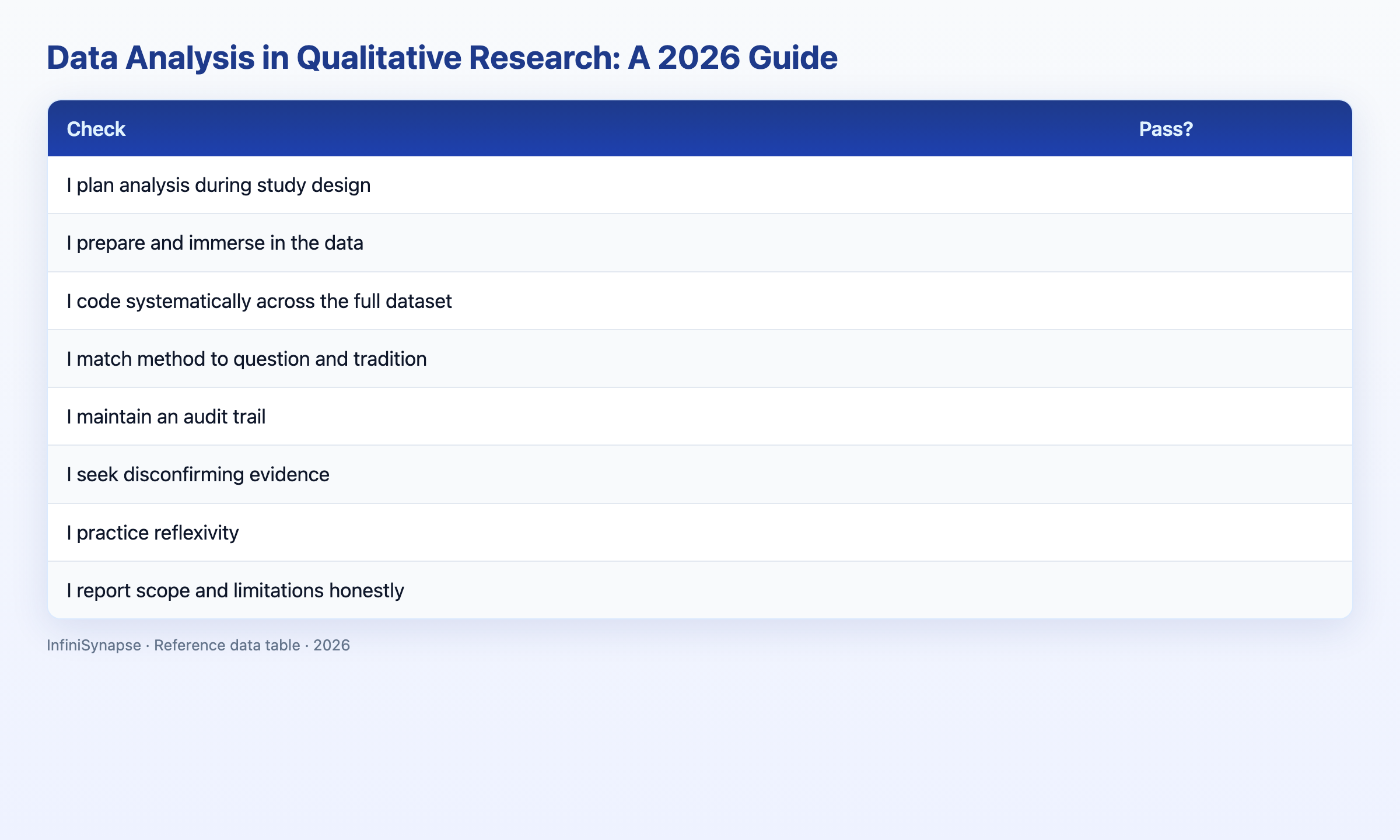
Assess your research analysis practice (1 point each):
| Check | Pass? |
|---|---|
| I plan analysis during study design | |
| I prepare and immerse in the data | |
| I code systematically across the full dataset | |
| I match method to question and tradition | |
| I maintain an audit trail | |
| I seek disconfirming evidence | |
| I practice reflexivity | |
| I report scope and limitations honestly |
6–8: rigorous research practice. 3–5: strengthen a step. Below 3: revisit rigor criteria.
Frequently Asked Questions
What is data analysis in qualitative research?
Data analysis in qualitative research is the stage where a researcher systematically examines non-numerical data, such as interviews, texts, and observations, to answer the research question. This stage bridges raw collection and final reporting, applying thematic analysis and coding under explicit rigor checks so findings stay credible.
How is data analysis done in qualitative research?
Data analysis in qualitative research is done through preparation and immersion in the material, followed by systematic coding that labels segments with meaning and groups them into themes addressing the research question. It proceeds iteratively across multiple passes, analyzing the full dataset rather than cherry-picking quotes, and is documented for rigor.
What methods are used for data analysis in qualitative research?
Methods include thematic analysis for identifying patterns, grounded theory for building theory from data, phenomenological analysis for lived experience, and narrative analysis for stories. The method is chosen to fit the research question and the study's methodological tradition, since a mismatch undermines the study.
How do you ensure rigor in qualitative research analysis?
Rigor in data analysis in qualitative research is ensured through criteria like credibility, transferability, dependability, and confirmability, supported by practices such as maintaining an audit trail, seeking disconfirming evidence, using multiple coders, member-checking with participants, and reflexivity about the researcher's own perspective.
How does AI help qualitative research data analysis?
AI-native tools help with data analysis in qualitative research by transcribing recordings, performing initial coding of large text volumes, and surfacing candidate themes, accelerating labor-intensive stages. The researcher validates and interprets, keeping judgment central, while AI handles the mechanical burden of processing large amounts of textual data.
Conclusion
Data analysis in qualitative research is the pivotal stage where collected material becomes evidence, sitting between data collection and reporting, guided by systematic methods and rigor criteria that make its findings credible. In 2026, AI-native tools accelerate the labor-intensive stages while the researcher supplies the interpretive judgment the work depends on.
To see multi-modal analysis that spans documents and structured data, read what AI-native data analysis means and try the InfiniSynapse web app free on registration, no credit card required.