Data Analysis What Is: In One Minute
By the InfiniSynapse Data Team · Last updated: 2026-07-09 · We build an AI-native data analysis platform and onboard newcomers constantly; this is the fastest clear answer we can give to data analysis what is.
Table of Contents
- TL;DR
- How We Evaluated Quick Definitions
- The One-Minute Answer
- The Essentials
- The Four Parts Compared
- A Quick Example
- Why It Matters Fast
- How AI Does It Now
- From Quick Answer to Real Skill
- Quick Scorecard
- Common Misconceptions
- Fast Answers to Common Questions
- Frequently Asked Questions
- Conclusion
TL;DR
Direct answer: data analysis what is it? It is examining data to find useful information that supports a decision. You take raw numbers, clean them, look for patterns, and explain what they mean. That is the entire idea in one sentence, and everything else is detail.
Who this is for: anyone who wants the fastest clear answer to data analysis what is it.
What you'll learn: how we evaluated quick definitions, the one-minute answer, the four parts compared, a quick example, and how AI performs it now.
This guide sits under the complete data analysis guide. For a fuller beginner's guide, see what is data analysis. For related depth in this pillar, see What Analysis of Data Means (With Examples).
How We Evaluated Quick Definitions
We selected this one-minute framing using criteria that matter for first-time learners: whether the answer fits in a single readable paragraph, whether it names the four actionable parts (gather, clean, analyze, communicate), and whether a beginner could try it the same day without specialized tools.
We cross-referenced these criteria with the formal description in the Wikipedia overview of data analysis and with practitioner guidance in IBM's augmented analytics overview. Data analysis what is it, at the level that helps someone start today, is organized examination of information to reach a useful conclusion — not a catalog of statistical techniques.
The Stanford HAI AI Index documents how quickly AI assistants accelerated routine examination, but data analysis what is it in human terms has not changed: question, evidence, judgment, communication. We favor quick definitions that survive contact with real data, including the cleaning step beginners most often skip. Dashboard-centric workflows sit within the broader Wikipedia business intelligence overview, but the quick answer here covers the investigative core. For warehouse-scale work, align outputs with Databricks documentation on governed data access.
The One-Minute Answer
Here is data analysis what is it, in the time it takes to read a paragraph: it is the practice of examining data to answer a question. You have some information, you want to understand it, and you work through it to find the answer. That is the fast, honest answer, and it is enough to get started.
When people ask data analysis what is it, they often expect something complicated, but the core is genuinely simple. The complexity lives in the tools and methods, not in the basic idea. Data analysis, what is it at heart, is organized examination of information to reach a useful conclusion, an idea graspable in a single minute at the level that matters most for getting started.
The Essentials
For data analysis what is it in terms of essentials, three things are always present. First, a question, because analysis without a question wanders aimlessly. Second, data relevant to that question. Third, a process of examining the data to extract the answer. These three essentials define the activity regardless of scale or field.
Knowing these essentials answers data analysis what is it, at a practical level. If you have a question, some relevant data, and you examine it to find an answer, you are doing analysis, whether in a spreadsheet or a sophisticated platform. This is why data analysis what is it, has the same answer everywhere: the essentials do not change even as the tools grow more powerful.
The Four Parts Compared
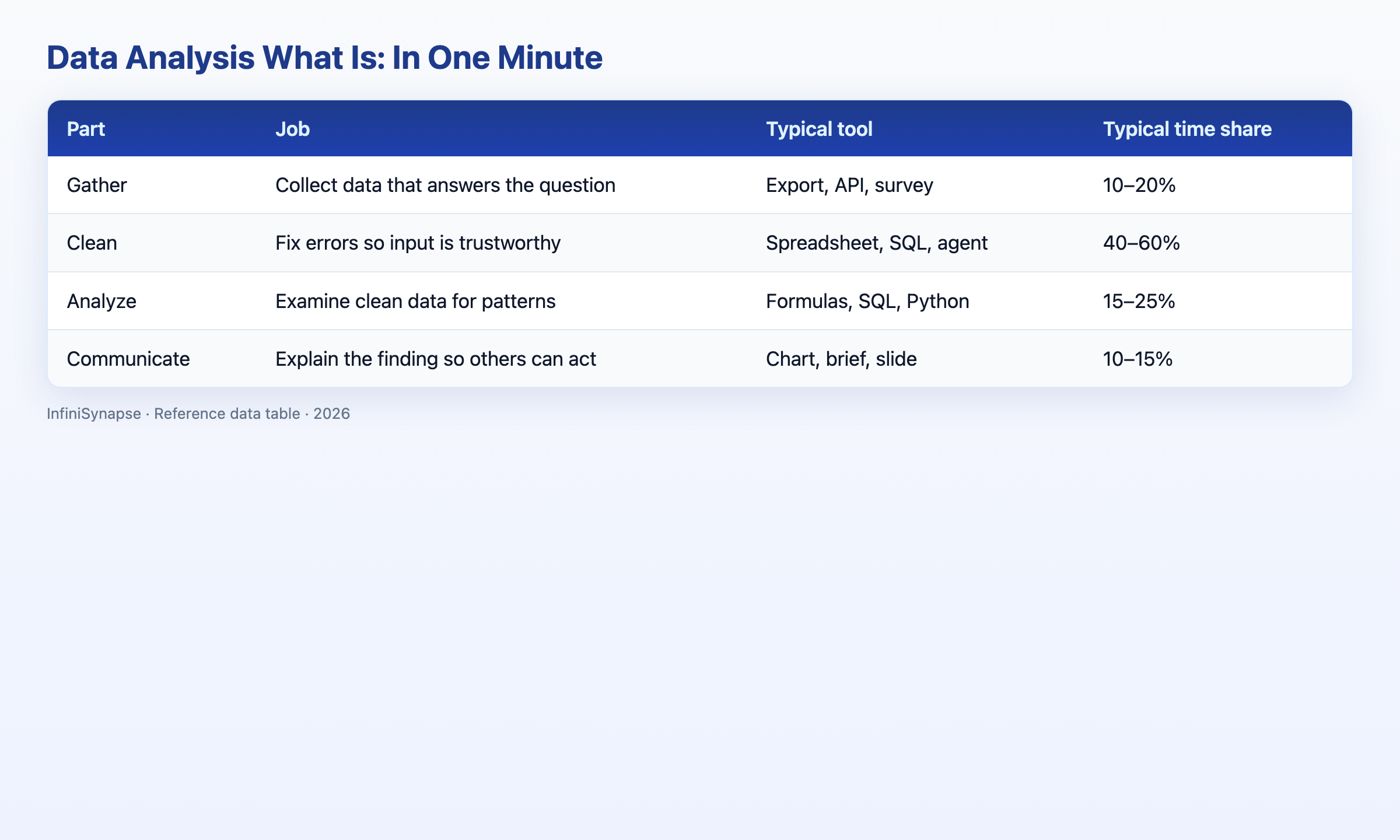
Breaking data analysis what is it into four parts makes it fully clear. Each part has a distinct job, and skipping one is the most common reason quick analyses fail.
| Part | Job | Typical tool | Typical time share |
|---|---|---|---|
| Gather | Collect data that answers the question | Export, API, survey | 10–20% |
| Clean | Fix errors so input is trustworthy | Spreadsheet, SQL, agent | 40–60% |
| Analyze | Examine clean data for patterns | Formulas, SQL, Python | 15–25% |
| Communicate | Explain the finding so others can act | Chart, brief, slide | 10–15% |
These four parts answer data analysis what is it, at the level of doing rather than just knowing. Every analysis, quick or complex, moves through them. When you next wonder data analysis what is it in a practical moment, run through gather, clean, analyze, communicate, and you will have both the answer and a method. Enterprise adoption patterns in Google Cloud's AI overview mirror the shift from pilots to governed analytics.
A Quick Example
A fast example nails down data analysis what is it. Say you run a blog and want to know which posts get the most readers. You gather the view counts, remove any bot traffic, rank the posts, and see that how-to guides dominate. In under a minute of examination, you have an answer: write more how-to guides.
That tiny example is data analysis what is it, in action, a question answered with evidence through quick examination. Notice it needed no advanced math or coding, just a clear question and a careful look at the numbers. This is the reassuring truth behind data analysis what is it: most everyday analysis is this straightforward.
Practical example: a newsletter operator compares open rates by send time across eight weeks, cleans out test blasts, and finds Tuesday 9 a.m. beats Thursday 3 p.m. by 4.2 percentage points. She schedules the next four sends accordingly — a decision made in one afternoon because data analysis what is it was demonstrated with a number and a next step, the practical standard that Harvard Business Review's skills-based hiring research links to teams that treat small evidence loops as normal operations.
Why It Matters Fast
Data analysis, what is it good for, is quickly answered too: better decisions. Instead of guessing, you decide based on what the data actually shows, which reliably produces better outcomes across business, science, and personal life. That is why the skill is valued nearly everywhere and why so many people want the fast answer to data analysis what is it.
The speed of the payoff is part of the appeal. Even a simple analysis can immediately improve a decision, so you do not need years of study to benefit from understanding data analysis what is it. A single afternoon spent examining real data often yields an insight that changes what you do next. This quick, tangible value is why grasping data analysis what is it, is worth the small effort.
How AI Does It Now
In 2026, data analysis what is it in practice, increasingly includes work done by AI-native agents. Rather than writing every query by hand, you can now ask a question in plain language and have an agent perform the analysis, returning both an answer and an inspectable record of how it reached it. This makes the activity faster and more accessible than ever.
For warehouse-scale or multi-source work, supplement fundamentals with governed AI-assisted analysis. We explain the paradigm in what AI-native data analysis means, and the Stanford HAI AI Index tracks how quickly agent-assisted analysis matured. For anyone asking data analysis what is it today, part of the answer is that a capable agent can now carry much of the work while you supply the question and judgment.
From Quick Answer to Real Skill
A one-minute answer to data analysis what is starts you off, but turning that quick understanding into real skill takes a little deliberate practice. The good news is that the leap is small, because the quick answer already contains the whole structure; you simply apply it repeatedly to real questions until it becomes second nature.
The most effective practice keeps the questions small and real. Rather than trying to analyze everything at once, pick a single question you care about and complete the loop — gather, clean, examine, and interpret — from start to finish. Finishing one small analysis teaches more than half-starting ten, because the value of understanding data analysis what is comes from completing the cycle and seeing an answer emerge.
As you practice, resist two temptations that trip up beginners. The first is skipping the cleaning step; the quick answer to data analysis what is includes cleaning for a reason, since analyzing messy data produces confident mistakes. The second is over-complicating the method when a simple examination would answer the question better. Holding to the disciplined simplicity of the quick answer, even as your skills grow, is what keeps your work reliable.
Quick Scorecard
Check your fast understanding (1 point each):
| Check | Pass? |
|---|---|
| I can answer in one sentence | |
| I know the three essentials | |
| I can give a quick example | |
| I know the four parts | |
| I know why it matters | |
| I understand simple is often enough | |
| I know AI can now perform it | |
| I feel ready to try it |
6–8: fast and clear. 3–5: reread the one-minute answer. Below 3: start with the essentials.
Common Misconceptions
Misconception 1: It requires a statistics degree. Data analysis what is it, at the basic level, needs clear thinking more than advanced math.
Misconception 2: Charts equal analysis. Displaying numbers is presentation; analysis means interpreting what they imply.
Misconception 3: Bigger data always needs complex methods. Often a simple examination on the right slice answers the question better.
Misconception 4: AI removes the need to understand the idea. Agents accelerate execution, but you still need the question and judgment that the quick answer describes.
Fast Answers to Common Questions
Q: Is it hard? No; the basics are simple and need only clear thinking and simple arithmetic.
Q: Do I need to code? No; spreadsheets and AI-native tools work without programming.
Q: Is complex better? No; simple analysis often answers a question best.
Q: Who uses it? Almost everyone who makes decisions with information.
Frequently Asked Questions
What is it in simple terms?
In simple terms, it is examining data to find useful information that supports a decision. Analysts start with raw figures, tidy inconsistent entries, spot patterns, and explain what those numbers imply. The core idea fits in one sentence, and everything else is detail built on that foundation.
What are the essentials?
The essentials are three things always present: a question you want answered, data relevant to that question, and a process of examining the data to extract the answer. These define the activity regardless of scale or field, which is why the core answer stays the same everywhere.
Can you explain it with a quick example?
To find your most-read blog posts, you gather view counts, remove bot traffic, rank the posts, and see how-to guides dominate, so you write more of them. That quick example is the activity in action: a question answered with evidence through examination, needing no advanced math or coding.
Does it require coding or advanced math?
No, not at the basic level. Practically, it can be done in a spreadsheet with simple arithmetic, or with AI-native tools that need no programming. Advanced math and coding help with harder questions, but most everyday work relies on clear questions and simple examination.
How do AI tools handle it now?
AI-native tools take a question in plain language, plan the steps, and perform the gathering, cleaning, and examination autonomously, returning an answer with an inspectable record. This makes the activity faster and more accessible, while humans still supply the question and judge whether the result makes sense.
Conclusion
Data analysis, what is it? Examining data to find useful information that supports a decision, through four simple parts: gather, clean, analyze, communicate. The core idea takes a minute to grasp, delivers value fast, and in 2026 can be carried largely by AI-native agents while you supply the question and judgment.
If you take one thing from this quick answer to data analysis what is, let it be that the idea is far more approachable than its reputation suggests. You do not need a degree, expensive software, or years of study to start extracting useful answers from information. You need a clear question, a willingness to tidy your data honestly, and the patience to look carefully at what it shows.
For a fuller understanding and modern tools, read the complete data analysis guide and what AI-native data analysis means, then try the InfiniSynapse web app free on registration, no credit card required.