Data Analyst Bootcamp: 2026 Options Compared
By the InfiniSynapse Data Team · Last updated: 2026-07-09 · We build an AI-native data analysis platform and track bootcamp outcomes; this guide compares the major data analyst bootcamp options for career changers.
Table of Contents
- TL;DR
- How We Evaluated These Bootcamps
- What a Data Analyst Bootcamp Offers
- Major Data Analyst Bootcamps Compared
- Full-Time vs Part-Time Programs
- Online vs In-Person Bootcamps
- Evaluating Bootcamp Quality
- Cost and Financing Options
- Bootcamp Outcomes
- AI Coverage in Bootcamp Programs
- Bootcamp Selection Scorecard
- Practical Next Steps
- Frequently Asked Questions
- Conclusion
TL;DR
Direct answer: a data analyst bootcamp in 2026 compresses analytics training into an intensive three-to-six-month program with project-based learning and career support. Options vary widely in quality, cost, and outcomes. Choose a data analyst bootcamp with verified placement data, deep SQL practice, and AI tool coverage rather than brand recognition alone.
Who this is for: career changers comparing specific data analyst bootcamp programs.
What you'll learn: how we evaluated bootcamps, what they offer, a provider comparison, format options, how to evaluate quality, costs, and expected outcomes.
This guide sits under the data analyst certification hub. For ROI analysis, see data analysis bootcamp and data analyst certificate. For online credential paths, see data analyst certification online.
How We Evaluated These Bootcamps
We assessed data analyst bootcamp programs using criteria that mirror what hiring managers list in 2026 job postings, not marketing claims alone. Each program was checked against four dimensions: SQL depth with hands-on practice, portfolio-ready capstone output, verifiable graduate employment data, and whether the curriculum acknowledges AI-assisted analysis workflows. We cross-referenced skill requirements with the Bureau of Labor Statistics occupational profile for data analysts and hiring-trend data from LinkedIn's 2025 Future of Recruiting report, which notes that skills assessments and portfolio evidence increasingly influence hiring alongside formal credentials.
How We Evaluated These: In Practice
Cost, format, and career services matter too. A bootcamp you abandon halfway delivers less value than a shorter certification you finish and turn into portfolio work. We favor programs with transparent syllabi, published placement methodology, and curricula aligned with tools employers actually list — SQL, Excel or Google Sheets, a BI platform, and basic statistical reasoning.## What a Data Analyst Bootcamp Offers
A data analyst bootcamp is an intensive training program designed to take career changers from little or no analytics background to job-ready skills in months rather than years. The typical curriculum covers SQL, spreadsheet analysis, data visualization, basic statistics, and portfolio project development. Most programs include career services such as resume review, interview preparation, and employer networking.
What distinguishes a data analyst bootcamp from a standard online course is intensity and support. Bootcamps run on fixed schedules with cohort-based accountability, daily or weekly assignments, and instructor feedback on projects. The compressed timeline demands significant weekly hours but produces faster skill development than self-paced alternatives. Career coaching is often bundled, addressing the job search alongside the technical training.
The data analyst bootcamp market has grown substantially, with providers offering full-time, part-time, online, and in-person formats. Quality ranges from programs with verified high placement rates to those that issue certificates without building genuine ability. Researching specific programs matters far more than choosing any bootcamp generically, as we detail in data analysis bootcamp and the skills in data analyst skills.
Major Data Analyst Bootcamps Compared
The table below compares the data analyst bootcamp programs we most often recommend to career changers in 2026. All include hands-on SQL and visualization work; the right pick depends on your budget, timeline, and whether you need a job guarantee or mentor support.
| Program | Provider | Core skills | Duration | Cost range | Best for |
|---|---|---|---|---|---|
| Data Analytics Career Track | Springboard | SQL, Python, Tableau, two capstone projects | 6 months PT | ~$8,500–$10,500 | Career changers wanting mentor support and job guarantee |
| Data Analytics Bootcamp | General Assembly | SQL, Excel, Tableau, real client projects | 12 weeks FT / 24 weeks PT | ~$15,950 | Learners who thrive in cohort-based intensive formats |
| Data Analytics Bootcamp | Thinkful | SQL, Python, Tableau, capstone + career coaching | 4–6 months PT | ~$8,000–$9,500 | Working professionals needing flexible part-time pacing |
| Data Analytics Program | CareerFoundry | SQL, Python, Tableau, job guarantee option | 5–8 months PT | ~$6,900–$8,500 | Beginners wanting structured curriculum with tutor feedback |
| Google Data Analytics Certificate | Google / Coursera | Spreadsheets, SQL, R, Tableau, capstone | 3–6 months PT | ~$49/month | Budget-conscious learners who do not need bootcamp intensity |
When evaluating a data analyst bootcamp, look beyond the brand name. Compare the curriculum against current job postings: does it teach SQL deeply, include a visualization tool, and cover statistical basics? Does it include capstone projects that become portfolio pieces? A data analyst bootcamp at a higher price point is justified only when it delivers measurably more practice, support, and job-placement assistance than cheaper alternatives.
Practical example: a career changer who completes the General Assembly Data Analytics Bootcamp, then publishes two supplemental analyses on public retail datasets (monthly revenue trends with SQL, cohort churn with charts), can cite both the bootcamp portfolio and live project links in applications. Recruiters see the intensive training as proof of structured learning and the portfolio as proof of execution — the combination that Harvard Business Review's skills-based hiring research describes as increasingly decisive in hiring decisions.
Full-Time vs Part-Time Programs
Data analyst bootcamp formats split between full-time intensive programs and part-time options designed for working professionals. Full-time programs typically require thirty to forty hours weekly for twelve to twenty-four weeks. They suit career changers who can take a leave from employment or dedicate themselves fully to the transition. The immersion accelerates learning but carries higher opportunity costs.
Part-time programs require fifteen to twenty hours weekly over four to six months. They suit learners who must maintain current employment while training. The extended timeline reduces weekly pressure but demands sustained discipline over a longer period. Both formats can produce strong graduates when the curriculum and instruction quality are equivalent.
| Format | Weekly hours | Duration | Best for |
|---|---|---|---|
| Full-time | 30–40 | 12–24 weeks | Dedicated career changers |
| Part-time | 15–20 | 4–6 months | Working professionals |
| Self-paced hybrid | 10–15 | 6+ months | Maximum flexibility |
Choose the bootcamp format you can sustain without burning out. An abandoned full-time program delivers less value than a completed part-time one. Be realistic about your weekly availability and financial runway before committing to an intensive format.
Online vs In-Person Bootcamps
Most data analyst bootcamp options in 2026 are available online, reflecting both provider investment in digital delivery and learner demand for geographic flexibility. Online bootcamps offer live virtual classrooms, collaborative project environments, and remote career services that rival in-person experiences for many learners.
In-person programs remain available in major cities, offering face-to-face instruction, local networking, and the social energy of a physical classroom. They suit learners who struggle with remote focus and benefit from being physically present with instructors and peers. The curriculum quality between strong online and in-person programs is often comparable.
The practical advantage of an online program is accessibility. You can enroll in the best program regardless of location, avoid relocation costs, and often pay less than in-person alternatives. Verify that online programs provide interactive practice environments and responsive instructor support, not just recorded lectures. We compare online training broadly in data analyst certification online. Warehouse-grounded analytics should align with Databricks documentation on SQL warehouses and data governance.
Evaluating Bootcamp Quality
Evaluating a data analyst bootcamp requires checking specific quality indicators rather than relying on marketing claims. Start with placement data: does the program publish verifiable employment outcomes with clear methodology? Can you speak with recent graduates about their experience? Strong programs welcome these conversations; weak ones deflect them.
Curriculum depth is the second critical factor. A quality data analyst bootcamp teaches SQL through extensive hands-on practice, not surface-level drag-and-drop exercises. Capstone projects should use messy, real-world datasets. Visualization, statistics, and communication skills should be integrated throughout, not treated as optional modules. The curriculum should reflect the analytical process described in the Wikipedia data analysis overview.
Instructor quality matters. Data analyst bootcamp instructors should have current or recent working analyst experience, not only teaching credentials. Career services should include substantive support such as mock interviews and employer introductions, not just resume templates. Alumni networks that generate referrals are a strong positive signal.
Cost and Financing Options
Data analyst bootcamp tuition typically ranges from five thousand to fifteen thousand dollars, with premium programs at the higher end. Financing options include upfront payment, installment plans, income-share agreements, and deferred tuition tied to employment outcomes. Each financing model has trade-offs that affect your total cost and financial risk.
Income-share agreements delay payment until you land a qualifying job, which sounds attractive but often costs more over time than upfront payment. Read terms carefully: income thresholds, payment caps, and duration limits vary significantly between providers. Some ISAs require payments even if you land a non-analyst role above the income threshold.
Compare the investment against alternatives before committing. A certification program at five hundred to two thousand dollars plus self-directed portfolio-building may produce similar outcomes. Employer tuition reimbursement may cover part or all of the cost if you are upskilling within your current organization. See data analyst training for a full comparison of training paths and their costs.
Bootcamp Outcomes
Data analyst bootcamp outcomes vary more by program than by format. Top programs report placement rates of seventy to eighty-five percent in analyst or analyst-adjacent roles within six months of graduation. These figures are meaningful only when the program defines its methodology clearly: what counts as placement, what timeframe is measured, and whether part-time or contract roles are included.
Graduates of strong data analyst bootcamp programs typically enter at junior analyst or analyst-adjacent roles with salaries ranging from fifty to eighty thousand dollars depending on location and industry. Career changers from unrelated fields often see significant income increases, justifying the bootcamp investment when placement succeeds. Graduates of weak programs may struggle to pass technical interviews despite holding the bootcamp certificate.
Maximize your outcomes by treating the bootcamp as a foundation, not a complete preparation. Build additional portfolio projects beyond capstones, network actively in analytics communities, and practice technical interview questions throughout the program. Bootcamp career services help, but your own initiative determines whether you convert training into employment.
AI Coverage in Bootcamp Programs
A data analyst bootcamp that omits AI-native tools in 2026 leaves graduates with an incomplete skill set. Employers increasingly expect new analysts to direct AI analysis agents, validate automated outputs, and integrate AI-assisted workflows into standard practice. Bootcamp curricula should reflect this shift, not teach only manual methods from pre-AI-era playbooks. The move toward augmented workflows, outlined in IBM's augmented analytics overview, frames how teams evaluate modern tooling.
When evaluating programs, ask whether the bootcamp includes modules on AI-assisted analysis, whether capstone projects incorporate AI-native workflows, and whether instructors have experience with modern AI platforms. Programs answering negatively will require supplemental learning after graduation. We explore the paradigm in what AI-native data analysis means, and the Stanford HAI AI Index documents how rapidly these skills have become standard.
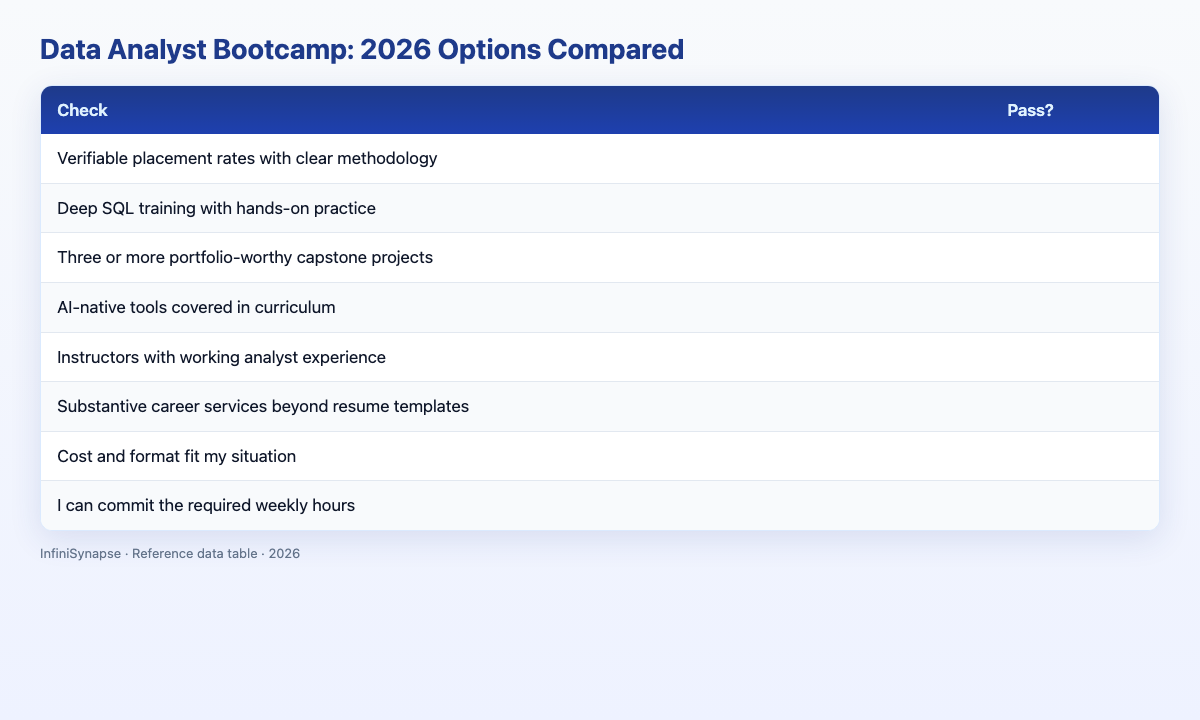
Bootcamp Selection Scorecard
Evaluate any data analyst bootcamp (1 point each):
| Check | Pass? |
|---|---|
| Verifiable placement rates with clear methodology | |
| Deep SQL training with hands-on practice | |
| Three or more portfolio-worthy capstone projects | |
| AI-native tools covered in curriculum | |
| Instructors with working analyst experience | |
| Substantive career services beyond resume templates | |
| Cost and format fit my situation | |
| I can commit the required weekly hours |
6–8: strong program worth considering. 3–5: compare carefully against alternatives. Below 3: look elsewhere.
Practical Next Steps
Verify against real job postings
Before committing time or budget, pull five recent job postings in your target market and list the SQL, visualization, and communication skills each repeats. Align your learning plan to those patterns rather than a generic syllabus.
Frequently Asked Questions
What is the best data analyst bootcamp?
The best data analyst bootcamp depends on your format preference, budget, and location. Evaluate programs on verified placement data, SQL curriculum depth, AI coverage, and instructor quality rather than brand alone. A data analyst bootcamp you can complete at the required intensity beats a prestigious one you cannot sustain.
How much does a data analyst bootcamp cost?
Most data analyst bootcamp programs cost five thousand to fifteen thousand dollars. Financing options include installments and income-share agreements. Compare total cost against certification programs and self-directed learning before committing to bootcamp pricing.
How long is a data analyst bootcamp?
Full-time data analyst bootcamp programs typically run twelve to twenty-four weeks. Part-time options run four to six months at lower weekly hours. Duration varies by provider and format.
Can I do a data analyst bootcamp online?
Yes. Most data analyst bootcamp providers offer online programs with live instruction, collaborative projects, and remote career services. Online bootcamps provide access to top programs regardless of geography.
Is a data analyst bootcamp better than a certification?
A data analyst bootcamp offers more intensity, structure, and career services at higher cost. Certifications offer focused skills at lower cost with more flexibility. A data analyst bootcamp suits career changers needing fast transition with support; certifications suit self-motivated learners on tighter budgets.
Conclusion
Choosing the right data analyst bootcamp in 2026 means evaluating specific programs on placement data, curriculum depth, AI coverage, and cost rather than trusting generic bootcamp marketing. The best data analyst bootcamp compresses genuine skill-building into an intensive timeline with career support that helps you convert training into employment. Research thoroughly, verify outcomes, and commit to a program you can complete at the required intensity.
To practice the AI-era skills employers want, read what AI-native data analysis means and try the InfiniSynapse web app free on registration, no credit card required.