Best Data Analyst Courses in 2026: Paid and Free Options
By the InfiniSynapse Data Team · Last updated: 2026-07-09 · We build an AI-native data analysis platform and evaluate training resources constantly; this roundup reflects what actually prepares analysts for 2026 jobs.
Table of Contents
- TL;DR
- How We Evaluated These Courses
- What Makes a Good Data Analyst Course
- Top Paid Courses
- Best Free Options
- Courses by Skill Level
- Online vs In-Person
- What Courses Miss in 2026
- How to Choose the Right Course
- Course Selection Scorecard
- Practical Next Steps
- Frequently Asked Questions
- Conclusion
TL;DR
Direct answer: the best data analyst course in 2026 teaches SQL, spreadsheets, visualization, and increasingly AI-native tools through hands-on practice, not just lectures. Strong options exist at every price point — from free modules on Kaggle Learn and SQLBolt to paid programs such as the Google Data Analytics Professional Certificate and intensive bootcamps. Choose a data analyst course that matches your starting level, includes real projects, and covers the skills current job listings actually require.
Who this is for: beginners and career changers researching which data analyst course to take.
What you'll learn: how we evaluated courses, what separates good programs from weak ones, specific paid and free picks, how to match a course to your level, and what to look for in 2026.
This guide sits under the data analyst certification hub. For online-specific picks, see data analyst course online and data analyst course free. For related depth in this pillar, see Top Certifications for Data Analysts in 2026.
How We Evaluated These Courses
We selected courses for this roundup using criteria that mirror what hiring managers list in 2026 job postings, not brand prestige alone. Each program was checked against four dimensions: SQL depth with hands-on practice, visualization and communication work, portfolio-ready capstone or project output, and whether the curriculum acknowledges AI-assisted analysis workflows. We cross-referenced skill requirements with the Bureau of Labor Statistics occupational profile for data analysts and hiring-trend data from LinkedIn's 2025 Future of Recruiting report, which notes that skills assessments and portfolio evidence increasingly influence hiring alongside formal credentials.
How We Evaluated These: In Practice
Price, format, and completion rates matter too. A data analyst course you abandon halfway delivers less value than a shorter free program you finish and turn into portfolio work. We favor programs with transparent syllabi, public learner reviews from working analysts, and curricula aligned with tools employers actually list — SQL, Excel or Google Sheets, a BI platform, and basic statistical reasoning.## What Makes a Good Data Analyst Course A worthwhile data analyst course shares several traits regardless of provider or price. First, it teaches through practice: you query real datasets, build visualizations, and present findings rather than only watching lectures. Second, it covers the skills employers list in job postings, with SQL as the highest priority, followed by spreadsheet fluency, a visualization tool, and basic statistical thinking. Third, it produces portfolio pieces you can show employers, because demonstrated ability matters more than any certificate a data analyst course issues.
Weak courses fail on one or more of these dimensions. Some emphasize theory without enough hands-on work; others teach outdated tools or skip SQL entirely. A data analyst course that promises mastery in a weekend or that focuses on tool-specific button-clicking without analytical thinking will not prepare you for real work. Evaluate any data analyst course against the skills in data analyst skills and the process described in the Wikipedia data analysis overview before enrolling.
In 2026, a good data analyst course also introduces AI-native analysis tools. As agents automate routine cleaning and querying, employers value analysts who can direct these tools effectively and validate their outputs. A data analyst course that ignores this shift teaches an incomplete skill set. Look for programs that incorporate working with modern AI-assisted platforms alongside traditional skills. The move toward augmented workflows, outlined in IBM's augmented analytics overview, frames how teams evaluate modern tooling.
What Makes A Good: In Practice
The table below maps the skills we see most often in entry-level analyst postings. Use it as a checklist when comparing any data analyst course.
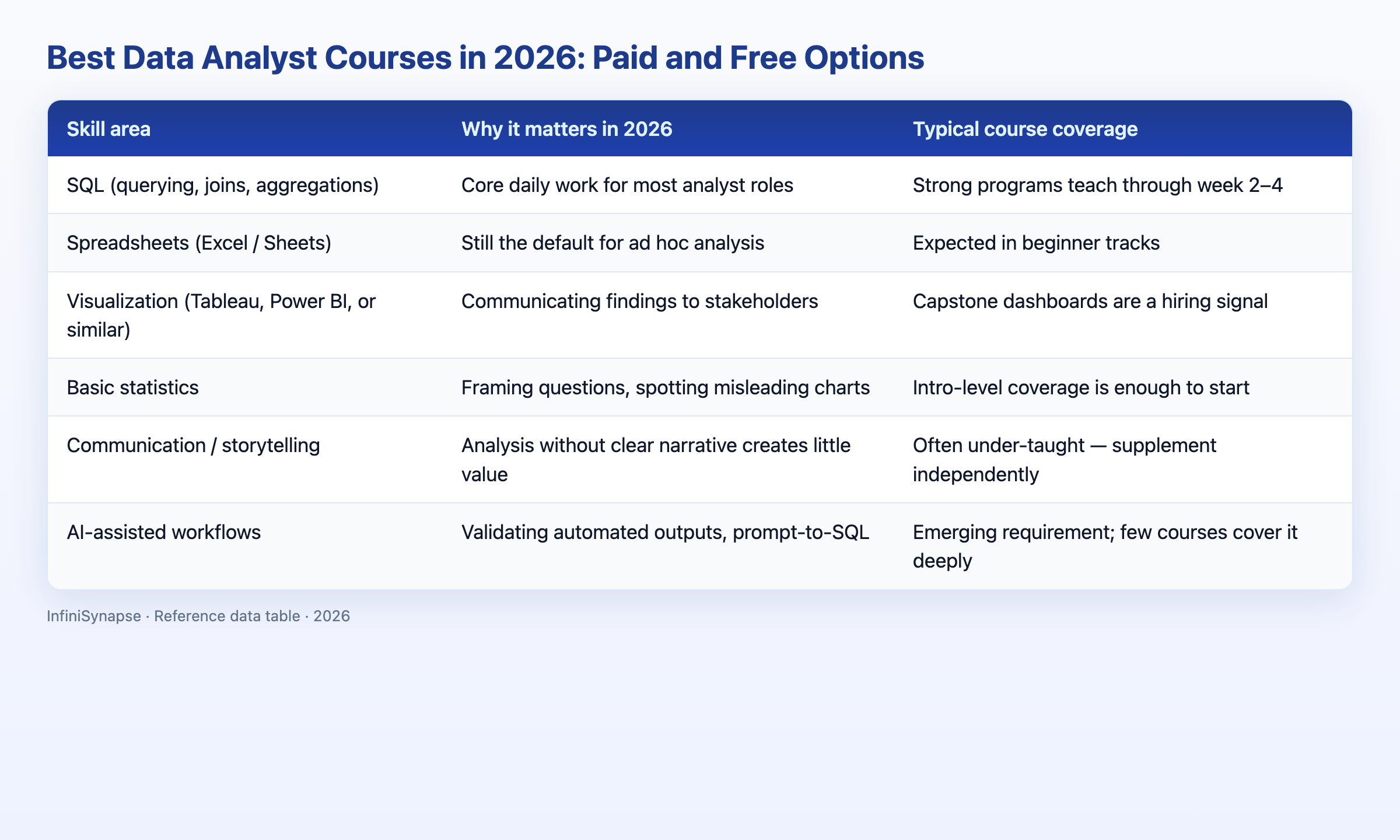
| Skill area | Why it matters in 2026 | Typical course coverage |
|---|---|---|
| SQL (querying, joins, aggregations) | Core daily work for most analyst roles | Strong programs teach through week 2–4 |
| Spreadsheets (Excel / Sheets) | Still the default for ad hoc analysis | Expected in beginner tracks |
| Visualization (Tableau, Power BI, or similar) | Communicating findings to stakeholders | Capstone dashboards are a hiring signal |
| Basic statistics | Framing questions, spotting misleading charts | Intro-level coverage is enough to start |
| Communication / storytelling | Analysis without clear narrative creates little value | Often under-taught — supplement independently |
| AI-assisted workflows | Validating automated outputs, prompt-to-SQL | Emerging requirement; few courses cover it deeply |
Paid data analyst course options generally offer more structure, instructor support, and career services than free alternatives. The table below compares the paid programs we most often recommend to beginners and career changers in 2026. All include hands-on SQL and visualization work; the right pick depends on your budget, timeline, and whether you need career coaching.
| Program | Provider | Core skills | Typical timeline | Best for |
|---|---|---|---|---|
| Google Data Analytics Professional Certificate | Google / Coursera | Spreadsheets, SQL, R, Tableau, capstone | 3–6 months part-time | Complete beginners wanting a structured, affordable entry path |
| IBM Data Analyst Professional Certificate | IBM / Coursera | Excel, SQL, Python, Cognos, dashboards | 4–6 months part-time | Beginners who want Python in the curriculum |
| Springboard Data Analytics Career Track | Springboard | SQL, Python, Tableau, two capstone projects | 6 months part-time | Career changers who want mentor support and job guarantee |
| General Assembly Data Analytics Bootcamp | General Assembly | SQL, Excel, Tableau, real client projects | 12 weeks full-time or 24 weeks part-time | Learners who thrive in cohort-based intensive formats |
| Udacity Data Analyst Nanodegree | Udacity | SQL, Python, statistics, A/B testing | 4 months at 10 hrs/week | Intermediate learners filling statistical gaps |
When evaluating a paid data analyst course, look beyond the brand name. Compare the curriculum against current job postings: does it teach SQL deeply, include a visualization tool, and cover statistical basics? Does it include capstone projects that become portfolio pieces? Does it offer career support such as resume review and interview preparation? A paid data analyst course at a higher price point is justified only when it delivers measurably more practice, support, and job-placement assistance than cheaper alternatives.
The best paid data analyst course for you depends on your starting point. Complete beginners benefit from comprehensive programs that teach fundamentals from scratch, while those with some experience may prefer a focused data analyst course that fills specific gaps. We compare certificate programs in data analyst certificate and training paths in data analyst training. Budget realistically: a data analyst course you complete is worth infinitely more than an expensive one you abandon.
Practical example: a career changer who completes the Google Data Analytics Professional Certificate, then publishes two supplemental analyses on public retail datasets (monthly revenue trends with SQL, cohort churn with charts), can cite both the credential and live portfolio links in applications. Recruiters see the certificate as proof of structured learning and the portfolio as proof of execution — the combination that Harvard Business Review's skills-based hiring research describes as increasingly decisive in hiring decisions.
Best Free Options
Free data analyst course options have improved substantially and can provide genuine skill-building for motivated learners. The programs below cost nothing beyond your time and cover the fundamentals employers expect. Pair them with deliberate portfolio-building to compensate for the lack of career services.
| Resource | Provider | What you learn | Format | Best for |
|---|---|---|---|---|
| Kaggle Learn | Kaggle | Python, pandas, SQL, data visualization | Short interactive modules | Self-starters who want bite-sized practice |
| SQLBolt | SQLBolt | SQL queries, joins, aggregations | Interactive tutorials | Anyone building SQL fluency from zero |
| freeCodeCamp Data Analysis with Python | freeCodeCamp | Python, NumPy, pandas, visualization | Full certification track | Learners who want a free credential |
| Google Data Analytics Certificate (audit) | Coursera | Same curriculum as paid track | Audit lectures free; pay for certificate | Budget-conscious beginners |
| Mode Analytics SQL tutorials | Mode | SQL on real-world-style queries | Written lessons + practice | Intermediate SQL after basics |
The trade-off with a free data analyst course is structure and accountability. Without deadlines, instructor feedback, or a cohort, many learners stall before completing the material. A free data analyst course works best for self-motivated people who can set their own schedule, seek feedback from online communities, and push through the unglamorous practice that builds real ability. We curate additional free options in data analyst course free.
Free courses also rarely include career services or recognized certificates, which matters less than many beginners assume. Employers hire on demonstrated ability, so a free data analyst course that produces strong portfolio pieces can be as effective as a paid one that only issues a credential. Pair free learning with deliberate portfolio-building and consider a low-cost certification later for the credential signal if you want one.
Courses by Skill Level
Matching a data analyst course to your current level prevents wasted time and frustration. Complete beginners need a course that starts with fundamentals: what data analysis is, how to think about questions, basic spreadsheet work, and introductory SQL. Intermediate learners benefit from a data analyst course that deepens SQL, adds a visualization platform, and introduces statistical methods. Advanced learners may want specialized courses in areas like marketing analytics, financial modeling, or AI-native tooling. Enterprise adoption patterns in Google Cloud's AI overview mirror the shift from pilots to governed analytics.
| Level | What to look for | Typical duration | Example picks |
|---|---|---|---|
| Beginner | Fundamentals, SQL basics, first portfolio project | 8–16 weeks | Google Data Analytics Certificate, Kaggle Learn, SQLBolt |
| Intermediate | Advanced SQL, visualization, statistics, second project | 6–12 weeks | IBM Data Analyst Certificate, Udacity Nanodegree, Mode SQL |
| Advanced | Specialization, AI-native tools, domain focus | 4–8 weeks | Domain bootcamps, AWS analytics specialty prep |
A common mistake is choosing an advanced data analyst course before mastering fundamentals. SQL fluency is the single highest-ROI skill, and rushing past it into machine learning or advanced statistics produces shallow knowledge that fails in interviews and on the job. We group courses by level in data analyst courses. Start where you actually are, not where you wish you were, and let each data analyst course build on the last.
Online vs In-Person
Most data analyst course options in 2026 are online, and for good reason. Online formats offer flexibility for career changers who study alongside full-time jobs, access to the best instructors regardless of geography, and often lower cost than in-person alternatives. Self-paced and cohort-based online models both work; the right choice depends on whether you need external accountability or prefer to set your own pace.
In-person options still exist through university extensions and local bootcamps, and they suit learners who thrive with face-to-face interaction and fixed schedules. The content quality between a strong online class and a strong in-person one is often comparable; the difference is format and support style. We cover online-specific options in data analyst course online and data analyst courses online.
For most learners, an online data analyst course is the practical choice. It removes geographic barriers, fits around existing commitments, and provides access to a wider range of providers. Choose in-person only if you know you learn better with physical presence and local networking, and a quality program is available near you.
What Courses Miss in 2026
Even strong programs have gaps that learners should plan to fill independently. The most common gap is AI-native tooling: many course curricula still center on traditional spreadsheets and manual SQL without teaching how to work with AI analysis agents. Another gap is real-world messiness: course datasets are often cleaner than production data, leaving graduates unprepared for the ambiguity and quality issues they will face on the job.
The curriculum may also underemphasize communication skills. Analysis that cannot be explained to a non-technical stakeholder creates little value, yet few courses dedicate substantial time to writing clear summaries, designing effective presentations, and handling the back-and-forth of stakeholder questions. Supplement any learning program with practice explaining your findings in plain language.
Plan to fill AI-era gaps through hands-on practice after your core data analyst course. The Stanford HAI AI Index documents how quickly AI capabilities moved from research into production roles, and we explore the analyst workflow shift in what AI-native data analysis means. Warehouse-grounded analytics should align with Databricks documentation on SQL warehouses and data governance.
How to Choose the Right Course
Choosing a structured program starts with honest self-assessment. Identify your current skills, your target role, your budget, and how much time you can commit weekly. A career changer with no technical background needs a different course option than a marketing professional who already lives in spreadsheets and wants to add SQL.
Next, evaluate candidates against a short checklist. Does the option teach SQL with hands-on practice? Does it include portfolio-worthy projects? Does it cover visualization and basic statistics? Does it address AI-native tools or at least acknowledge their role? Can you realistically complete it given your schedule? A program that fails on multiple checks is not the right one, regardless of brand recognition.
Finally, plan what comes after the course. The credential or certificate is a step, not a destination. Schedule time to build additional portfolio pieces, practice on messy real-world data, and begin networking into the job market. The data analyst course that launches you into active practice, not passive completion, is the one worth your investment.
Course Selection Scorecard
Evaluate any training program before enrolling (1 point each):
| Check | Pass? |
|---|---|
| It teaches SQL with hands-on practice | |
| It includes portfolio-worthy projects | |
| It covers visualization and basic statistics | |
| It addresses or incorporates AI-native tools | |
| The cost and time fit my situation | |
| It matches my current skill level | |
| It has positive reviews from working analysts | |
| I will realistically complete it |
6–8: a strong course selection worth enrolling in. 3–5: compare against alternatives. Below 3: keep looking.
Practical Next Steps
Verify against real job postings
Before committing time or budget, pull five recent job postings in your target market and list the SQL, visualization, and communication skills each repeats. Align your learning plan to those patterns rather than a generic syllabus.
Ship one portfolio artifact this month
Employers hire on demonstrated ability. Publish one finished analysis — with a clear question, reproducible queries, and a short executive summary — alongside any credential or course completion.
Frequently Asked Questions
What is the best data analyst course for beginners?
The best data analyst course for beginners teaches fundamentals from scratch with heavy hands-on practice in SQL, spreadsheets, and visualization. The Google Data Analytics Professional Certificate and free resources like SQLBolt and Kaggle Learn are strong starting points. Look for programs with capstone projects that become portfolio pieces and curricula aligned with current job postings. Both paid and free options can work; completion and practice matter more than price.
Are paid data analyst courses worth it?
Paid courses are worth it when they provide structure, instructor feedback, career support, and recognized certificates that free alternatives lack. They are not worth it when the curriculum is shallow, outdated, or identical to free content with a credential attached. Evaluate based on what the specific program teaches and whether you will complete it.
Can I learn data analysis from free courses?
Yes. Free courses from Kaggle Learn, SQLBolt, freeCodeCamp, and audited MOOCs can teach genuine skills for motivated self-starters. The trade-off is less structure and no career services, so pair free learning with deliberate portfolio-building and community feedback. A strong portfolio from free courses can be as effective as a paid credential alone.
How long does a data analyst course take?
Most comprehensive data analyst course programs take eight to sixteen weeks at ten to fifteen hours per week. Bootcamp-style intensive programs may compress this into three to six months full-time. Self-paced learners set their own timeline, though stretching beyond six months without consistent practice reduces retention.
Should a data analyst course cover AI tools?
Yes. In 2026, a data analyst course should introduce AI-native analysis tools, because employers increasingly expect analysts to direct automated workflows and validate AI-generated outputs. A course that teaches only traditional methods leaves a gap you will need to fill independently through practice on real multi-step analyses.
Conclusion
The right data analyst course in 2026 teaches SQL, visualization, and AI-native skills through hands-on practice and produces portfolio pieces that prove your ability. Strong options exist at every price point — from free SQLBolt and Kaggle modules to paid certificates and bootcamps — and the best choice matches your level, fits your schedule, and launches you into active practice rather than passive completion. Evaluate courses against real job requirements, build a portfolio alongside your studies, and remember that the course is a scaffold for demonstrated ability, not a job ticket on its own.
To practice the AI-era skills employers want, read what AI-native data analysis means and try the InfiniSynapse web app free on registration, no credit card required.