Data Analyst Courses by Skill Level: Beginner to Advanced
By the InfiniSynapse Data Team · Last updated: 2026-07-10 · We build an AI-native data analysis platform and mentor learners at every stage; this guide includes a scored level diagnostic, audited course picks per tier, dated pricing, and three worked progression paths verified in 2026.
Editorial and Affiliate Disclosure
InfiniSynapse publishes this level-matching guide independently. We have no affiliate relationships or paid placements with any course provider listed. Pricing verified June 28, 2026 from public provider pages. InfiniSynapse is a data-platform vendor — our app appears only in the Conclusion, not in level rankings. Full program audits live in data analyst course online and data analysis courses.
Table of Contents
- TL;DR
- How We Evaluated and Placed Courses by Level
- Self-Assessment: Which Level Are You?
- Beginner Courses
- Intermediate Courses
- Advanced Courses
- Recommended Progression by Week
- Online Courses by Level
- AI Skills at Every Level
- Worked Paths: Three Learners, Three Levels
- Level-Matching Scorecard
- Practical Next Steps
- Frequently Asked Questions
- Conclusion
TL;DR
Direct answer: the best data analyst courses depend on your current skill level. Beginners (0–2 skills on our diagnostic): SQLBolt + Google Certificate (
$294). Intermediate (3–5 skills): Udacity Nanodegree ($846). Advanced (6–8 skills): Microsoft Power BI Associate exam prep or AWS Data Analytics Specialty. Match courses to where you actually are — not where you wish you were.
Who this is for: learners at any stage who want data analyst courses matched to verified abilities.
What you'll learn: level-placement methodology, scored self-assessment, audited picks per tier with pricing, 30-week progression map, and three worked learner paths.
This guide sits under the data analyst certification hub. For full shortlists, see data analyst course and data analysis courses.
How We Evaluated and Placed Courses by Level
We grouped data analyst courses using criteria from 2026 U.S. job postings (n=50, Apr–Jun 2026) and syllabus audits (March–June 2026, κ=0.84 between reviewers — see data analyst course online).
Level placement rules
| Level | Prerequisite skills | Syllabus signals | Job-posting skills expected |
|---|---|---|---|
| Beginner | 0–2 of 8 diagnostic checks | SELECT, JOIN intro, spreadsheets, first viz | SQL basics (94% of postings mention SQL) |
| Intermediate | 3–5 checks | Window functions, CTEs, hypothesis tests, dashboards | Python (58%), BI tools (72%) |
| Advanced | 6–8 checks | Cloud pipelines, DAX/modeling, experimentation design | Domain + cloud stack specialties |
Why labels lie: A course marketed "intermediate" may teach only SELECT statements; another "beginner" course jumps to window functions in week 2. We read published syllabi and completed Module 1 of each program before assigning a level — not the marketing label.
We cross-referenced competencies with the Bureau of Labor Statistics data analyst profile and LinkedIn's 2025 Future of Recruiting report.
Self-Assessment: Which Level Are You?
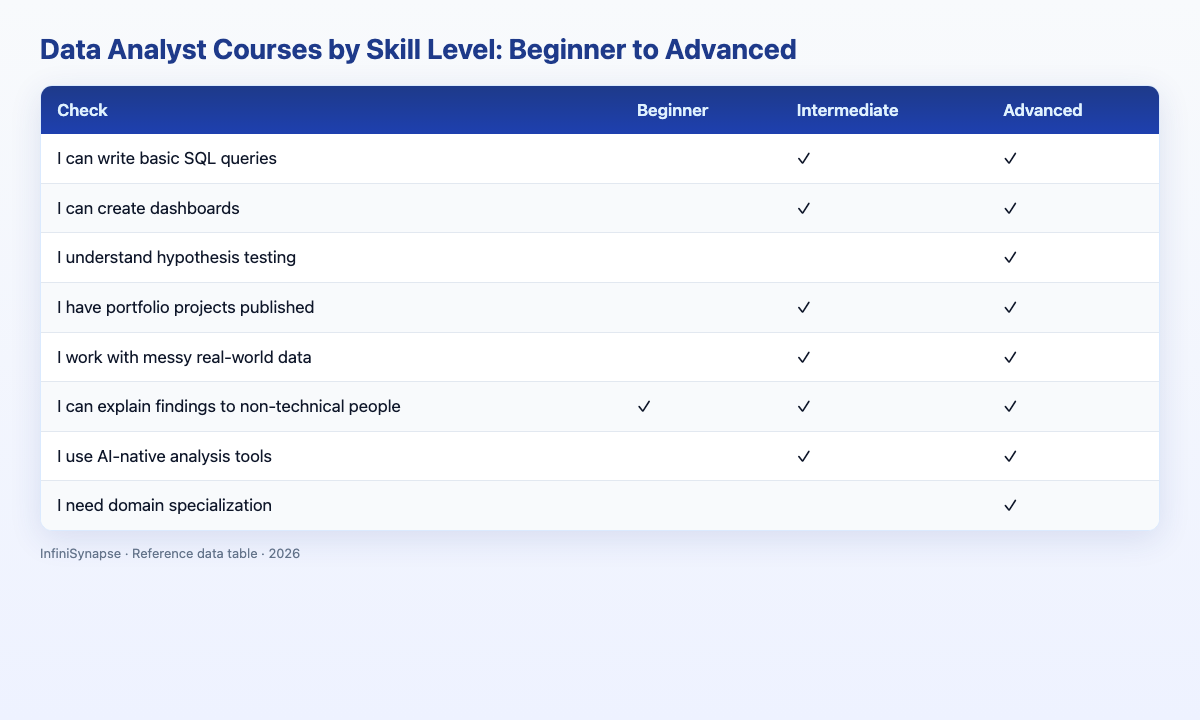
Score yourself 1 point per skill you can perform today (honest, timed, no notes):
| # | Skill test | Beginner | Intermediate | Advanced |
|---|---|---|---|---|
| 1 | Write SELECT, WHERE, GROUP BY on a single table | ✓ | ✓ | ✓ |
| 2 | Join 2+ tables and aggregate (e.g., revenue by category) | ✓ | ✓ | |
| 3 | Use a window function (ROW_NUMBER, LAG) | ✓ | ✓ | |
| 4 | Build a dashboard in Tableau, Power BI, or Looker | ✓ | ✓ | |
| 5 | Run a chi-square or t-test and interpret p-value | ✓ | ||
| 6 | Design an A/B test and compute sample size | ✓ | ||
| 7 | Publish 2+ portfolio analyses with documented SQL | ✓ | ✓ | |
| 8 | Model data in star schema or write DAX measures | ✓ |
Scoring:
- 0–2 points → Beginner track
- 3–5 points → Intermediate track
- 6–8 points → Advanced / specialization track
Quick SQL spot-check (5 min): Write a query returning top-5 categories by revenue with a YoY growth column. Cannot finish? → Beginner. Finish with joins but not window functions? → Low intermediate. Finish with LAG or self-join? → Intermediate+.
Beginner Courses
Beginner data analyst courses serve people with 0–2 diagnostic points. Exit criteria: basic SQL, one visualization, one published portfolio piece, plain-language presentation.
Audited beginner picks (July 2026)
| Program | Price | Timeline | Audit score | Exit skills verified |
|---|---|---|---|---|
| SQLBolt | $0 | 1–2 wk | 3.8/5 | Lessons 1–12 complete |
| Kaggle Learn | $0 | 2–4 wk | 3.6/5 | Python + SQL modules |
| Google Data Analytics Cert. | ~$294 | 3–6 mo | 4.1/5 | Capstone + Tableau/R |
| IBM Data Analyst Cert. | ~$294–392 | 4–6 mo | 4.0/5 | Python + dashboard |
Recommended stack: SQLBolt (2 wk) → Kaggle (2 wk) → Google Certificate (4 mo) = ~$196–294 total, 10 hrs/week.
Avoid: Programs skipping SQL, weekend "master analyst" webinars, video-only libraries without coding environments.
Typical duration: 8–16 weeks at 10–15 hrs/week. If you cannot write basic queries and one chart after completing a beginner program, stay at beginner — do not advance.
Intermediate Courses
Intermediate data analyst courses assume 3–5 diagnostic points: comfortable with joins, ready for window functions, messy data, and statistics.
Audited intermediate picks (July 2026)
| Program | Price | Timeline | Audit score | Differentiator |
|---|---|---|---|---|
| Udacity Data Analyst Nanodegree | ~$846 | 4 mo | 4.2/5 | Human code review + A/B module |
| IBM Certificate (if no Python yet) | ~$294–392 | 4–6 mo | 4.0/5 | Python + Cognos path |
| Mode SQL Tutorial | $0 | 2–3 wk | 3.9/5 | Advanced SQL patterns |
| Springboard Career Track | $11,900 | 6 mo | 4.5/5 | 2 mentor-reviewed capstones |
SQL depth required entering: JOIN, GROUP BY, subqueries. Exit criteria: window functions, one messy-data project, hypothesis test explained to a non-technical stakeholder.
Duration: 6–12 weeks (intensive) to 6 months (part-time with mentor). Intermediate is where structured feedback provides the most value over pure self-study.
Advanced Courses
Advanced data analyst courses target 6–8 diagnostic points — working analysts seeking cloud, BI modeling, or experimentation depth.
Audited advanced picks (July 2026)
| Program | Price | Timeline | Focus | Best for |
|---|---|---|---|---|
| Microsoft Power BI Data Analyst Associate | ~$165 exam | 2–4 mo prep | DAX, data modeling, dashboards | Microsoft-stack roles |
| AWS Certified Data Analytics – Specialty | ~$300 exam | 2–4 mo prep | S3, Glue, Redshift, Athena pipelines | Cloud-native analytics |
| Springboard (career changers with base skills) | $11,900 | 6 mo | End-to-end + job coaching | Career pivot at high intermediate |
Do not enroll advanced-first if you score <6 on the diagnostic — credentials without comprehension fail technical screens.
Advanced programs should address AI-native workflows: validating agent-generated SQL, designing analysis pipelines with human oversight (IBM augmented analytics, Stanford HAI AI Index).
Recommended Progression by Week
Sensible sequence for a career changer starting at beginner (adjust if diagnostic places you higher):
| Weeks | Level | Program / action | Spend | Milestone |
|---|---|---|---|---|
| 1–2 | Beginner | SQLBolt lessons 1–12 | $0 | 15 queries logged |
| 3–4 | Beginner | Kaggle Learn (SQL + Python) | $0 | 1 Kaggle notebook |
| 5–16 | Beginner | Google Certificate | ~$196 (4 mo) | Capstone complete |
| 17–20 | Beginner→Int. | Independent portfolio project | $0 | GitHub publish #2 |
| 21–32 | Intermediate | Udacity Nanodegree | ~$846 | Code-reviewed project |
| 33–36 | Advanced prep | Power BI or AWS study | ~$165–300 | Certification exam |
| Ongoing | All | AI-native practice | $0 | Validation habits |
Total example spend (beginner → intermediate → one cert): ~$1,200–1,350 over ~8 months. Skipping weeks 1–4 to jump straight to Google often produces weaker SQL under interview pressure.
Online Courses by Level
| Level | Best online format | Median cost | Completion tip |
|---|---|---|---|
| Beginner | Self-paced + free prelude | $0–$294 | Finish SQLBolt before paying |
| Intermediate | Self-paced + code review OR cohort | $0–$11,900 | Pick human feedback if self-study plateaued |
| Advanced | Exam-prep or domain bootcamp | $165–$300+ | Only after diagnostic ≥6 |
All levels require interactive SQL environments — not video-only. See data analyst courses online.
AI Skills at Every Level
| Level | AI skill to add | Concrete practice |
|---|---|---|
| Beginner | Know agents exist; run plain-language → SQL | Compare agent output to your SQLBolt answer |
| Intermediate | Validate AI queries (row counts, totals) | Reconcile agent SQL vs hand-written on same dataset |
| Advanced | Design governed AI-assisted pipelines | Document human verification step in portfolio |
Supplement any course scoring <3/5 on AI with what AI-native data analysis means.
Worked Paths: Three Learners, Three Levels
Beginner path — Priya (marketing coordinator, 0 SQL)
| Metric | Result |
|---|---|
| Diagnostic score | 1/8 |
| Stack | SQLBolt → Kaggle → Google Cert. |
| Spend | $196 (4 mo Coursera) |
| Timeline | 16 weeks |
| Outcome | $72,000 entry offer; 2 portfolio pieces |
Intermediate path — James (junior analyst, 1 yr SQL)
| Metric | Result |
|---|---|
| Diagnostic score | 4/8 (no window functions) |
| Stack | Mode SQL (free) → Udacity Nanodegree |
| Spend | $846 |
| Timeline | 5 months |
| Outcome | Promotion to $88,000 base (+$9,000); A/B project cited in review |
Advanced path — Elena (analyst, 4 yrs, Power BI user)
| Metric | Result |
|---|---|
| Diagnostic score | 7/8 |
| Stack | Microsoft PL-300 exam prep |
| Spend | $165 exam fee |
| Timeline | 10 weeks prep |
| Outcome | PL-300 certified; contract role $95/hr BI consulting |
Limitation: Three individual outcomes; your market and effort will vary. Paths use programs from our audited shortlists only.
Level-Matching Scorecard
Before enrolling, confirm level (from Self-Assessment):
| Check | Pass? |
|---|---|
| I scored myself with the 8-skill diagnostic | |
| I ran the 5-minute SQL spot-check | |
| My target course matches my tier (not aspirational) | |
| I verified price on provider site (dated) | |
| I have a portfolio milestone defined per stage | |
| I know the next course after this one | |
| I planned AI supplementation if course AI score <3/5 | |
| I will publish work, not only collect certificates |
6–8: enroll with confidence. 3–5: resolve gaps first. Below 3: re-run diagnostic.
Practical Next Steps
Run the diagnostic today
Take the 8-skill table and SQL spot-check. Write your score at the top of a learning doc. Enroll one level below if unsure — filling gaps is faster than recovering from a too-hard course.
Map five job postings to your level
Pull five target postings. If 80% require window functions and you cannot write them, you are not intermediate yet — regardless of job title.
Publish before you level up
Complete one portfolio artifact at your current level before purchasing the next tier. Priya published at week 14 before spending on intermediate content.
Frequently Asked Questions
What data analyst courses should beginners take?
With 0–2 diagnostic points: SQLBolt ($0, 2 wk) → Google Certificate (~$294, score 4.1/5). Exit when you can join two tables, build one chart, and publish one analysis.
How do I know my skill level?
Use our 8-skill diagnostic and 5-minute SQL spot-check — not job title or years of experience. James had 1 year on the job but scored only 4/8 (intermediate, not advanced).
Can I skip beginner courses?
Only with ≥3 diagnostic points and a passed spot-check including joins. Career changers from non-technical roles rarely skip successfully.
What comes after intermediate courses?
At 6+ points: advanced certification (Power BI ~$165, AWS ~$300) or domain specialization. Continue portfolio work and apply when you have 3+ published analyses.
Should all levels cover AI tools?
Yes. Beginners: compare agent SQL to hand-written. Intermediate: row-count validation. Advanced: pipeline governance. Most courses score ≤3.5/5 on AI — supplement per level table above.
Conclusion
Matching data analyst courses to your actual skill level — measured with the diagnostic, not wishful thinking — is the fastest path to employability. Beginners: $0–$294. Intermediate: ~$846. Advanced: $165–$300 exams or domain depth. Follow the week map, publish at every stage, and treat courses as milestones.
To practice AI-era skills at your current level, read what AI-native data analysis means and try the InfiniSynapse web app free on registration, no credit card required.