Data Analyst: The Complete 2026 Career Guide
By the InfiniSynapse Data Team · Last updated: 2026-07-09 · We build an AI-native data analysis platform and work with analysts every day; this guide reflects how the role is actually changing in 2026, not generic career advice.

Table of Contents
- TL;DR
- How We Evaluated This Guide
- What a Data Analyst Is
- What a Data Analyst Actually Does
- The Skills That Matter in 2026
- How to Become a Data Analyst
- Salary and Career Path
- How AI Is Reshaping the Role
- The Role Across Industries
- Career Scorecard
- Common Misconceptions
- Cluster Guides in This Pillar
- Frequently Asked Questions
- Conclusion
TL;DR
Direct answer: a data analyst turns raw data into decisions — collecting, cleaning, analyzing, and communicating it so an organization can act. In 2026 the role is being reshaped by AI-native tools that automate mechanical work, shifting the job toward asking the right questions, validating results, and communicating insight rather than writing every query by hand.
Who this is for: anyone considering, entering, or advancing a data analyst career in 2026.
What you'll learn: what the role is and does, the skills that matter now, how to break in, salary and progression, and how AI is changing the work.
This hub maps the whole data analyst career; the cluster guides below go deep on jobs, salary, skills, and the path in.
How We Evaluated This Guide
We built this career guide from occupational research and hiring signals rather than generic listicles. Every section below reflects what we see when data analyst hiring teams evaluate candidates in 2026. We cross-referenced role definitions and growth projections from the Bureau of Labor Statistics occupational profile for data analysts, which lists analytical, communication, and technical skills as core competencies and projects continued demand for the profession. We aligned skill expectations with LinkedIn's 2025 Future of Recruiting report, which notes that skills assessments and portfolio evidence increasingly influence hiring alongside formal credentials.
The table below summarizes the career dimensions we see most often when analysts plan their next move. Use it as a map; the cluster guides linked throughout this pillar go deeper on each row.
| Career dimension | What to know in 2026 | Where to go deeper |
|---|---|---|
| Role definition | Descriptive and diagnostic analysis closest to business questions | Role defined |
| Day-to-day work | SQL, dashboards, stakeholder communication | Day-to-day responsibilities |
| Entry path | Portfolio + SQL beats credentials alone | Step-by-step path in |
| Compensation | Rises steeply with experience and domain depth | Salary by level |
| Job search | Targeted search + referrals beat mass applying | Jobs market guide |
| AI-era skills | Directing and validating AI-assisted workflows | Skills for 2026 |
Practical example: a career changer who masters SQL, publishes two portfolio analyses on public retail data, and earns a referral from a former colleague can land an entry-level data analyst role at a growth-stage SaaS company without a statistics degree — even when the posting lists a bachelor's as preferred. Recruiters see the portfolio as proof of execution and the referral as a trust signal — the combination that Harvard Business Review's skills-based hiring research describes as increasingly decisive in hiring decisions.
What a Data Analyst Is
A data analyst is a professional who examines data to answer questions and support decisions. Where a data scientist often builds predictive models and a data engineer builds pipelines, analysts sit closest to the business question, translating messy data into a clear answer that a manager, product team, or executive can act on. The role exists in nearly every industry because nearly every organization now collects more data than it can interpret unaided.
Key Definition: a data analyst collects, cleans, analyzes, and communicates data to help an organization make better decisions, turning raw numbers into actionable insight.
The distinction from adjacent roles matters for anyone choosing a path. Analysts focus on descriptive and diagnostic questions — what happened and why — while data scientists lean toward prediction and machine learning. We compare these paths directly in vs data scientist, and the underlying activity is the disciplined process described in the Wikipedia data analysis overview.
What a Data Analyst Actually Does
The day-to-day work is more varied than the title suggests. A typical week includes pulling data from databases with SQL, cleaning and reconciling inconsistent sources, building summaries and dashboards, and — most importantly — explaining what the numbers mean to people who will act on them. The communication half of the job is often underestimated by newcomers who imagine the role is purely technical.
The tasks cluster into a repeatable cycle: a stakeholder asks a question, the analyst gathers and cleans the relevant data, analyzes it, and delivers an answer with a recommendation. We detail the responsibilities in day-to-day responsibilities and the standard job scope in job description template. What unites every task is the goal of turning data into a decision, which is the enduring core of the role even as the tools change.
The Skills That Matter in 2026
The skill set of a strong analyst blends technical and human abilities. On the technical side, SQL remains the foundational skill, spreadsheet fluency is assumed, and comfort with a visualization tool such as Tableau or Power BI is expected. Increasingly, the ability to direct an AI-native analysis agent effectively — asking precise questions and validating its output — is becoming its own competency.
| Skill area | Why it matters in 2026 | How employers test it |
|---|---|---|
| SQL (querying, joins, aggregations) | Core daily work for most analyst roles | Live coding + take-home exercises |
| Spreadsheets (Excel / Sheets) | Still the default for ad hoc analysis | Case-style problems |
| Visualization (Tableau, Power BI, or similar) | Communicating findings to stakeholders | Portfolio dashboards |
| Communication / storytelling | Analysis without narrative creates little value | Interview walkthroughs |
| Business context | Framing the right question matters more than syntax | Case interviews |
| AI-assisted workflows | Validating automated outputs, prompt-to-SQL | Portfolio + live demos |
On the human side, analytical thinking, business understanding, and communication distinguish the best performers. The ability to frame the right question, judge whether a result makes sense, and explain it clearly is what turns technical output into value. We break down the full list in skills for 2026. As routine querying gets automated, these judgment-and-communication skills are precisely the ones rising in importance, a shift the Stanford HAI AI Index documents across knowledge work.
How to Become a Data Analyst
There is no single path to becoming a data analyst, which is good news for career changers. Some enter through a degree in statistics, economics, or computer science; many others transition from adjacent roles or complete a focused course or bootcamp. What employers actually want is demonstrated ability: a portfolio of real analyses that show you can turn data into insight. We lay out the routes in step-by-step path in. The move toward augmented workflows, outlined in IBM's augmented analytics overview, frames how teams evaluate modern tooling.
The most reliable path combines learning the core skills with building a visible portfolio. Master SQL and a spreadsheet, learn a visualization tool, practice on real datasets, and publish the results where an employer can see them. Entry points such as entry-level openings and internship guide then become accessible. The key is that analysts are hired on evidence of skill far more than on credentials alone, so building that evidence is the surest investment.
Salary and Career Path
Compensation varies widely by region, industry, and experience, but the role generally pays a solid professional wage and offers clear progression. The Bureau of Labor Statistics reports median annual wages well above the national average for occupations requiring similar education, with the highest earners in finance, technology, and specialized analytics roles. Entry-level positions lead to senior analyst roles, and from there to analytics management, specialized paths, or a transition into data science.
| Career stage | Typical focus | Compensation lever |
|---|---|---|
| Entry / junior | Executing analyses, building dashboards | Foundational SQL + first portfolio |
| Mid-level | Owning analyses end to end | Domain depth + stakeholder trust |
| Senior / lead | Setting analytical direction, mentoring | Business impact + team influence |
We cover the numbers in detail in salary by level and pay and negotiation, with the senior end in senior pay bands. The career path rewards those who pair technical growth with business impact. Analysts who consistently turn analysis into decisions that matter tend to advance faster than those who are merely technically proficient, because the value of the role lies in influence on outcomes. Remote options have also widened the field, as covered in remote landscape.
How AI Is Reshaping the Role
The most important 2026 development is the arrival of AI-native tools that automate much of the mechanical work. Cleaning, joining, and routine querying — tasks that once consumed the majority of an analyst's time — can now be delegated to an agent that plans and executes them from a plain-language goal. This is not a threat to the role so much as a reshaping of it.
Look for ways to show AI-era competency in your portfolio: prompt-to-SQL workflows, output validation, and when to trust automated summaries versus when to drill down manually. We explore the paradigm in what AI-native data analysis means, and the Stanford HAI AI Index tracks how rapidly these skills have become standard. Candidates who treat AI as leverage — directing tools skillfully while validating and communicating results — gain a decisive edge over those who ignore the shift.
The Role Across Industries
One reason the role is so durable is that nearly every industry needs it. In e-commerce, analysts study conversion funnels and customer segments; in healthcare, patient outcomes and operational efficiency; in finance, risk, fraud, and portfolio performance; in SaaS, retention, churn, and product engagement. The core cycle — gather, clean, analyze, communicate — stays the same, while the questions and domain knowledge shift. Enterprise adoption patterns in Google Cloud's AI overview mirror the shift from pilots to governed analytics.
This breadth shapes how analysts should think about specialization. Early in a career, generalist skills open the most doors for a data analyst, since the fundamentals transfer everywhere. Over time, domain depth — understanding the specific metrics, regulations, and data quirks of an industry — becomes a differentiator that raises both influence and pay. The strongest analysts pair transferable technical and communication skills with deep knowledge of one domain, which lets them ask sharper questions than a pure generalist and interpret results with context a newcomer would miss. We explore industry-specific tasks in what do data analysts do.
Career Scorecard
Assess your readiness for this career (1 point each):
| Check | Pass? |
|---|---|
| I can write basic SQL queries | |
| I am fluent with spreadsheets | |
| I can use a visualization tool | |
| I can frame a business question clearly | |
| I can judge whether a result makes sense | |
| I can explain findings to non-experts | |
| I have or am building a portfolio | |
| I can direct an AI analysis tool effectively |
6–8: strong readiness. 3–5: focus your learning. Below 3: start with fundamentals.
Common Misconceptions
Misconception 1: It is purely technical. Analysts spend as much effort communicating as computing.
Misconception 2: You need a specific degree. Employers hire on demonstrated skill and portfolio more than on credentials.
Misconception 3: AI will eliminate the role. AI automates mechanical tasks and shifts the job toward judgment and communication.
Misconception 4: More tools mean more skill. Mastering a few tools deeply beats dabbling in many.
Cluster Guides in This Pillar
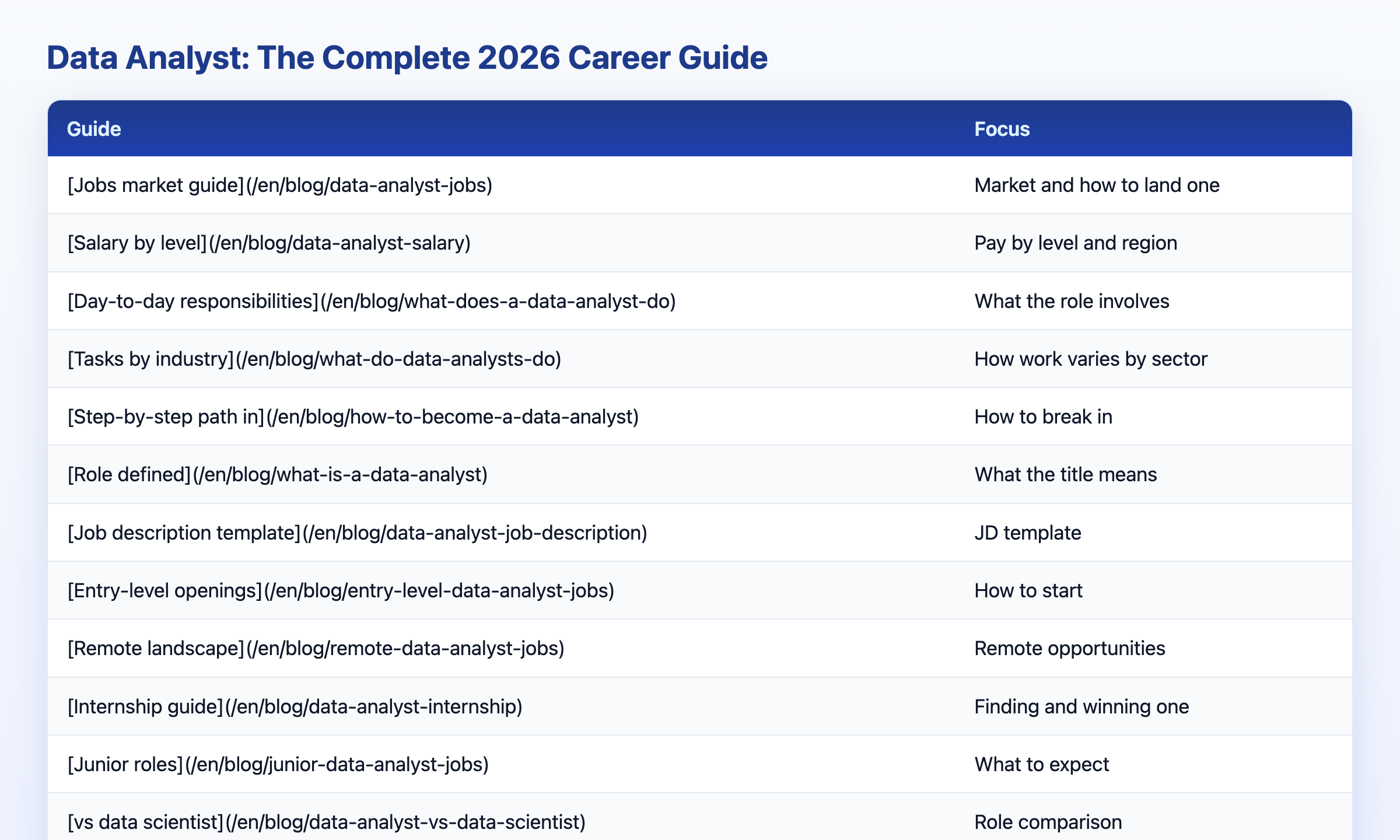
This hub is the map; the guides below go deep on each part of the data analyst career.
| Guide | Focus |
|---|---|
| Jobs market guide | Market and how to land one |
| Salary by level | Pay by level and region |
| Day-to-day responsibilities | What the role involves |
| Tasks by industry | How work varies by sector |
| Step-by-step path in | How to break in |
| Role defined | What the title means |
| Job description template | JD template |
| Entry-level openings | How to start |
| Remote landscape | Remote opportunities |
| Internship guide | Finding and winning one |
| Junior roles | What to expect |
| vs data scientist | Role comparison |
| Resume examples | Examples and tips |
| Interview prep | Common questions |
| Senior pay bands | Senior compensation |
| Pay and negotiation | Bands and negotiation |
| Skills for 2026 | Technical and soft skills |
Frequently Asked Questions
What does a data analyst do?
A data analyst collects, cleans, analyzes, and communicates data to help an organization make decisions. The work spans pulling data with SQL, reconciling messy sources, building dashboards, and — crucially — explaining what the numbers mean and what to do about them to the people who will act on the findings.
How do I become a data analyst?
Become a data analyst by mastering core skills — SQL, spreadsheets, a visualization tool — and building a portfolio of real analyses that prove you can turn data into insight. A degree, course, or bootcamp can help, but employers hire mainly on demonstrated ability, so visible evidence of skill matters most.
How much does a data analyst earn?
A data analyst generally earns a solid salary that rises with experience, though the exact figure varies by region, industry, and level. The Bureau of Labor Statistics reports median wages above the national average for comparable occupations. Entry-level roles progress to senior analyst and analytics management. See our dedicated salary by level and pay and negotiation guides for detailed ranges.
Will AI replace data analysts?
AI is unlikely to replace the role; it is reshaping it. AI-native tools automate mechanical work like cleaning and routine querying, which shifts the job toward framing questions, validating results, and communicating insight — the judgment-heavy parts that remain distinctly human. Analysts who direct these tools well gain leverage.
What skills does a data analyst need?
A data analyst needs SQL, spreadsheet fluency, a visualization tool, and increasingly the ability to direct an AI analysis agent. Equally important are analytical thinking, business understanding, and communication — the human skills that turn technical output into decisions and that are rising in value as routine work is automated.
Conclusion
A data analyst turns data into decisions, and in 2026 the role is being reshaped — not replaced — by AI-native tools that automate mechanical work and elevate judgment and communication. Build the core skills, prove them with a portfolio, and learn to direct AI as leverage.
To see the tools changing the profession, read what AI-native data analysis means and try the InfiniSynapse web app free on registration, no credit card required.