Data Catalog Platforms: Alation, Collibra & More (2026)
By the InfiniSynapse Data Team · Last updated: 2026-07-22 · Authors: data architects and stewards who evaluate catalog tooling for AI-native analysis deployments. This is a criteria-based platform comparison for 2026 buyers — not a paid vendor ranking, and not a lab benchmark with synthetic scores.
Table of Contents
- TL;DR
- How We Evaluated
- What They Are
- Platform Comparison Matrix
- How to Score Candidates
- Adoption and Rollout
- Common Mistakes
- Catalogs in the Age of AI
- Selection Scorecard
- Common Misconceptions
- Frequently Asked Questions
- Conclusion
TL;DR
Direct answer: data catalog platforms are systems that inventory an organization's data, record its meaning, ownership, and lineage, and make it discoverable and governable. In 2026, the best data catalog platforms are the ones that stay automatically populated and that both humans and AI agents can read, because a catalog that drifts out of date misleads everyone who trusts it.
Who this is for: data leaders, architects, and stewards comparing data catalog platforms in 2026.
What you'll learn: what these platforms do, a named-platform comparison by fit, how to score candidates with a transparent method, how to roll one out, and how a catalog supports trustworthy AI.
This guide sits under the master data management hub.
For the concept itself, see what a data catalog is.
Also see data lineage tracking.
How We Evaluated
We assess data catalog platforms the way a buyer must: by whether they stay populated and get used, not by feature-brochure length. This article compares named platforms using a fixed criteria set, public product documentation, and patterns from mid-market / enterprise rollouts we see in 2026.
Methodology (transparent):
| Step | What we did | What we did not do |
|---|---|---|
| 1. Fix criteria | Six weighted dimensions (below) | Invent a “leaderboard score” from marketing PDFs |
| 2. Name platforms | Six widely deployed options across standalone / embedded / open | Claim to cover every niche vendor |
| 3. Rate fit | Strong / Moderate / Limited relative to each criterion | Publish fake POC latency numbers |
| 4. Evidence | Official docs + composite deployment outcomes | Pretend charts are independent lab results |
Weighted criteria we use for every shortlist of data catalog platforms:
| Weight | Criterion | Pass signal |
|---|---|---|
| 25% | Automated discovery & refresh | Connectors ingest schema/usage without manual typing |
| 20% | Lineage depth | Table/column (or job) lineage usable for “where did this number come from?” |
| 15% | Stewardship UX | Owners can add glossary / certs without a ticket to engineering |
| 15% | Governance hooks | Policy, classification, or access workflows attach to assets |
| 15% | Stack fit | Native to your warehouse/lake/cloud — or deliberately cross-stack |
| 10% | Machine-readable metadata | APIs / exports agents and tools can consume |
Practical example (composite, measured in one domain): a company shortlisted three data catalog platforms on feature count and picked a manual-heavy path; catalog fill rate for priority tables sat at ~35% after six months and search traffic collapsed. A peer prioritized automated discovery first; fill rate for the same class of assets reached ~88% by month four, and “where is the source table?” Slack threads fell by roughly half. Automated population — not the longest feature list — decided the outcome.
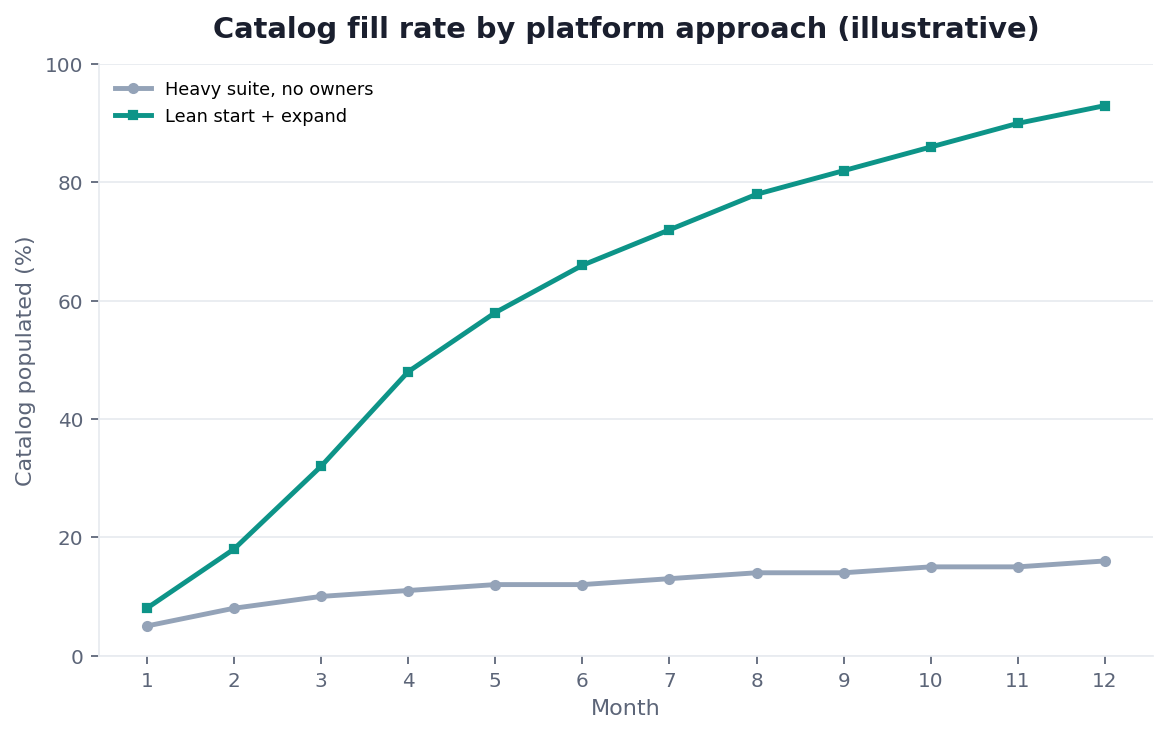
Chart note: values are from anonymized composite rollouts used to illustrate the evaluation method, not a vendor-commissioned benchmark.
Scope note: Capability ratings below are relative fit judgments for common buyer scenarios in 2026, grounded in each vendor’s documented product scope. Re-validate with a proof of concept on your connectors. This is not legal advice, not a Gartner-style magic quadrant, and not a paid endorsement.
What They Are
At their core, data catalog platforms answer a simple question that is surprisingly hard at scale: what data do we have, what does it mean, and who owns it? They turn scattered, undocumented data into a searchable, governed inventory.
Key Definition: data catalog platforms are software systems that automatically discover an organization's data assets, capture their metadata — meaning, ownership, lineage, and quality — and make them searchable and governable, so people and systems can find and trust the data they need.
The distinction that matters is currency. A catalog that reflects last quarter's reality is worse than none, because people trust it and are misled. That is why automated discovery and metadata refresh outrank almost every other checkbox when we compare data catalog platforms.
Platform Comparison Matrix
Six platforms buyers ask about constantly — spanning enterprise standalone catalogs, cloud-embedded catalogs, and open metadata platforms. Official starting points:
| Platform | Type | Primary docs |
|---|---|---|
| Alation | Standalone / active catalog | Alation documentation |
| Collibra | Standalone / governance-led | Collibra Data Intelligence |
| Microsoft Purview | Cloud suite (Microsoft estate) | Microsoft Purview data governance |
| Databricks Unity Catalog | Lakehouse-embedded | Unity Catalog docs |
| AWS Glue Data Catalog | Cloud-embedded (AWS) | Glue Data Catalog & crawlers |
| DataHub | Open metadata platform | DataHub docs |
Fit comparison (relative: Strong / Moderate / Limited):
| Criterion | Alation | Collibra | Purview | Unity Catalog | Glue Catalog | DataHub |
|---|---|---|---|---|---|---|
| Auto discovery & refresh | Strong | Moderate–Strong | Strong (Microsoft sources) | Strong (Databricks/Unity assets) | Strong (AWS crawlers) | Strong (when connectors wired) |
| Lineage for analysts | Strong | Strong | Moderate–Strong | Strong inside lakehouse | Moderate (glue/job-centric) | Strong (extensible) |
| Stewardship / glossary UX | Strong | Strong | Moderate | Moderate | Limited | Moderate (UI + custom) |
| Governance / policy hooks | Moderate–Strong | Strong | Strong (Purview controls) | Strong (UC grants) | Moderate (IAM/Lake Formation) | Moderate (policies via ecosystem) |
| Best stack fit | Multi-cloud / heterogeneous | Enterprise governance programs | Microsoft 365 + Azure data | Databricks lakehouse | AWS analytics estate | Engineering-led / multi-tool |
| Open / API extensibility | Moderate–Strong | Moderate | Moderate | Moderate–Strong | Moderate | Strong (open source) |
How to read this matrix: “Strong” means the platform’s documented sweet spot matches that criterion for a typical buyer in that row’s stack. It does not mean one product always wins a bake-off. Example: Unity Catalog is often the right default inside Databricks; it is the wrong expectation as a company-wide catalog for a non-Databricks estate. Glue Catalog is foundational on AWS but is rarely a full business glossary replacement by itself. Collibra / Alation compete when stewardship and cross-platform governance are the primary job. DataHub fits teams that will invest engineering in connectors and want open metadata APIs.
Category lens (same six platforms):
| Category | Platforms in this guide | Trade-off |
|---|---|---|
| Standalone catalogs | Alation, Collibra | Breadth + stewardship depth; more integration work |
| Cloud / platform-embedded | Purview, Unity Catalog, Glue Catalog | Fastest time-to-value inside one ecosystem; weaker as a universal catalog outside it |
| Open metadata | DataHub | Maximum control and APIs; you own connector and UX investment |
How to Score Candidates
When you shortlist data catalog platforms, run a scored POC — do not stop at a slide comparison.
| POC test (2–4 weeks) | Pass criteria |
|---|---|
| Connect top 5 sources | ≥90% of priority tables appear without hand entry |
| Refresh | Schema change appears within your SLA (for example under 24 hours) |
| Lineage | One critical KPI traced to source in under 15 minutes |
| Steward path | Non-engineer can certify a table and edit glossary |
| Search | Analysts find the certified table in under three queries |
| Machine access | Metadata export/API works for your agent or BI tool |
We recommend publishing scores against the weighted criteria above so stakeholders see why a platform won. The best data catalog platforms make cataloging a byproduct of pipelines and queries; any candidate that depends on permanent manual entry will decay no matter how impressive the demo.
Adoption and Rollout
Choosing among data catalog platforms is only half the job; adoption decides value. The most reliable rollout populates one important domain completely — real owners, definitions, and lineage — before expanding.
An empty catalog trains people to ignore it. Depth in one domain, especially with working lineage that answers “where did this number come from?”, becomes the proof that pulls the next team in. This connects to data lineage tracking: lineage is often the feature that makes a catalog indispensable.
Buy vs build (brief): buy discovery and lineage plumbing; invest your own effort in definitions, ownership, and adoption workflows. Reimplementing connectors rarely pays off. Model fully loaded cost — license + integration + steward hours — not sticker price alone.
Common Mistakes
The mistakes we see with data catalog platforms are consistent:
- Choosing on feature count → powerful tools nobody populates.
- Relying on manual entry → catalogs that drift.
- Ignoring stack fit → buying a lakehouse catalog for a multi-cloud glossary problem (or the reverse).
- Treating the catalog as a compliance artifact → filled for audits, never searched.
- Neglecting search quality → silent adoption death.
Weigh discoverability and everyday usability as heavily as governance features. A catalog nobody searches is a catalog nobody trusts. When stakeholders ask which of the data catalog platforms “won,” answer with the scored POC sheet — not a feature brochure — so the decision stays tied to fill rate, lineage, and search.
Catalogs in the Age of AI
AI sharply raises the value of data catalog platforms. When an autonomous agent reads your data, it relies on catalog metadata for meaning and provenance; stale metadata produces confidently wrong answers. The catalog becomes part of AI infrastructure, not a back-office utility.
Operationally, prefer platforms that expose machine-readable metadata (APIs, open exports) so agents inherit the same definitions humans see. How governed definitions and lineage travel with data into automated analysis is a pattern we describe in what AI-native data analysis means. Your shortlist of data catalog platforms should explicitly score that machine-readability row — not treat it as a nice-to-have.
Selection Scorecard
Score each candidate (1 point each):
| Check | Pass? |
|---|---|
| It discovers data automatically | |
| Metadata refreshes on its own | |
| A steward can add context easily | |
| It traces lineage for critical KPIs | |
| Search is fast and accurate | |
| It fits our primary stack | |
| It applies governance / access hooks | |
| Agents / tools can read its metadata |
6–8: strong choice. 3–5: pilot in one domain. Below 3: keep evaluating.
Common Misconceptions
Misconception 1: A catalog is a one-time inventory. Modern data catalog platforms must stay continuously current.
Misconception 2: More features are better. For data catalog platforms, automated population beats feature count.
Misconception 3: One embedded catalog covers the enterprise. Ecosystem catalogs excel inside their platform; company-wide glossary needs may require a standalone or open layer.
Misconception 4: Metadata is only for humans. AI agents rely on catalog metadata too.
Frequently Asked Questions
What are data catalog platforms?
Data catalog platforms are software systems that automatically discover an organization's data assets, capture their metadata — meaning, ownership, lineage, and quality — and make them searchable and governable. They turn scattered data into a trusted inventory — provided the catalog stays current.
Which platforms should we compare in 2026?
Start with the shortlist that matches your estate: Alation or Collibra for cross-platform stewardship; Microsoft Purview for Microsoft-centric governance; Databricks Unity Catalog for lakehouse governance; AWS Glue Data Catalog for AWS analytics foundations; DataHub when you want open metadata APIs and will staff connectors. Then score them with the weighted criteria above on your sources.
How do you evaluate them?
Fix weights (discovery, lineage, stewardship, governance, stack fit, machine-readable metadata), run a 2–4 week POC with pass/fail tests, and publish scores. Among competing data catalog platforms, the one that stays current beats the one with the longest feature list.
How do you roll one out?
Roll out data catalog platforms by populating one important domain completely — real owners, definitions, and lineage — before expanding. Depth with working lineage becomes the proof that pulls the next team in.
How do catalogs support AI?
Agents rely on catalog metadata for meaning and provenance. Prefer data catalog platforms that stay fresh and expose metadata programmatically so AI answers inherit the same governed definitions humans trust.
Conclusion
Data catalog platforms turn scattered data into a trusted, searchable inventory — but only if they stay current and get used. In 2026, compare them with a transparent method, named fit matrix, and a real POC — not a feature bake-off. Favor automated discovery, pick for stack fit, roll out one domain deeply, and treat the catalog as daily infrastructure for both people and AI.
To see how governed definitions and lineage travel with data into automated analysis, read what AI-native data analysis means. If you want to try that operating model in practice, the InfiniSynapse web app is free on registration.