Data Governance News: How to Stay Current in 2026
By the InfiniSynapse Data Team · Last updated: 2026-07-15 · Authors: platform engineers and data stewards who ship an AI-native analysis product and review customer governance/retention questions weekly. This is operational guidance for program owners, not legal advice — confirm jurisdiction-specific obligations with qualified counsel.
Table of Contents
- TL;DR
- Primary Sources This Guide Cites
- How We Track This
- What Counts as Signal
- The Big 2026 Developments
- Where to Follow It
- Turning News Into Action
- Case Study: A Quarterly Triage Log
- Common Failure Modes
- News and AI-Native Analysis
- Reader Scorecard
- Common Misconceptions
- Frequently Asked Questions
- Conclusion
TL;DR
Direct answer: data governance news is the stream of regulatory, standards, and technology developments that change how organizations must define, protect, and use data. In 2026, following data governance news matters because AI regulation and privacy enforcement are moving fast, and a rule you missed can turn a compliant program into a liability overnight.
Who this is for: data leaders, compliance owners, and stewards who need to stay current in 2026.
What you'll learn: what counts as signal, the major developments, where to follow them, and how to turn data governance news into concrete program changes.
This guide sits under the data governance frameworks hub.
To act on what you read, see data governance best practices.
Also see data governance strategy.
Primary Sources This Guide Cites
High-trust data governance news starts with primary texts, not vendor roundups. The citations below are the authorities we use when we triage a headline:
| Authority | What it is | Use when tracking news |
|---|---|---|
| EU GDPR (EUR-Lex) | Binding EU privacy regulation | Storage limitation, accountability, erasure |
| EU AI Act (EUR-Lex) | Binding EU AI regulation | AI data logging, risk-tier obligations |
| EDPB guidelines | EU supervisory guidance | How GDPR principles are interpreted in practice |
| ICO (UK) | UK data-protection authority | UK GDPR / DPA expectations and enforcement themes |
| California CCPA | California consumer privacy statute hub | U.S. state privacy notice/deletion themes |
| FTC privacy & security | U.S. federal consumer-protection guidance | Unfair/deceptive practices risk around data use |
| NIST Privacy Framework | Voluntary U.S. control framework | Map headlines to privacy controls |
| NIST AI RMF | Voluntary AI risk framework | AI data governance functions |
| NIST CSRC | Security publications library | Sanitization, control catalogs |
| ISO 15489 | Records-management standard | Retention lifecycle / disposition framing |
Jurisdiction accuracy note (read before you act on any headline):
| If you operate in… | Primary “must verify” sources | Common false assumption |
|---|---|---|
| EU / EEA | EUR-Lex + EDPB | “A U.S. blog summary of the AI Act applies to us next week” |
| United Kingdom | ICO + UK legislation / guidance | “EU AI Act deadlines are automatically UK deadlines” |
| California / multi-state U.S. | CCPA hub + counsel on other state laws; FTC for federal unfairness risk | “CCPA text equals every U.S. state” |
| Global product | All of the above, filtered by where data subjects and controllers sit | “One retention schedule fits every region” |
Treat this guide as a triage method and source map — not a multi-jurisdiction compliance matrix.
How We Track This
We follow data governance news the way a working team must: filtering for developments that actually require a program change rather than chasing headlines. Every recommendation below reflects how we triage sources in 2026. We start from primary texts — for example the storage-limitation and accountability principles in the EU GDPR on EUR-Lex — and we watch control baselines such as the NIST Privacy Framework, which many organizations use to translate headlines into concrete safeguards.
The table below shows the categories of data governance news we monitor. Use it to build your own watchlist.
| Category | What changes | Why it matters |
|---|---|---|
| Regulation | New laws and enforcement | Compliance obligations shift |
| Standards | Framework revisions | Baseline controls update |
| AI governance | Rules for AI data use | New categories to govern |
| Privacy | Enforcement actions | Penalties and precedent |
| Tooling | Platform capabilities | New ways to enforce |
Scope note: This guide reflects patterns we see when mid-market and enterprise teams work with data governance news in 2026. It is not a substitute for legal counsel, vendor runbooks, or a formal survey of every industry — and when a smaller toolset or lighter process would serve, a full program is overkill.
What Counts as Signal
Not everything labeled data governance news deserves your attention. The signal is any development that would change a policy, a control, or an owner's obligations. Everything else is context.
Key Definition: data governance news is the ongoing stream of regulatory, standards, technology, and enforcement developments that alter how organizations must define, protect, retain, and use data — the subset of which requires an actual change to your governance program.
The discipline is filtering. A vendor announcement rarely changes your obligations; a new privacy law or a revised control framework does. Treating data governance news as a triage problem — what must I act on, what should I note, what can I ignore — is what keeps the stream useful rather than overwhelming.
A useful filter asks three questions before you escalate: (1) Does this create, change, or clarify a legal or contractual obligation for our data categories? (2) Does it change a control we already claim to operate? (3) Does it introduce a new data category (for example model prompts or training sets) that our inventory does not cover? If all three answers are no, log it as context and move on. That filter is how data governance news stays operational instead of becoming a reading club.
The Big 2026 Developments
Three threads dominate data governance news in 2026, and each has direct program implications.
Regulation and AI governance
AI-specific regulation is the loudest thread in data governance news this year. Rules increasingly govern how training data is sourced, how model inputs are logged, and how automated decisions are explained. In the EU, teams should track the official EU AI Act text alongside existing GDPR duties rather than relying on blog summaries. For risk framing that maps to program controls, the NIST AI Risk Management Framework remains a widely cited baseline outside pure legal text. Together these sources create new data categories to govern and new retention and logging obligations.
Privacy enforcement
The second thread is enforcement. Regulators are moving from writing rules to penalizing violations, so data governance news increasingly features fines and precedent rather than proposals. Supervisory practice collected by the EDPB and national authorities such as the ICO show that minimization, lawful basis documentation, and retention discipline are now examined in investigations — not merely described in policies. The practical takeaway: if your program cannot show evidence of deletion and access control, a headline about enforcement is already relevant to you.
Standards and provenance
The third thread is standards evolution — revised control frameworks and growing emphasis on data provenance and lifecycle. Information-security and privacy control catalogs such as those referenced through NIST CSRC publications and records-lifecycle practice in ISO 15489 shape the baselines auditors expect. Watching this strand of data governance news tells you where the compliance floor is heading before a customer questionnaire forces the change.
Where to Follow It
The best sources of data governance news are primary: regulators, standards bodies, and official framework repositories, supplemented by a few analysts who summarize implications. Subscribe to primary sources directly and treat secondary commentary as interpretation, not fact.
| Tier | Source type | Examples (start here) | How to use |
|---|---|---|---|
| 1 — Primary | Law & regulators | EUR-Lex GDPR, EU AI Act, EDPB, ICO, CCPA, FTC privacy guidance | Read the text when it changes obligations |
| 2 — Standards | Frameworks & controls | NIST Privacy Framework, NIST AI RMF, NIST CSRC, ISO 15489 | Map headlines to controls you already run |
| 3 — Interpretation | Counsel / analysts | Internal legal notes, one trusted external brief | Interpret — never replace — tier 1 |
Build a small watchlist rather than a firehose. Five reliable sources you actually read beat fifty you skim, and the goal of consuming data governance news is to catch the handful of developments that require action, not to be perpetually informed about everything.
Turning News Into Action
Consuming data governance news is worthless without a path to action. The teams that benefit have a standing process: when a relevant development lands, an owner assesses its impact, decides whether a policy or control must change, and schedules the work.
This is where data governance news connects to your data governance strategy: strategy sets the priorities that decide which developments matter most. Without that filter, every headline feels urgent; with it, you act on the few that move your risk. A quarterly review that maps recent developments to program changes turns the stream into a manageable cadence.
The action loop also needs a memory. When you decide that a development does not require change, record why, so you do not re-debate the same item every time it resurfaces. When you decide it does, log the change and the reasoning alongside it. Over time this record becomes an audit-ready history of how your program responded to data governance news, which is exactly what a regulator or board wants to see: not just that you were aware, but that you assessed and acted deliberately.
A minimal triage artifact (one row per item) looks like this:
| Field | Example |
|---|---|
| Date seen | 2026-04-03 |
| Source (primary URL) | EUR-Lex / EDPB / ICO link |
| Jurisdiction | EU / UK / CA / multi |
| Obligation change? | Yes / No / Unclear |
| Affected data categories | Customer location, support tickets |
| Owner | Steward + compliance lead |
| Decision | Policy change / monitor / ignore |
| Due date / evidence link | Ticket ID + updated schedule |
Case Study: A Quarterly Triage Log
Practical example (composite, anonymized): a mid-market retailer selling in the EU and California tracked data governance news with a fixed operating rhythm — not ad-hoc Slack links.
Process they ran (artifact, not theory):
- Weekly scan (30 min): owner skims Tier-1 RSS/email alerts only (EUR-Lex / EDPB / ICO / CA AG / FTC roundups).
- Intake row: every candidate is logged with jurisdiction + primary URL before any Slack debate.
- Monthly triage (45 min): steward + compliance lead score “obligation change?”; engineering joins only when a control change is likely.
- Evidence close: decisions that change policy attach a ticket ID and an updated retention/catalog row within 10 business days.
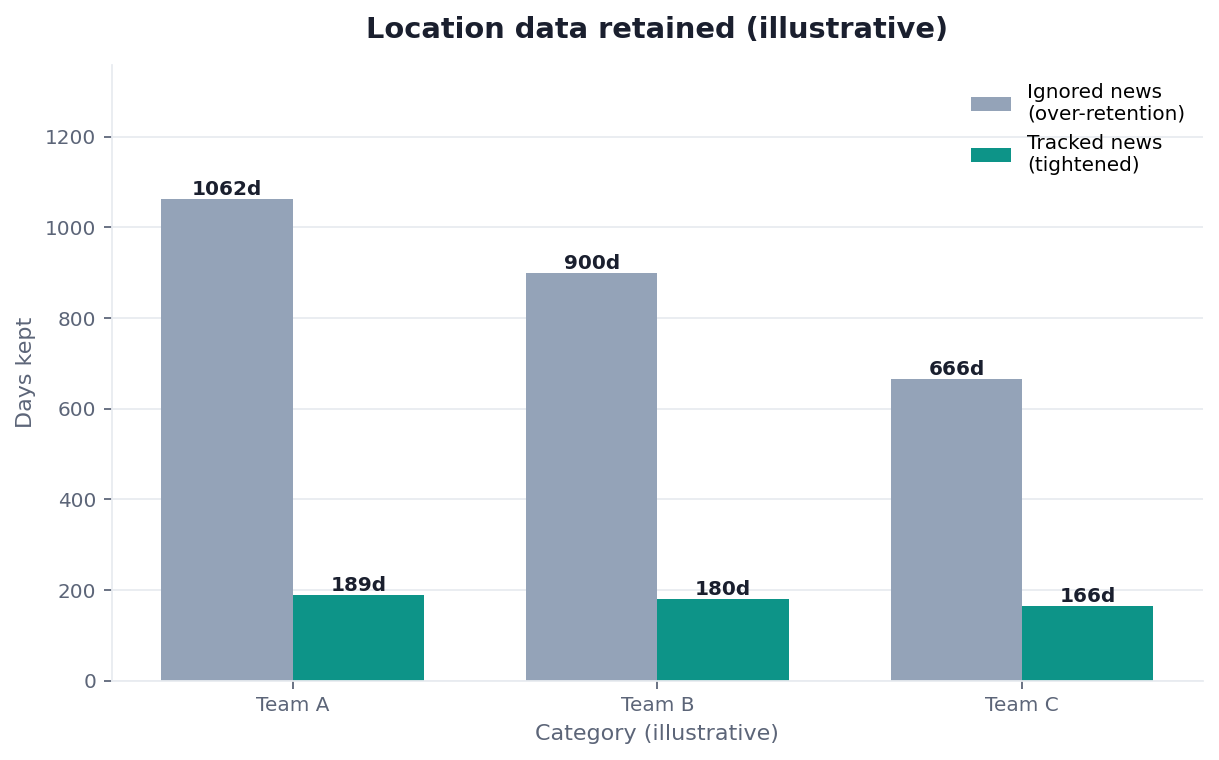
In Q1 they logged 12 items; 3 required action; 9 were closed as “monitor/ignore” with a written rationale so the same rumor was not re-litigated.
| Item | Primary source used | Decision | Outcome (90 days) |
|---|---|---|---|
| Location analytics retention challenged in peer enforcement coverage | Verified against ICO retention / minimization themes + internal counsel; CA storefront checked against CCPA deletion expectations | Cut location event retention from 24 months → 90 days; update schedule | Storage for that dataset −28%; inquiry prep checklist closed 4 open findings |
| AI feature logging prompts without retention class | Mapped to NIST AI RMF data-governance functions + GDPR storage limitation | New category “prompt & tool logs” with 180-day default | Catalog coverage +1 category; agent access scoped; mean time to answer “where are prompts kept?” 2 days → 20 min |
| Vendor blog claiming “AI Act requires X by Friday” | Checked EU AI Act applicability to their risk tier | Ignore (not in scope this year); logged rationale | Avoided a two-sprint panic project (~80 eng-hours) |
The competitor pattern we still see: teams that only read secondary data governance news summaries acted on the vendor blog, burned engineering time, and still missed the location-retention gap. Tracking primary sources is cheaper than remediation.
Common Failure Modes
The failures are predictable. The first is not tracking at all, so obligations change silently until an audit or incident reveals the gap. The second is over-tracking — drowning in data governance news without a triage process, so nothing gets acted on. The third is tracking without ownership, so developments are noted but never turned into program changes.
A subtler failure is trusting secondary summaries over primary sources. Commentary simplifies, and simplifications drift, so serious programs verify consequential data governance news against the original regulation or framework before acting. Vendor roundups and general-interest explainers can help you discover a topic; they are not evidence that your control set is compliant until you open the primary text (EUR-Lex, ICO, NIST, and so on).
News and AI-Native Analysis
AI changes both what counts as data governance news and how you respond to it. New rules about AI data use create governance obligations that did not exist a few years ago, and the volume of developments makes assisted triage attractive. An AI agent can summarize and classify incoming developments, but only if it works from governed, trustworthy sources — starting from the same primary texts you would cite in an audit, not from a random feed.
That is where an AI-native analysis approach helps: by binding governed definitions to data, the analysis you run on your own compliance posture stays reliable, as we describe in what AI-native data analysis means. In practice, when a new retention theme appears in data governance news, a well-governed catalog lets you identify which datasets fall under it and how long they are currently kept — a question that otherwise becomes a manual audit. Governance and automation reinforce each other when you treat them as one capability.
Reader Scorecard
Assess how well you track data governance news (1 point each):
| Check | Pass? |
|---|---|
| We follow primary regulatory sources | |
| We have a focused watchlist | |
| We triage signal from noise | |
| An owner assesses each development | |
| Relevant news drives program changes | |
| We verify against original sources | |
| We track AI-specific developments | |
| We review on a regular cadence |
6–8: strong. 3–5: add a triage process. Below 3: start with primary sources.
Common Misconceptions
Misconception 1: More sources are better. A focused watchlist beats a firehose you cannot process.
Misconception 2: Commentary equals fact. Verify consequential data governance news against primary sources.
Misconception 3: Tracking is enough. News is worthless without an owner and a path to action.
Misconception 4: It is only about regulation. Standards, tooling, and enforcement all count.
Frequently Asked Questions
What is data governance news?
Data governance news is the ongoing stream of regulatory, standards, technology, and enforcement developments that change how organizations must define, protect, retain, and use data. The useful subset is the developments that require an actual change to your program — a new policy, control, or obligation — as opposed to context that is merely interesting.
Why should teams follow data governance news?
Because obligations change continuously, and a rule you missed can turn a compliant program into a liability. AI regulation and privacy enforcement are moving quickly in 2026, so tracking developments early — and verifying them against primary sources — is far cheaper than remediating a violation after an audit or incident reveals the gap.
What are the big developments in 2026?
Three threads dominate: AI-specific regulation (read official texts such as the EU AI Act where applicable), privacy enforcement shifting from rules to penalties, and standards evolution emphasizing provenance and lifecycle controls. Each creates new categories to govern or new obligations, so each deserves a place on your watchlist and a path to program action.
Where is the best place to follow it?
Primary sources — regulators and official legal databases, plus standards bodies such as NIST and ISO — supplemented by a few interpreters who summarize implications. Build a small watchlist of five reliable sources you actually read rather than a firehose you skim, and treat secondary commentary as interpretation to verify, not fact.
How do you turn news into action?
Establish a standing process: when a relevant development lands, an owner assesses its impact, decides whether a policy or control must change, and schedules the work. Keep a triage log with jurisdiction, decision, and evidence links. Tie this to your governance strategy so priorities filter which developments matter, and review on a regular cadence so the stream becomes a manageable rhythm rather than constant noise.
Conclusion
Data governance news matters because obligations change faster than programs do. The winning approach is disciplined: a focused watchlist of primary sources, a triage process with a written log, and an owner who turns signal into program changes. In 2026, that discipline is what keeps governance current for both people and AI.
To make analysis of your own compliance posture reliable when the next development lands, read what AI-native data analysis means. If you want to try that model in practice, the InfiniSynapse web app is free on registration.