Data Retention Policy: How to Build One in 2026
By the InfiniSynapse Data Team · Last updated: 2026-07-15 · Authors: data stewards and platform engineers who help teams operationalize retention schedules. This guide shows how to build and enforce a data retention policy in 2026 — operational practice, not sample legalese, and not a substitute for counsel in your jurisdictions.

Table of Contents
- TL;DR
- How We Approached This
- What It Is
- Building the Schedule
- Legal Holds and Exceptions
- Automating Enforcement
- Retention Across the Data Lifecycle
- Common Mistakes
- Retention in the Age of AI
- Policy Scorecard
- Common Misconceptions
- Frequently Asked Questions
- Conclusion
TL;DR
Direct answer: a data retention policy is a formal, enforceable schedule defining how long each category of data is kept, where it lives, and when it is securely deleted. In 2026, building a data retention policy matters because storing data forever multiplies cost and breach risk, while automated, auditable deletion is what regulators and AI governance reviews now expect.
Who this is for: data leaders, compliance owners, and engineers building a data retention policy in 2026.
What you'll learn: what the policy is, how to build the schedule, handle legal holds, automate enforcement, avoid mistakes, and extend retention to AI.
This guide sits under the data governance frameworks hub.
For the definition, see what a data retention policy is.
Also see data governance best practices.
How We Approached This
We wrote this build guide from real retention projects rather than a template. Every step reflects what we see when teams operationalize a data retention policy in 2026. We ground schedule design in the EU storage-limitation principle in GDPR Article 5(1)(e) on EUR-Lex, UK practice in the ICO storage limitation guidance, and secure disposal in NIST SP 800-88.
Primary sources this build guide cites:
| Authority | Use when building the policy |
|---|---|
| EUR-Lex GDPR | Storage limitation (Art. 5) and erasure (Art. 17) |
| ICO storage limitation | UK justification / delete-or-anonymize practice |
| California CCPA | U.S. state privacy deletion / notice themes |
| EDPB guidelines | Supervisory interpretation of purpose + storage limitation |
| NIST SP 800-88 | Media sanitization / secure disposal |
| NIST Privacy Framework | Minimization and disposal as privacy risk controls |
| ISO 15489 | Records lifecycle / disposition framing |
| NIST AI RMF | Retention for AI-adjacent data (prompts, logs, training sets) |
Jurisdiction note: EU/EEA operators should verify against EUR-Lex + EDPB; UK operators against the ICO; California / multi-state U.S. operators against CCPA/CPRA themes and counsel for other state laws. Do not treat WCAG, database product docs, or analytics tooling as privacy-law proxies.
The table below maps the parts of a data retention policy.
| Part | What it specifies |
|---|---|
| Category | The kind of data |
| Period | How long to keep it |
| Location | Where it lives |
| Legal hold | When deletion pauses |
| Disposal | How it is deleted |
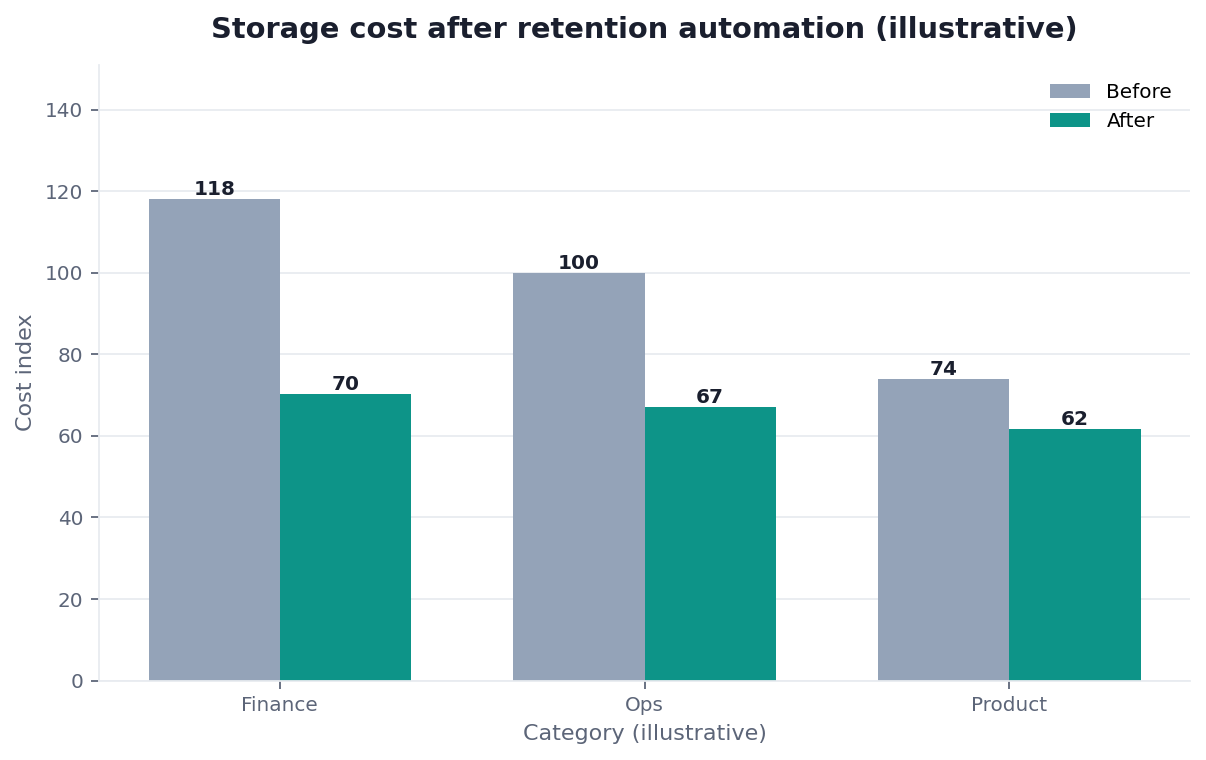
Practical example (composite metrics): a mid-market SaaS company built a data retention policy with a five-tier schedule and automated deletion. Hot object-storage cost index fell 100 → 67 (−33%) in two quarters; marketing event logs moved from “keep forever” to 90 days; support tickets stayed at 24 months with a documented dispute window. Audit prep time for “show us deletion evidence” dropped from 3 weeks → 2 days once deletion jobs wrote immutable logs. Automation, not the schedule alone, is what made it real.
Scope note: This guide reflects patterns we see when mid-market and enterprise teams work with a data retention policy in 2026. It is not a substitute for legal counsel, vendor runbooks, or a formal survey of every industry. Periods below are illustrative patterns, not mandates.
What It Is
At its core, a data retention policy turns “keep data a reasonable time” into specific, enforceable rules per data category. It governs deletion as much as retention.
Key Definition: a data retention policy is a formal document that specifies, for each category of data, how long it is retained, where and how it is stored, the events that trigger legal holds, and the secure method and timing of its disposal — enforced automatically rather than manually.
The distinction that matters is enforceability. A data retention policy in a wiki nobody automates is a wish; one wired into systems so data is actually deleted on schedule is a control. Regulators and increasingly AI governance reviews look for the latter — building the policy is only half the job; enforcing it is the rest.
Building the Schedule
Building a data retention policy starts with the schedule: for each data category, a defensible retention period tied to a legal or business reason. Start with your highest-risk categories — personal and regulated data — and work outward.
Keep the schedule specific and small at first. A data retention policy with five well-enforced tiers beats one with fifty categories nobody maintains. Frame categories with records-lifecycle thinking from ISO 15489: retention is disposition planning, not a cleanup sprint. Each category should name an owner accountable for confirming that deletion actually happens when a period lapses.
| Tier (example) | Illustrative period | Typical reason type |
|---|---|---|
| Financial / tax records | Multi-year (jurisdiction-specific) | Statutory minimum retention |
| Customer support tickets | 12–24 months | Contract / dispute window |
| Product analytics events | 90 days–12 months | Product purpose + minimization |
| Marketing engagement logs | 30–90 days | Purpose ends quickly |
| Security / audit logs | Per policy + investigation needs | Security + legal hold readiness |
Defensibility is what turns a schedule from arbitrary into auditable. For every period, state the reason — a specific regulation, contract, or documented business need — not a round number chosen for comfort. Under the ICO storage limitation guidance, you should be able to justify how long personal data is kept and delete or anonymize it when the purpose ends. For personal data subject to erasure rights under GDPR Article 17, your data retention policy and request-handling process must agree on what “delete” means across production, backups, and derived stores.
Legal Holds and Exceptions
A data retention policy must handle legal holds — events that suspend deletion because litigation or investigation requires preserving data. Without a hold mechanism, you risk deleting data you were obligated to keep, which turns a compliance measure into a liability.
Define, as part of the data retention policy, who can place a hold, how it overrides the schedule, and how it is lifted. Privacy regimes also create exceptions in the other direction — obligations to delete personal data when the purpose ends (see EDPB guidance and CCPA deletion themes). The policy must balance both. Getting holds right is what makes the rest of the schedule safe to automate.
| Control | Minimum definition |
|---|---|
| Who can place a hold | Named roles (legal / compliance) |
| Scope | Systems, categories, date ranges |
| Override | Deletion jobs skip held objects |
| Lift | Written release + evidence |
| Audit | Hold register searchable by case ID |
Automating Enforcement
Enforcement is where a data retention policy lives or dies. Manual deletion never scales, so the schedule must be wired into the systems that hold data, with holds able to override it and every deletion logged for audit.
Automate your highest-risk categories first and expand. A data retention policy whose deletions are logged and confirmed lets you prove compliance with evidence rather than intentions. When media leave your control, align disposal with NIST SP 800-88 — application-level DELETE is not the same control as verified sanitization of retired disks. Treat the deletion log as a first-class artifact.
This connects retention to your broader data governance framework: governance supplies the categories and owners the schedule depends on. The NIST Privacy Framework is a useful map for treating disposal as a privacy risk control, not only a storage-cost project.
Retention Across the Data Lifecycle
A data retention policy is most robust when it follows data across its whole lifecycle rather than treating each system in isolation. Data is born, copied, transformed, and archived; a policy that governs only the original source leaves copies and derivatives ungoverned.
Copies and backups
The hardest part of enforcing a data retention policy is that data rarely lives in one place. A record deleted from production may persist in backups, exports, analytics copies, and caches. Explicitly address backups and copies — how long they are kept and how deletion propagates — so “deleted” means deleted everywhere that matters for your risk model.
Archival and cold storage
Not all retention means hot availability. Distinguish data that must stay instantly queryable from data that can move to cheaper archival storage while still satisfying a retention requirement. Specify which categories move to archive, when, and how they can be retrieved if a legal hold or audit later requires them.
Common Mistakes
The mistakes we see in a data retention policy are predictable. Writing a schedule but never automating it lets data accumulate anyway. Forgetting legal holds leads to deleting data litigation required. Defining retention without owners means no one confirms deletion. Keeping everything “just in case” quietly multiplies cost and breach exposure. Citing unrelated standards (for example accessibility guidelines) as if they were privacy retention law undermines defensibility.
A subtler mistake is treating the data retention policy as one-time. Categories, regulations, and systems change, so schedule an annual review at minimum.
Retention in the Age of AI
AI adds new retention questions to a data retention policy. Training data, prompt logs, and derived datasets all need retention rules, and the data an agent can query is governed by the same schedules. A modern data retention policy covers these AI-adjacent categories explicitly — consistent with data-lifecycle expectations in the NIST AI Risk Management Framework.
How governed access and retention context travel with data into automated analysis is a pattern we describe in what AI-native data analysis means. The point for builders: enforce the schedule in the systems agents can reach, so the policy is not bypassed by automation.
Policy Scorecard
Assess your data retention policy (1 point each):
| Check | Pass? |
|---|---|
| Every category has a period | |
| Periods tie to a legal/business reason | |
| Storage location is documented | |
| Legal holds can override deletion | |
| Disposal is secure and defined | |
| Deletion is automated | |
| Deletions are logged | |
| AI-adjacent data is covered |
6–8: strong. 3–5: automate enforcement. Below 3: start with high-risk categories.
Common Misconceptions
Misconception 1: It just means keeping data. A data retention policy governs deletion as much as retention.
Misconception 2: Longer is safer. Keeping data forever raises cost and breach risk.
Misconception 3: A written schedule is enough. It must be automated to matter.
Misconception 4: AI data is exempt. Prompt logs and training data need rules too.
Frequently Asked Questions
What is a data retention policy?
A data retention policy is a formal, enforceable schedule that specifies, for each category of data, how long it is retained, where it is stored, the events that trigger legal holds, and the secure method and timing of its disposal. It governs deletion as much as retention and must be wired into systems so deletion actually happens, not merely written in a document.
How do you build the schedule?
Start with your highest-risk categories — personal and regulated data — and assign each a defensible retention period tied to a legal or business reason (see ICO storage limitation for personal-data justification practice). Keep it specific and small: five well-enforced tiers beat fifty categories nobody maintains. Name an owner for each category.
How do legal holds work?
A legal hold suspends deletion because litigation or investigation requires preserving data. Define who can place a hold, how it overrides the schedule, and how it is lifted. Holds protect you from deleting data you were obligated to keep; privacy deletion duties (GDPR / CCPA themes) pull in the other direction — your data retention policy must encode both.
How do you enforce it?
Wire the schedule into the systems that hold data so deletion happens automatically, with holds able to override it, and log every deletion for audit. Align media disposal with NIST SP 800-88 where relevant. Automate highest-risk categories first.
How does retention apply to AI?
Training sets, prompt/response logs, and derived datasets each need retention rules, and whatever an agent can query falls under the same schedules as its sources. Name these AI-adjacent categories explicitly and enforce them in the systems agents use.
Conclusion
A data retention policy is an enforceable, automated schedule that governs how long you keep, where you store, and how you delete each category of data — now including AI-adjacent data. In 2026, automated, logged deletion is what regulators expect. Start with high-risk categories, handle legal holds, cite primary privacy and disposal sources accurately, and automate enforcement.
Make every period defensible with a documented reason, follow the data into backups and archives, and treat the deletion log as the evidence that proves your policy actually runs. To see how retention context can travel with data into automated analysis, read what AI-native data analysis means. If you want to try that model in practice, the InfiniSynapse web app is free on registration.