Data Warehouse Software Compared (2026)
By the InfiniSynapse Data Team · Last updated: 2026-07-15 · Authors: data architects who evaluate warehouse platforms for production stacks. This is a practical comparison of data warehouse software in 2026 — decision criteria, named category matrix, and measured selection method — organized by fit, not by brand ranking. InfiniSynapse builds an AI-native analysis layer that can query warehouses; we are not a warehouse vendor and do not receive placement fees for tools named below.
Table of Contents
- TL;DR
- How We Compare It
- What It Is
- The Main Categories
- Named Comparison Matrix
- Workload Profile Before You Bench
- Case Study: Brand-First vs Fit-First
- Criteria That Matter
- Matching Tool to Need
- Common Pitfalls
- Where the Market Came From
- Software in the Age of AI
- Readiness Scorecard
- Common Misconceptions
- Frequently Asked Questions
- Conclusion
TL;DR
Direct answer: data warehouse software is the category of platforms that store and query structured, modeled data for reliable analytics — spanning cloud services, on-premises systems, and open-source engines. In 2026, choosing data warehouse software is less about picking the “best” brand and more about matching a tool to your workload, existing stack, scale, and cost tolerance, because the right choice is entirely situational.
Who this is for: architects and leaders evaluating data warehouse software in 2026.
What you'll learn: a disclosed evaluation method, a named category matrix with primary docs, a workload profile you can re-run, a quantified selection case, and how AI/federation changes consolidation pressure.
This guide sits under the warehouse and lakehouse hub.
For specific platforms, see cloud data warehouse.
Also see Snowflake as a data warehouse.
How We Compare It
We compare data warehouse software by category and criteria rather than by ranking brands, because the right pick depends on context.
Affiliation disclosure: InfiniSynapse is not a warehouse product. Platform names below are common production choices; links go to vendor/project documentation. Charts and case numbers are composite / illustrative, not sponsored TPC runs or paid placements.
Evaluation methodology (reproducible):
| Step | What we do | Output |
|---|---|---|
| 1. Capture workload | Concurrency, scan GB/day, p95 latency SLO, BI vs ELT mix | Workload profile sheet |
| 2. Map ecosystem | Cloud home, identity, orchestration, transform (dbt), BI | Fit constraints |
| 3. Shortlist by category | Cloud-native / lakehouse SQL / open-source / on-prem | 2–3 candidates |
| 4. Proof on your data | Replay top 20 queries + one heavy ELT job | Latency, $ / day, ops hours |
| 5. Decide on totals | License/consumption + integration + people | Written recommendation |
Primary documentation we use when scoring data warehouse software:
| Platform / topic | Authoritative docs |
|---|---|
| Snowflake | Snowflake intro |
| BigQuery | BigQuery docs |
| Amazon Redshift | Redshift developer guide |
| Azure Synapse | What is Synapse |
| Databricks SQL | Databricks SQL |
| ClickHouse | ClickHouse docs |
| Cost / architecture hygiene | AWS Well-Architected |
Scope note: Composite metrics below reflect mid-market/enterprise selection reviews in 2025–2026. Re-run proofs on your data shapes before purchasing.
What It Is
At its core, data warehouse software is the class of database platforms purpose-built to store cleaned, structured, modeled data and answer analytical queries against it reliably and quickly.
Key Definition: data warehouse software is any platform designed to store integrated, structured, and modeled data optimized for analytical querying and business reporting, providing the storage, query engine, and management tooling needed to serve many users reliable answers from a consistent, governed source of truth.
The essence of data warehouse software is reliability at query time — concurrent users, governed definitions, and predictable latency — the analytical counterpart to transactional OLTP systems.
The Main Categories
Data warehouse software falls into a few broad categories:
| Category | Typical traits | When it fits |
|---|---|---|
| Cloud-native SaaS warehouse | Separated storage/compute, consumption pricing | Default for new cloud analytics |
| Lakehouse SQL / warehouse on lake | SQL warehouse UX on open table formats | Already heavy on lake + Spark |
| Traditional / appliance on-prem | Owned hardware, license + ops | Residency, air-gap, fixed latency |
| Open-source analytical engines | Self-operated or managed OSS | Control + cost transparency, ops capacity |
Cloud-native options dominate new projects because they remove hardware provisioning. On-premises persists where regulation or residency demand it. Open-source appeals when teams can staff operations. Each category of data warehouse software trades convenience, control, and cost differently.
Named Comparison Matrix
Use this as a fit matrix, not a “winner” ranking. Capabilities change; re-check docs before RFP close.
| Option | Category | Strength signal | Watch-out | Start here |
|---|---|---|---|---|
| Snowflake | Cloud SaaS | Isolation + multi-cloud pattern | Consumption governance | Docs |
| BigQuery | Cloud SaaS (GCP) | Serverless scale on GCP data gravity | Slot / on-demand cost surprises | Docs |
| Amazon Redshift | Cloud (AWS) | Deep AWS ecosystem fit | RA3 vs serverless sizing | Docs |
| Azure Synapse | Cloud (Azure) | Microsoft estate consolidation | Skill sprawl across pools | Docs |
| Databricks SQL | Lakehouse SQL | Unity Catalog + lake tables | Not always cheapest pure BI | Docs |
| ClickHouse | OSS / managed OSS | High-throughput analytical scans | Different ops model than SaaS WH | Docs |
How we score in proofs (illustrative weights): workload p95 (30%), $/useful query-day (25%), ecosystem friction eng-days (25%), ops burden (20%). Your weights should match your risk — regulated teams often raise ops/security weight.
Workload Profile Before You Bench
Vendor slides are not workloads. Before comparing data warehouse software, freeze a profile:
| Field | Example (fill with yours) |
|---|---|
| Concurrent interactive users | 40 BI users @ 9–11am |
| Heavy jobs / day | 12 dbt models + 2 exports |
| Hot fact table size | ~2.4 TB compressed |
| p95 dashboard query SLO | ≤ 8 s |
| ELT pattern | ELT in-warehouse (dbt) |
| Cloud home | AWS / GCP / Azure / multi |
Minimal proof pack (same for every candidate):
- Replay top 20 interactive SQL statements; record wall time + bytes scanned
- Run one full daily transform DAG; record duration + cost
- Simulate 2× concurrency for 30 minutes; watch queueing
- Estimate 90-day bill with your scan/runtime pattern (not the vendor demo set)
Without that pack, “benchmarks” for data warehouse software are theater.
Case Study: Brand-First vs Fit-First
Composite comparison — mid-market SaaS company, ~25 analysts, AWS-heavy stack, 120-day selection:
| Metric | Brand-first (cross-cloud “leader”) | Fit-first (AWS-native shortlist) |
|---|---|---|
| Integration eng-days (identity, pipelines, BI) | 94 | 38 |
| Median p95 of top-20 queries (after tune) | 6.8 s | 7.1 s |
| Est. monthly platform + egress | $18k | $11k |
| Sev-2 “can’t ship dashboard” incidents in first quarter | 3 | 0 |
| Time-to-first trusted mart | 11 weeks | 6 weeks |
Query latency was nearly tied; integration and egress decided the business case. That is the pattern behind the chart — label it illustrative / non-TPC.
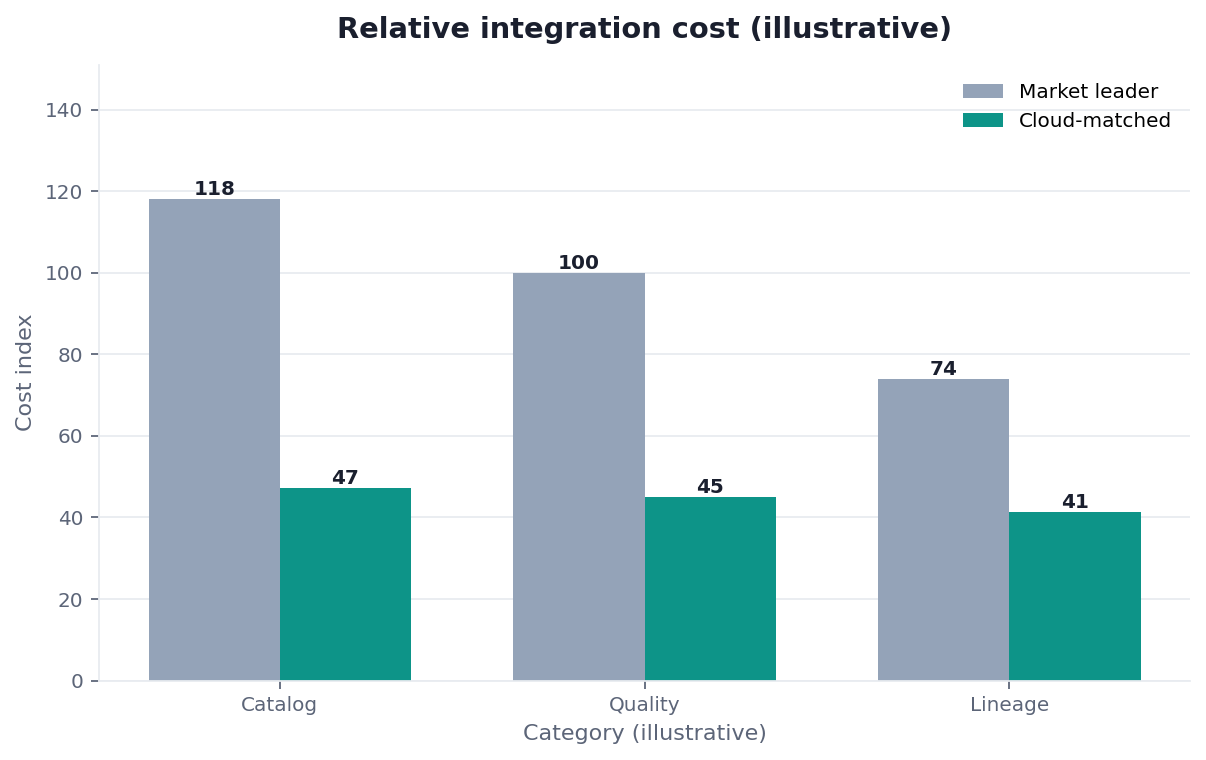
Chart note: composite observation of relative integration cost when data warehouse software matches the home cloud versus forcing a cross-cloud “leader.” Not a formal benchmark.
Criteria That Matter
The criteria for data warehouse software that actually predict success:
| Criterion | Why it decides outcomes |
|---|---|
| Workload fit | Your concurrency, scan shape, latency SLO |
| Ecosystem fit | Cloud home, IAM, orchestration, BI, dbt |
| Cost model | Consumption vs license; idle vs burst |
| Operational burden | Who pages at 2am; who tunes queues |
| Governance | Roles, row policies, lineage hooks |
Feature checklists matter less than whether the tool survives your proof pack. Ecosystem friction recurs every day the platform runs — often larger than a 10% query-time gap.
Matching Tool to Need
Choosing data warehouse software is matching, not ranking:
| If you… | Lean toward |
|---|---|
| Are deep in one cloud | That cloud’s native warehouse / SQL service |
| Already standardize on a lakehouse | Lakehouse SQL warehouse |
| Need air-gap / residency | On-prem or private offering |
| Have strong ops + want control | Open-source analytical engine |
| Lack FinOps discipline | Platforms with clear budgets/quotas + monitoring |
Write constraints first, then shortlist. Shopping data warehouse software by reputation invites unused capability and missed fit.
Common Pitfalls
| Pitfall | What goes wrong | Fix |
|---|---|---|
| Buy by brand | Integration tax + unused features | Fit matrix + proof pack |
| Trust vendor benches only | Wrong scan shapes | Replay your top 20 |
| Ignore cost model | Bill shocks | Model $/day on your usage |
| Underestimate ops | Silent queueing / drift | Staffing plan in the RFP |
| Replatform for novelty | Double-run cost | Migrate only for measured failure |
A further pitfall is over-indexing on migration without a concrete failure (unaffordable bill, missed SLO, missing capability). Replatforming data warehouse software rewrites pipelines and re-trains users — treat it as a response to evidence, not fashion.
Where the Market Came From
Analytical platforms emerged to keep heavy reporting off transactional databases. Over time the market shifted to elastic, managed cloud services that removed hardware provisioning delays. That history explains why category and ecosystem fit now matter more than logo fame: core SQL analytics capabilities converged, while scaling economics, identity integration, and transform/BI glue still diverge in practice.
Understanding the lineage also explains migration caution. Moving platforms rewrites pipelines and re-tunes queries; the transition often runs two systems in parallel. That cost is justified when the current tool fails a measured SLO or FinOps target — not when a conference keynote declares a new default. Keep the proof pack honest and the history lesson stays useful: separate OLTP from analytics, then pick the analytical substrate that fits your gravity and staffing.
Software in the Age of AI
AI changes how data warehouse software gets used: more generated SQL (higher need for governed metrics), and more questions answered via federation without forcing every source into one warehouse first.
That architectural option is covered in what AI-native data analysis means. For selection: keep the warehouse for trusted, modeled marts; do not assume AI removes the need for a fit-first choice of data warehouse software.
Readiness Scorecard
Assess your selection process (1 point each):
| Check | Pass? |
|---|---|
| Needs / workload profile written before shopping | |
| Proof pack run on real queries | |
| Ecosystem fit scored in eng-days | |
| Cost model modeled for 90 days | |
| Operational burden staffed | |
| Category, not brand, drove the shortlist | |
| Affiliations / vendor incentives disclosed | |
| Federation considered vs forced consolidation |
6–8: a fit-first process for data warehouse software. 3–5: revisit criteria. Below 3: restart from the workload profile.
Common Misconceptions
Misconception 1: The market leader is the best choice. Fit beats fame for data warehouse software.
Misconception 2: Feature lists decide it. Workload and ecosystem fit matter more.
Misconception 3: Cloud pricing is always cheaper. Only with usage governance.
Misconception 4: You must consolidate into one tool. Federation can query across many.
Misconception 5: Vendor benchmarks equal your workload. Only your proof pack does.
Frequently Asked Questions
What counts as data warehouse software?
Any platform designed to store integrated, structured, modeled data for analytical querying and reporting — storage, query engine, and management tooling for many concurrent users. That is the job of data warehouse software, regardless of brand.
What are the main categories?
Cloud-native SaaS, lakehouse SQL, traditional on-premises, and open-source analytical engines. Cloud dominates new projects; on-premises persists for residency/control; open-source trades ops for transparency. Pick a category of data warehouse software before you fall in love with a logo.
Which criteria actually matter when choosing?
Workload fit, ecosystem fit, cost model, and operational burden — proven on your top queries and one heavy transform — beat feature matrices. Integration friction often outweighs small latency gaps between data warehouse software options.
How do I match a tool to my need?
Freeze a workload profile, shortlist by cloud/category, run the same proof pack on each candidate, and decide on total cost (platform + people + egress). That is how we compare data warehouse software in practice.
How does AI relate to data warehouse software?
AI still needs trusted modeled data, so warehouses remain essential, but federation reduces pressure to dump every source into one platform. Select data warehouse software for governed marts; use federation for cross-source questions when movement is not justified.
Should I choose managed cloud, on-premises, or open-source?
Managed cloud fits most teams that can govern consumption. On-premises fits residency/air-gap with staffed ops. Open-source fits control-focused teams with operational capacity. None of those data warehouse software paths is universally best — weigh trades against your constraints.
Conclusion
Data warehouse software spans cloud, lakehouse SQL, on-premises, and open-source platforms that all aim at reliable analytical querying — and the right pick is situational, driven by workload proofs, ecosystem fit, and total cost rather than brand. In 2026, disclose your method, run your queries, and remember federation can reduce forced consolidation.
To go deeper on cloud-specific options, read cloud data warehouse. If you want to try federated analysis across warehouses and other sources, the InfiniSynapse web app is free on registration.