Entry Level Data Analyst Jobs: How to Start in 2026
By the InfiniSynapse Data Team · Last updated: 2026-07-09 · We build an AI-native data analysis platform and help newcomers break into the field; this guide reflects how entry-level hiring actually works in 2026.

Table of Contents
- TL;DR
- How We Evaluated Entry-Level Hiring
- What Entry-Level Roles Involve
- How to Qualify Without Experience
- Where to Find Them
- How to Stand Out
- The First 90 Days
- How AI Changes the Entry Point
- Building Momentum in Your First Role
- Turning an Entry Role into a Career
- Readiness Scorecard
- Failure Modes
- Frequently Asked Questions
- Conclusion
TL;DR
Direct answer: entry level data analyst jobs are the on-ramp into the field for candidates with little professional experience. They focus on executing defined analyses and building dashboards under guidance, and you qualify through a portfolio of real analyses plus foundational skills, not through years on the job.
Who this is for: newcomers, students, and career changers targeting entry level data analyst jobs.
What you'll learn: how we evaluated entry-level hiring, what these roles involve, how to qualify without experience, where to find them, how to stand out, and what the first 90 days look like.
This guide sits under the data analyst career hub; for the full path in, see how to become a data analyst.
How We Evaluated Entry-Level Hiring
We built this guide from occupational research and hiring signals rather than recycled job-board advice. First, we cross-referenced role definitions and growth projections from the Bureau of Labor Statistics occupational profile for data analysts, which lists analytical, communication, and technical skills as core competencies and projects continued demand for the profession. Second, we reviewed hiring-trend signals in LinkedIn's 2025 Future of Recruiting report, which notes that skills assessments and portfolio evidence increasingly influence hiring alongside formal credentials. Third, we aligned entry expectations with the skill checklist in data analyst skills and interview patterns in data analyst interview questions.
The table below summarizes what employers filling entry level data analyst jobs look for in 2026 and how to prove each signal before you apply. Treat it as a preparation map, not a guarantee — individual companies vary, but the patterns hold across most entry-level hiring we see.
| Entry path signal | What employers expect in 2026 | How to prove it |
|---|---|---|
| SQL fluency | Basic queries, joins, aggregations | Portfolio + take-home |
| Visualization | Clear dashboard or chart narrative | Published analysis |
| Communication | Written walkthrough of findings | Interview storytelling |
| Portfolio evidence | 2–3 real datasets analyzed end to end | GitHub or personal site |
| AI-tool fluency | Direct and validate automated outputs | Documented workflow |
| Domain interest | Tailored applications by sector | Sector-specific portfolio piece |
Practical example: a career changer who publishes two SQL and visualization analyses on public retail data, tailors applications to e-commerce entry level data analyst jobs, and earns a referral from a former colleague can land an offer at a growth-stage SaaS company without a degree — even when the posting lists a bachelor's as preferred. Recruiters see the portfolio as proof of execution and the referral as a trust signal — the combination that Harvard Business Review's skills-based hiring research describes as increasingly decisive in hiring decisions.
What Entry-Level Roles Involve
Entry level data analyst jobs are designed for people at the start of their analytics careers, and understanding their scope sets realistic expectations. These roles typically focus on executing analyses that others have defined, building and maintaining dashboards, pulling data to answer specific questions, and supporting senior analysts on larger projects. The emphasis is on learning the craft under guidance rather than setting analytical direction independently.
The scope of entry level data analyst jobs is a feature, not a limitation. Because the role is structured and supported, it is an ideal environment to build fluency with real data, real stakeholders, and real deadlines without being thrown into the deep end alone. Newcomers who embrace this structure, treating the guidance as accelerated learning rather than constraint, tend to progress quickly toward the more autonomous mid-level roles. The work follows the same disciplined process described in the Wikipedia data analysis overview, just with more support around it.
How to Qualify Without Experience
The apparent paradox of entry level data analyst jobs is that they seem to require experience you do not yet have. The resolution is that employers filling these roles hire on demonstrated ability, which a portfolio provides, rather than on prior job titles. Two or three real analyses that show you can gather, clean, analyze, and communicate data substitute effectively for professional experience at this stage.
Qualifying for entry level data analyst jobs therefore comes down to building the foundational skills and proving them visibly. Master SQL, spreadsheets, and a visualization tool, then apply them to real public datasets and publish the results with clear explanations. This portfolio is your evidence, and it frequently matters more than a degree or certification. We cover the full preparation path in how to become a data analyst, and the key insight is that you manufacture the "experience" employers want by doing real analysis on your own initiative before anyone hires you to do it.
Where to Find Them
Entry level data analyst jobs appear across many channels, and casting a wide but targeted net works best. General job boards list them, but so do company career pages, university career services, and analytics-specific communities. Internships, covered in data analyst internship, are a particularly reliable on-ramp for students and often convert into full-time roles.
When searching for entry level data analyst jobs, pay attention to titles beyond the obvious. Roles labeled "junior analyst," "reporting analyst," "business analyst," or "analytics associate" often carry the same responsibilities, and we cover the closely related tier in junior data analyst jobs. Remote options, discussed in remote data analyst jobs, have also widened access for entry-level candidates who might not live near a traditional hub. Searching by responsibility rather than exact title surfaces many more genuine opportunities.
How to Stand Out
Standing out for entry level data analyst jobs is less about competing on experience, which few applicants have, and more about demonstrating genuine ability and fit. A strong portfolio is the foundation, but the candidates who get offers pair it with the ability to talk through their work clearly, explaining why they framed a question a certain way and how they validated the result. This storytelling signals the judgment employers value.
A second way to stand out for entry level data analyst jobs is to tailor each application and show domain interest. A candidate applying to a healthcare analytics role who has a portfolio piece on public health data, and who can speak to why the domain interests them, is far more compelling than a generic applicant. Adding fluency with AI-native tools further distinguishes a candidate, since it signals they work the way modern teams do. Combined with active networking and referrals, these moves turn a first-time applicant into a memorable one rather than one resume among hundreds.
The First 90 Days
Landing one of the entry level data analyst jobs is the beginning, and the first 90 days shape your trajectory. The priority early on is learning the organization's data: where it lives, how it is defined, and whom to ask when something is unclear. Analysts who invest in understanding the data landscape early avoid the common mistake of producing confident but wrong analysis on data they did not fully understand.
The other priority in the first 90 days of entry level data analyst jobs is building trust through reliable, well-communicated work. Deliver what you promise, explain your findings clearly, and ask good questions rather than pretending to know everything. Newcomers who combine reliability with visible curiosity earn more interesting work quickly, which accelerates their growth toward mid-level roles. This early period is where the habits that define a strong analytical career are formed, so treating it deliberately pays dividends for years. The move toward augmented workflows, outlined in IBM's augmented analytics overview, frames how teams evaluate modern tooling.
How AI Changes the Entry Point
AI-native tools are reshaping entry level data analyst jobs in a way that favors newcomers who embrace them. Because agents now handle much of the mechanical cleaning and querying, entry-level analysts can produce meaningful analysis sooner, spending less time stuck on technical plumbing and more time learning to frame questions and communicate results, which are the skills that drive advancement.
We explore the paradigm in what AI-native data analysis means, and the Stanford HAI AI Index tracks how rapidly these skills have become standard. For someone in entry level data analyst jobs, learning to direct such a tool effectively is a genuine advantage, letting them punch above their experience level while they build fundamentals.
Building Momentum in Your First Role
Securing one of the entry level data analyst jobs is a milestone, but the momentum you build in the first year determines how quickly you advance. The analysts who progress fastest treat their entry role as active learning rather than passive task completion. They volunteer for slightly harder problems, ask why behind the requests they receive, and study how senior colleagues frame and solve questions. This proactive posture turns a structured starter role into an accelerated apprenticeship that compounds over months.
A practical way to build momentum in entry level data analyst jobs is to keep a running record of the analyses you complete and the impact they had. This record does triple duty: it reinforces your own learning, it supplies concrete stories for future interviews, and it demonstrates your value when reviews and promotions are discussed. Analysts who can point to specific decisions their work shaped stand out from peers who merely completed assigned tasks. Because these roles are designed as a foundation, the habits you form in them — especially reliability and clear communication — become the reputation that carries you into more autonomous work.
Turning an Entry Role into a Career
The best entry level data analyst jobs are launchpads, not destinations, and treating them that way shapes a strong career. Within the first year or two, aim to move from executing defined analyses toward owning problems more independently, which is the transition from entry-level to mid-level work. Signal your readiness by consistently delivering reliable work, then asking for stretch assignments that expand your scope beyond the original role definition.
Progression from entry level data analyst jobs also benefits from deliberate skill investment. Deepen your SQL, add statistical technique, and grow fluent with the AI-native tools that increasingly define modern analytical work, since each capability widens the problems you can own. Many analysts who start in entry roles reach senior or specialized positions within a few years by pairing this technical growth with a track record of business impact. The key is intentionality: treat each entry role as a rung, keep building demonstrable skill, and the path from a first analytics job to a substantial career unfolds naturally rather than by accident. Enterprise adoption patterns in Google Cloud's AI overview mirror the shift from pilots to governed analytics.
Readiness Scorecard
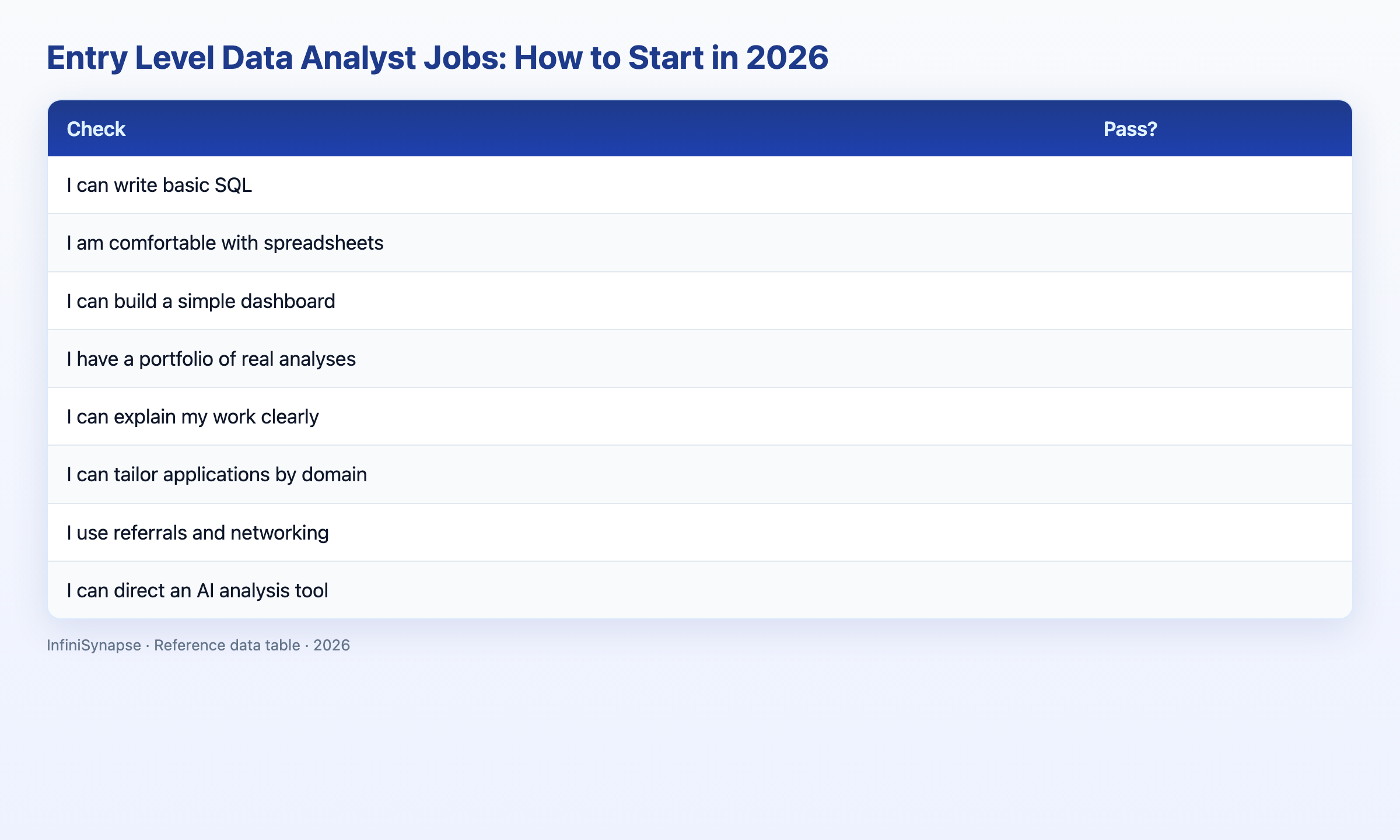
Assess your readiness for entry level data analyst jobs (1 point each):
| Check | Pass? |
|---|---|
| I can write basic SQL | |
| I am comfortable with spreadsheets | |
| I can build a simple dashboard | |
| I have a portfolio of real analyses | |
| I can explain my work clearly | |
| I can tailor applications by domain | |
| I use referrals and networking | |
| I can direct an AI analysis tool |
6–8: ready to apply. 3–5: strengthen your portfolio. Below 3: build fundamentals first.
Failure Modes
Failure 1: Waiting for experience. Entry level data analyst jobs reward a portfolio, which you can build now.
Failure 2: Searching by exact title only. Many equivalent roles use different titles.
Failure 3: Generic applications. Untailored applications rarely convert for first-timers.
Failure 4: Neglecting communication. Technical skill without clear explanation loses interviews.
Frequently Asked Questions
How do I get an entry-level data analyst job with no experience?
Get an entry level data analyst job with no experience by building a portfolio of two or three real analyses on public data, which substitutes for professional experience. Master SQL, spreadsheets, and a visualization tool, publish your work with clear explanations, and target roles whose domain matches your portfolio.
What do entry level data analyst jobs involve?
Entry level data analyst jobs involve executing defined analyses, building and maintaining dashboards, pulling data to answer specific questions, and supporting senior analysts. The emphasis is on learning the craft under guidance rather than setting analytical direction, which makes them an ideal environment to build real-world fluency.
Where can I find entry level data analyst jobs?
Find entry level data analyst jobs on job boards, company career pages, university career services, and analytics communities. Search by responsibility rather than exact title, since roles labeled junior analyst, reporting analyst, or analytics associate often qualify. Internships and remote listings widen the options further.
What skills do entry level data analyst jobs require?
Entry level data analyst jobs require foundational SQL, spreadsheet proficiency, and a visualization tool, plus analytical thinking and communication. Increasingly, familiarity with AI-native tools is valued. A portfolio demonstrating these skills matters more than a degree or years of experience at this stage of a career.
Do employers require a portfolio for entry level data analyst jobs?
Yes — for most entry level data analyst jobs, a portfolio of two or three real analyses is the strongest proof of ability when you lack professional experience. Employers hire on demonstrated skill at this level, and visible evidence of end-to-end work frequently outweighs credentials alone.
Conclusion
Entry level data analyst jobs are a welcoming on-ramp into a strong career, and you qualify through a portfolio of real analyses rather than prior experience. Build the fundamentals, prove them visibly, search by responsibility, and embrace AI-native tools to punch above your experience level.
To learn the tools that help newcomers stand out, read what AI-native data analysis means and try the InfiniSynapse web app free on registration, no credit card required.