How to Become a Data Analyst in 2026: A Step-by-Step Path
By the InfiniSynapse Data Team · Last updated: 2026-07-09 · We build an AI-native data analysis platform and mentor people entering the field; this path reflects what actually works in 2026, not a generic checklist.
Table of Contents
- TL;DR
- How We Evaluated This Path
- Is This Career Right for You?
- Step 1: Learn the Core Skills
- Step 2: Build a Portfolio
- Step 3: Gain Real Experience
- Step 4: Run the Job Search
- Do You Need a Degree?
- A Realistic Timeline and Learning Plan
- Readiness Scorecard
- Failure Modes
- Practical Next Steps
- Frequently Asked Questions
- Conclusion
TL;DR
Direct answer: how to become a data analyst in 2026 comes down to four steps: learn the core skills, build a portfolio of real analyses, gain hands-on experience, and run a targeted job search. A degree helps but is not required; demonstrated ability matters most, and fluency with AI-native tools is now part of the modern toolkit.
Who this is for: career changers, students, and beginners researching how to become a data analyst.
What you'll learn: how we evaluated the path, whether the career fits you, the four-step plan, whether a degree is needed, and a readiness checklist for knowing when to apply.
This guide sits under the data analyst career hub; for the destination roles, see entry-level data analyst jobs.
For related depth in this pillar, see What Is a Data Analyst? The Role Defined for 2026.
How We Evaluated This Path
We built this guide to how to become a data analyst from hiring outcomes and occupational requirements rather than a generic course syllabus. We cross-referenced entry-level education and skill expectations from the Bureau of Labor Statistics occupational profile for data analysts, which lists analytical, communication, and technical skills as core competencies and notes a bachelor's degree as typical entry-level education while acknowledging equivalent experience paths. We aligned the modern hiring bar with LinkedIn's 2025 Future of Recruiting report, which notes that skills assessments and portfolio evidence increasingly influence hiring alongside formal credentials.
How We Evaluated This: In Practice
The table below maps the four steps in how to become a data analyst to typical timelines, deliverables, and what employers actually evaluate at each stage. Use it as a planning aid; pace varies, but the sequence rarely changes.
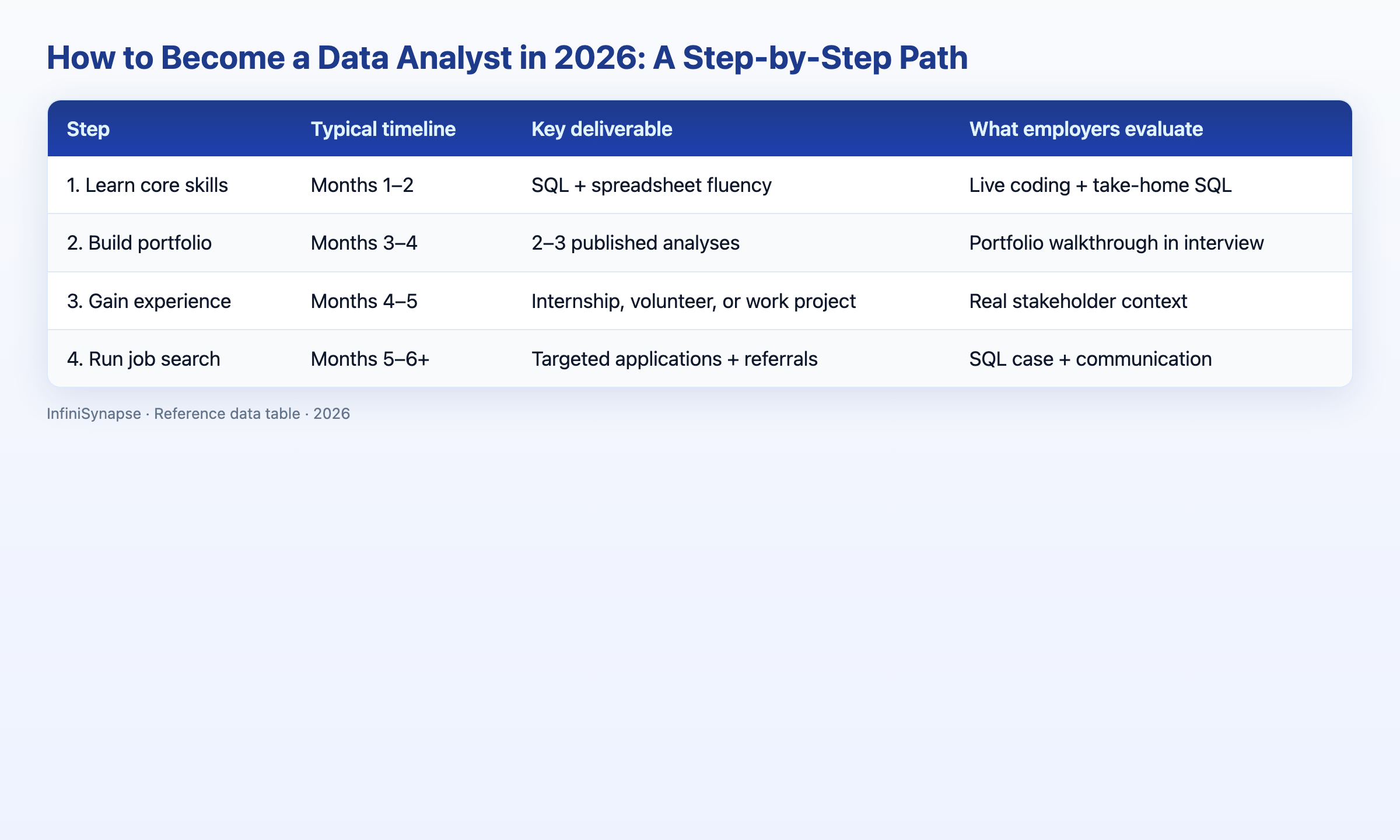
| Step | Typical timeline | Key deliverable | What employers evaluate |
|---|---|---|---|
| 1. Learn core skills | Months 1–2 | SQL + spreadsheet fluency | Live coding + take-home SQL |
| 2. Build portfolio | Months 3–4 | 2–3 published analyses | Portfolio walkthrough in interview |
| 3. Gain experience | Months 4–5 | Internship, volunteer, or work project | Real stakeholder context |
| 4. Run job search | Months 5–6+ | Targeted applications + referrals | SQL case + communication |
Practical example: a career changer following how to become a data analyst who masters SQL in eight weeks, publishes two portfolio analyses on public retail data, volunteers to build a dashboard for a local nonprofit, and earns a referral from a former colleague can land an entry-level offer at a growth-stage SaaS company without a statistics degree — even when the posting lists a bachelor's as preferred. Recruiters see the portfolio as proof of execution and the referral as a trust signal — the combination that Harvard Business Review's skills-based hiring research describes as increasingly decisive in hiring decisions.## Is This Career Right for You?
Before working through how to become a data analyst, check whether the role suits you. The work rewards curiosity about why things happen, patience with messy data, and genuine enjoyment of explaining findings to other people. If you like turning ambiguous questions into clear answers, and you do not mind the unglamorous cleaning that precedes most insight, the fit is likely a good one. These traits predict satisfaction in the role more reliably than any particular academic background does.
Understanding the path also means being honest about the parts people tend to dislike. A large share of the job is preparation and communication rather than glamorous modeling, and progress usually comes from patient iteration instead of sudden breakthroughs. Those who thrive treat the whole cycle, including the tedious cleaning and the stakeholder conversations, as part of the craft rather than an obstacle to it. If that description appeals to you, the path ahead is very achievable, because the role is more learnable than many technical careers and follows the disciplined process described in the Wikipedia data analysis overview.
Step 1: Learn the Core Skills
The first concrete step in how to become a data analyst is learning the foundational skills, and the order matters. SQL is the highest priority, because pulling data is where most analysis begins, so invest there first and deeply until querying feels natural. Spreadsheet fluency comes next, since a great deal of everyday work still happens in a grid, followed by a visualization tool such as Tableau or Power BI to communicate findings clearly to non-technical audiences.
In 2026, learning how to become a data analyst also means becoming comfortable directing AI-native analysis tools, which increasingly form part of the expected toolkit. Rather than replacing the fundamentals, these tools sit alongside them, and employers value candidates who can use them to work faster while still validating results carefully. We map the full skill set in data analyst skills. Focus on depth over breadth: mastering SQL, one spreadsheet program, one visualization tool, and one AI-native agent beats a shallow acquaintance with a dozen technologies, because interviews test depth and real work demands it. The Stanford HAI AI Index documents how central these tools have become across knowledge work.
Step 2: Build a Portfolio
The most important step in how to become a data analyst is building a portfolio, because employers hire on demonstrated ability far more than on credentials. A portfolio is a small set of real analyses, two or three is plenty, that each take a genuine question, work through messy data, and end in a clear recommendation. It is concrete, explorable proof that you can actually do the job rather than merely describe it.
To build one, practice on real, public datasets rather than polished tutorials. Pick topics you find genuinely interesting, frame a question, clean the data, analyze it, and present the result with a clear chart and a short written takeaway. Publish the work where employers can see it, and annotate your reasoning so a reviewer can follow your thinking step by step. This portfolio does double duty: it develops your skills through deliberate practice and demonstrates them to employers at the same time, which is precisely why it sits at the heart of how to become a data analyst successfully rather than as an afterthought.
Step 3: Gain Real Experience
The third step in how to become a data analyst is gaining experience that goes beyond personal projects. Internships, covered in data analyst internship, are a proven on-ramp for students entering the field. For career changers, look for analytical tasks within your current role, volunteer to analyze data for a nonprofit, or take on small freelance projects that produce real, referenceable work with genuine stakeholders attached to the outcome.
This experience matters in how to become a data analyst because it demonstrates you can apply skills in a messy real-world context, not just on tidy practice datasets. It also builds the stories you will tell in interviews: how you handled ambiguous requirements, reconciled conflicting data, and communicated an inconvenient finding to someone who did not want to hear it. Even modest real experience distinguishes you from candidates with only coursework, and it frequently reveals which industry or type of analysis you enjoy most, which in turn sharpens the targeted job search that follows in the next step.
Step 4: Run the Job Search
The final step in how to become a data analyst is a disciplined job search rather than a scattershot one. Instead of mass-applying, target roles whose domain matches your portfolio and interests, tailor each application to show the fit explicitly, and use referrals wherever you can, since they convert far better than cold applications. Prepare thoroughly for interviews, which typically test SQL, an analytical case, and communication in roughly equal measure.
Knowing how to become a data analyst includes knowing how to present yourself, so invest in a strong resume and structured interview preparation; we cover these in data analyst resume and data analyst interview questions, with the broader market in data analyst jobs. Treat the search itself as an analytical project: define your target, track what works, and iterate on your approach. The candidates who approach the hunt methodically, rather than spraying applications and hoping, complete the path of how to become a data analyst far faster and with far less frustration.
Do You Need a Degree?
A common question in how to become a data analyst is whether a degree is required, and the honest answer is that it helps but is not mandatory. Many analysts hold degrees in statistics, economics, computer science, or business, and such a background can smooth the early path, but a large and growing share enter the field through focused courses, bootcamps, or disciplined self-study backed by a strong portfolio of real work.
What employers consistently prioritize when evaluating candidates is demonstrated ability over credentials. The Bureau of Labor Statistics lists a bachelor's degree as typical entry-level education, yet job postings increasingly add language such as "or equivalent experience." A candidate without a relevant degree but with a compelling portfolio and real experience frequently beats a degree-holder who cannot show their work in action. The move toward augmented workflows, outlined in IBM's augmented analytics overview, frames how teams evaluate modern tooling alongside traditional credentials.
A Realistic Timeline and Learning Plan
People researching how to become a data analyst often want a timeline, so here is a realistic one for a dedicated learner. In the first two months, focus entirely on SQL and spreadsheets, because these fundamentals underpin everything that follows and rushing past them undermines the rest of the plan. A learner who treats how to become a data analyst as a marathon rather than a sprint builds durable skill instead of a fragile veneer that collapses under a real interview question.
In months three and four, add a visualization tool and begin your first portfolio project, since applying skills to a real question is how they consolidate. This is the stage where how to become a data analyst shifts from consuming tutorials to producing work, and that shift is the single most important one in the whole plan. Learners who linger in passive study, forever preparing to start, are the ones who stall; those who start building, however imperfectly, are the ones who progress.
By months five and six, most learners working through how to become a data analyst have two portfolio pieces, comfort with an AI-native tool, and enough confidence to begin the job search. The exact pace varies, and there is no shame in a slower timeline driven by work or family, but the sequence rarely changes: fundamentals first, then building, then experience, then the search. Anyone following this plan should measure progress by work produced rather than hours studied, because employers hire on the former.
Readiness Scorecard
Assess whether you are ready to apply (1 point each):
| Check | Pass? |
|---|---|
| I can write SQL queries confidently | |
| I am fluent with spreadsheets | |
| I can use a visualization tool | |
| I have built a portfolio of real analyses | |
| I have some real or project experience | |
| I can explain my work clearly | |
| I can direct an AI analysis tool | |
| I have a targeted list of roles |
6–8: ready to apply. 3–5: close the gaps first. Below 3: keep building skills and portfolio.
Failure Modes
Failure 1: Endless learning, no building. Studying forever without a portfolio is the most common way progress on how to become a data analyst stalls.
Failure 2: Tutorial hell. Reproducing tutorials without original analysis builds no demonstrable skill.
Failure 3: Mass applying. Untargeted applications rarely convert and waste your energy.
Failure 4: Ignoring communication. Technical skill without clear explanation loses interviews at the final stage.
Practical Next Steps
Verify against real job postings
Before committing time or budget, pull five recent job postings in your target market and list the SQL, visualization, and communication skills each repeats. Align your learning plan to those patterns rather than a generic syllabus.
Frequently Asked Questions
How do I become a data analyst with no experience?
To follow how to become a data analyst with no experience, learn the core skills and build a portfolio of two or three real analyses on public data. Then gain experience through internships, volunteer projects, or analytical tasks in your current role. Demonstrated ability, shown in a portfolio, matters more than prior job titles.
How long does it take to become a data analyst?
The timeline for how to become a data analyst varies with your starting point and time commitment, but a focused learner can build job-ready skills and a portfolio in six months to a year. It depends less on a fixed program and more on how quickly you can demonstrate real analytical ability to employers through visible work.
Do I need a degree to become a data analyst?
No, a degree is not required for how to become a data analyst, though it can help. Many analysts enter through courses, bootcamps, or self-study backed by a strong portfolio. Employers prioritize demonstrated ability over credentials, so a compelling portfolio and real experience can outweigh the absence of a specific degree.
What skills do I need to become a data analyst?
You need SQL, spreadsheet fluency, and a visualization tool to follow how to become a data analyst, plus increasingly the ability to direct AI-native analysis tools. Equally important are analytical thinking and communication — the human skills that turn technical output into decisions and that employers say they cannot easily teach on the job.
Is it hard to become a data analyst?
How to become a data analyst is very achievable and generally more learnable than many technical careers, though it takes dedicated effort. The main challenge is not any single skill but the discipline to build a portfolio and gain real experience rather than studying indefinitely without producing demonstrable work.
Conclusion
The path of how to become a data analyst in 2026 follows four clear steps: learn the core skills, build a portfolio, gain real experience, and run a targeted job search. A degree helps but is not required, and demonstrated ability, shown through visible work, matters most of all.
Part of the modern toolkit is fluency with AI-native tools, so learn them early; see what AI-native data analysis means and try the InfiniSynapse web app free on registration, no credit card required.