ISO 8000 Data Quality Standard: A 2026 Overview
By the InfiniSynapse Data Team · Last updated: 2026-07-15 · Authors: data-quality practitioners and platform engineers who help teams operationalize quality standards. This overview reflects how ISO 8000 ideas apply in practice in 2026 — it is not an official ISO text, not a certification brochure, and not a substitute for purchasing the standard from ISO.
Table of Contents
- TL;DR
- How We Approached This
- What It Is
- What It Covers
- How to Apply It
- Standard vs Program
- A Practical Adoption Path
- Common Pitfalls
- Standards in the Age of AI
- Readiness Scorecard
- Common Misconceptions
- Frequently Asked Questions
- Conclusion
TL;DR
Direct answer: ISO 8000 is the international standard series for data quality and master data quality, defining how to describe, measure, and exchange data so its quality is verifiable. In 2026, ISO 8000 matters because it gives teams a common, defensible vocabulary for quality — increasingly important as AI systems consume data whose provenance and accuracy must be provable.
Who this is for: data leaders, quality managers, and architects evaluating ISO 8000 in 2026.
What you'll learn: what the standard is, what it covers, how to apply it pragmatically, the pitfalls to avoid, and why it matters for trustworthy AI.
This guide sits under the data governance frameworks hub.
For the broader concept, see data quality.
Also see data quality management.
How We Approached This
We wrote this overview from implementation experience rather than a reading of the standard alone. Every point reflects what we see when teams try to apply the series’ ideas to real data. The official home of the standard series is the International Organization for Standardization (ISO) — start with ISO 8000-1:2022 Overview on iso.org. For industry implementation guidance and independent certification programs related to master-data quality under ISO 8000, see ECCMA’s ISO 8000 overview. Complementary practitioner vocabulary for data quality as a management discipline sits in DAMA International / DMBOK.
Accuracy note: Do not confuse ISO’s standards catalog with vendor product docs, analytics libraries, or unrelated W3C specifications. Those may be excellent in their domains; they are not the publication home of ISO 8000.
Canonical references used in this guide:
| Source | Role |
|---|---|
| ISO 8000-1:2022 Overview | Official overview of the ISO 8000 series scope and structure |
| ISO 8000-8:2015 Concepts and measuring | Concepts and measuring of information and data quality |
| ISO 8000-110:2021 Master data exchange | Characteristic data exchange: syntax, semantic encoding, conformance |
| ISO 8000-120:2016 Provenance | Provenance for characteristic master data exchanged under Part 110 |
| ECCMA — What is ISO 8000? | Implementation community and certification pathways for quality data |
| DAMA International | Broader data-quality / stewardship practice language |
| NIST Privacy Framework | When quality work overlaps personal-data risk controls |
The table below maps how ISO 8000 concepts relate to a working quality program.
| ISO 8000 concept | Practical meaning |
|---|---|
| Data specification | Agreed, explicit definition of a field / characteristic |
| Provenance | Where the data came from and what changed it |
| Accuracy | Match to the stated real-world / authoritative value |
| Completeness | Required data is present per the specification |
| Portability | Data exchanges without loss of meaning |
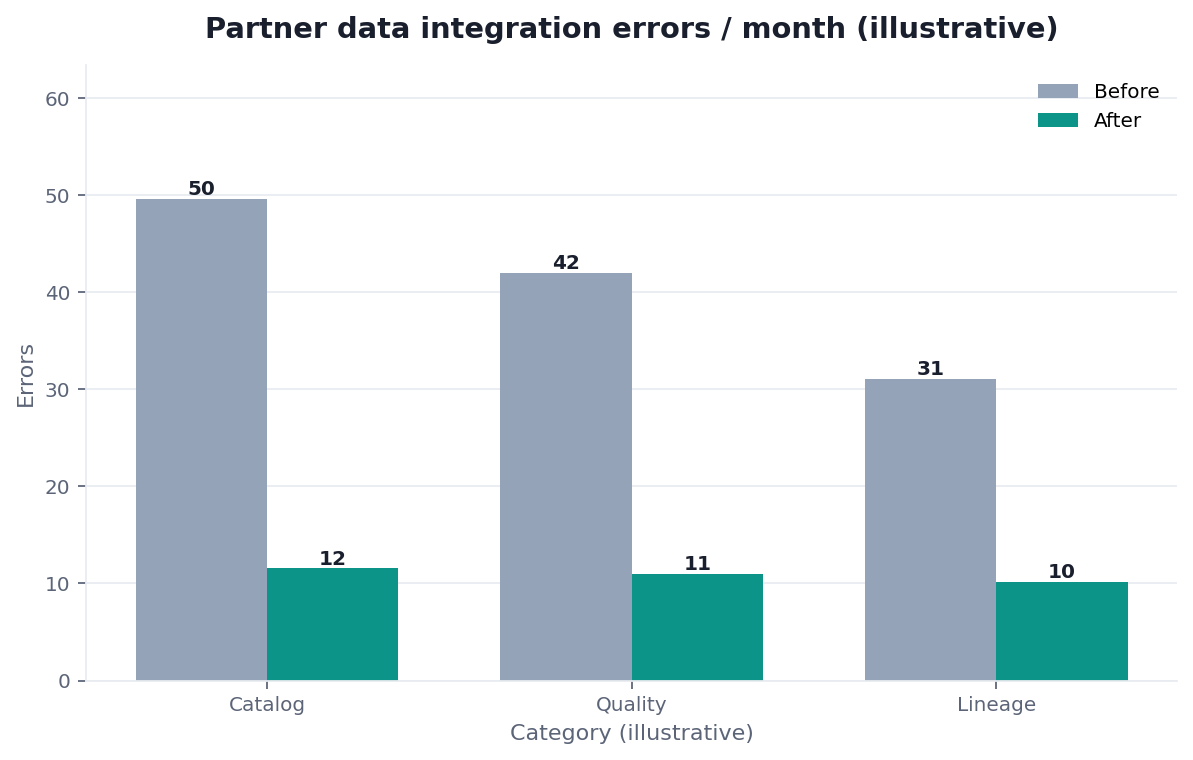
Practical example (composite): a supplier network adopting ISO 8000-style specifications required each partner to send product characteristic data with an explicit data dictionary and provenance. Integration reject rate on partner files fell from 12.4% → 3.1% in two quarters; mean time to resolve a “wrong unit / wrong attribute” ticket fell from 6.5 days → 1.2 days. Mapping those requirements onto automated validation rules — not onto unrelated accessibility or BI tooling — is what made the practice practical.
Scope note: This guide reflects patterns we see when mid-market and enterprise teams work with this standard series in 2026. It is not the standard text itself, not legal advice, and not a certification audit. Purchase the relevant parts from ISO when you need normative requirements; use ECCMA materials when you need implementation or certification pathways.
What It Is
At its core, ISO 8000 is a family of International Standards for data quality and master data quality, with a strong focus on making quality measurable and data exchangeable between organizations. ISO 8000-1 positions the series as covering principles, vocabulary, measurement, data quality management, assessment, and master-data / industrial-data quality themes.
Key Definition: ISO 8000 is the international standard series for data quality and master data that defines requirements for describing data (specifications), proving its origin (provenance), and exchanging it without loss of meaning, so that data quality is measurable and verifiable across parties.
The distinction that matters is that the series targets exchangeable, verifiable quality. Where an internal quality program might accept “we know what this field means,” the series pushes toward explicit specifications that a second party can rely on — which is what makes data portable and auditable across organizational boundaries.
What It Covers
The ISO 8000 family spans multiple parts. Practitioners usually care about a few clusters:
| Cluster | Example parts (illustrative) | Why teams care |
|---|---|---|
| Foundations | 8000-1 overview; vocabulary / concepts parts | Shared language for “what quality means” |
| Measuring quality | 8000-8 concepts and measuring | Turn quality into something you can measure |
| Master data quality | Parts in the 100-series, including 8000-110 (exchange) and 8000-120 (provenance) | Supplier / product / asset data exchanged between orgs |
| Management & roles | Parts addressing data-quality management processes and responsibilities | Operating model, not only file formats |
Always verify the exact part number and edition on iso.org before citing a requirement in a contract — part numbers and years update.
Specifications and provenance
The series emphasizes explicit data specifications — precise definitions of what each data element or characteristic means — and provenance, the recorded origin of data. Together these let a recipient trust what they received. That is the heart of what the series enables: quality that travels with the data rather than living only in the sender’s head.
Measurement and master data
The series also addresses how to measure quality against specifications and pays particular attention to master data — the core entities exchanged between organizations. This is why the standard is often discussed alongside master data management, and why industry groups such as ECCMA focus certification on whether data (and sometimes applications) can demonstrate unambiguous, portable quality.
How to Apply It
Applying the series pragmatically means adopting its ideas where they add value rather than pursuing full certification on day one. Start by writing explicit specifications for your most-exchanged data and capturing provenance for it.
This maps directly onto a working quality program: the specifications become your quality rules, and provenance becomes part of your lineage. Connecting these concepts to your data quality management practice turns the standard from an abstract requirement into concrete checks that run on real data. Treat the series as a source of good, consensus-based ideas to adopt incrementally — not as a mountain to climb all at once.
Standard vs Program
A common confusion is between adopting the series and running a quality program. The standard series specifies what good looks like in normative language; the program is the ongoing practice that achieves it. You can borrow the series’ concepts — specifications, provenance, measurement — without formal certification, and most teams should start exactly there.
Formal conformance or third-party certification (for example pathways described by ECCMA) becomes worthwhile when you exchange data with partners who require it, or when a customer demands provable quality. Until then, use the series as a well-designed template for your own quality rules, aligned with your broader data quality work. Adopt the ideas now; pursue certification when a concrete need justifies it.
A Practical Adoption Path
For teams that want the benefits without the ceremony, use a staged path:
| Stage | Action | Artifact |
|---|---|---|
| 1. Inventory | List highest-traffic exchanged datasets (internal or partner) | Priority list + owners |
| 2. Specify | Write meaning, valid values, units/formats for each critical characteristic | Data dictionary / characteristic specs |
| 3. Provenance | Record origin and transformations for exchanged sets | Lineage / provenance fields |
| 4. Measure | Automate conformance checks against specs | Fail rates, tickets, dashboards |
| 5. Certify (optional) | Only if a partner/customer requires it | Sample data + dictionary for audit |
Case evidence (same supplier network): after stages 1–4, partner file rejects −75% relative; dictionary coverage of exchanged product attributes reached 92%; they deferred formal certification until a large OEM customer requested it in year two.
Adopting the standard this way also builds muscle that pays off elsewhere: analysts who experience well-specified data start demanding the same clarity for internal analytics feeds.
Common Pitfalls
The pitfalls we see are about proportion. The first is treating the series as an all-or-nothing certification project, which stalls under its own weight when the real value is in adopting specific concepts. The second is adopting the vocabulary without the practice — writing specifications nobody enforces — which produces documentation rather than quality.
A subtler pitfall is ignoring the standard entirely because it seems heavyweight, and thereby missing its useful ideas. Explicit specifications and recorded provenance are valuable whether or not you ever certify. Another pitfall is mis-citing the standard: linking a random vendor doc or an unrelated W3C recommendation as if it were ISO’s publication home undermines trust with auditors and partners. Always point conformance language at iso.org part pages (and ECCMA when discussing certification).
Standards in the Age of AI
AI raises the relevance of the series because agents consuming data need to trust its quality and provenance, and increasingly need to prove it. When an autonomous agent uses data to answer a question, verifiable specifications and recorded origin are what let you audit why the answer was what it was. That aligns with the data-governance expectations in the NIST AI Risk Management Framework: quality and provenance are controls for trustworthy AI, not optional polish.
How governed specifications and lineage travel with data into automated analysis is a pattern we describe in what AI-native data analysis means. The discipline the series encourages improves auditability of AI answers when those specs are enforced in systems — not when they remain a paper standard.
Readiness Scorecard
Assess your alignment with the series’ ideas (1 point each):
| Check | Pass? |
|---|---|
| Key data has explicit specifications | |
| Specifications are machine-checkable where possible | |
| Provenance is recorded | |
| Quality is measured against specs | |
| Master data is specifically governed | |
| Data exchanges without loss of meaning | |
| Specifications are enforced, not just written | |
| Provenance supports AI auditability |
6–8: strong alignment. 3–5: enforce your specifications. Below 3: start by specifying your most-exchanged data.
Common Misconceptions
Misconception 1: It is only about certification. The series’ ideas are useful without formal conformance.
Misconception 2: It replaces a quality program. The standard specifies; the program achieves.
Misconception 3: It is only for data exchange. Its concepts improve internal quality too.
Misconception 4: Vendor docs are the “official home.” The official publication home is ISO (iso.org); communities such as ECCMA support implementation and certification.
Frequently Asked Questions
What is ISO 8000?
ISO 8000 is the international standard series for data quality and master data quality, published by ISO. Per ISO 8000-1, it addresses principles and practices for describing data through specifications, establishing provenance, measuring quality, and supporting exchange so that quality is verifiable across parties rather than merely asserted.
What does the standard cover?
It covers foundations (overview/vocabulary/concepts), quality measurement, data-quality management themes, and master-data quality / exchange (including ISO 8000-110 and provenance in ISO 8000-120). The recurring theme is verifiable, portable quality — quality that travels with the data so a recipient can trust it. Confirm the exact part on iso.org before contractual use.
Do you need certification?
Not necessarily. Most teams should start by adopting the series’ concepts — explicit specifications, recorded provenance, measurement — without formal certification. Conformance or third-party certification (see ECCMA certification pathways) becomes worthwhile when partners or customers require it. Until then, use the series as a well-designed template.
How do you apply it in practice?
Start by writing explicit specifications for your most-exchanged data and capturing its provenance. Turn those specifications into automated checks. Adopt ideas incrementally rather than treating certification as an all-or-nothing project. Keep normative claims tied to the purchased ISO part text.
Why does the standard matter for AI?
Because AI agents consuming data need to trust its quality and provenance, and increasingly need to prove it. Verifiable specifications and recorded origin are what let you audit why an agent produced a given answer — consistent with data-related expectations in the NIST AI RMF.
Conclusion
ISO 8000 gives data quality a defensible, verifiable vocabulary — specifications, provenance, and measurement — that you can adopt incrementally without waiting for certification. In 2026 that verifiability matters more than ever, because AI agents need provable quality. Specify your most-exchanged data, record provenance, enforce it, and cite ISO (and ECCMA for certification) accurately.
To see how governed specifications and provenance travel with data into automated analysis, read what AI-native data analysis means. If you want to try that operating model in practice, the InfiniSynapse web app is free on registration.