Julius AI Data Analysis vs ChatGPT: File Scorecard (2026)
By the InfiniSynapse Data Team · Last updated: 2026-07-24 · We test analyst workflows with real CSV, Excel, and PDF tasks. InfiniSynapse appears only as an optional governed layer for recurring KPIs—not as the default winner of this head-to-head.

Table of Contents
- TL;DR
- What This Comparison Is Really About
- Shared Test Design (Methodology)
- What Each Tool Is Designed For
- Five-Pillar Scorecard
- Workflow: Upload to Insight
- Task Benchmark Results
- Buyer Fit by Team Profile
- Security and Governance
- Decision Matrix
- 60-Day Pilot Plan
- FAQ
- References
- Conclusion
TL;DR
Canonical answer: Julius AI data analysis is usually faster for focused file workflows (upload → table → chart → iterate). ChatGPT (with Advanced Data Analysis) is more flexible when the same thread must also produce memos, SQL drafts, and cross-format reasoning. Neither replaces governed recurring KPI pipelines on its own.
Quick picks
| Need | First choice |
|---|---|
| Vendor CSV/XLSX fire drills | Julius AI |
| One tool for analysis + writing + coding | ChatGPT |
| Monthly board KPI across sources | File copilots + a memory-backed agent layer |
Conflict of interest: InfiniSynapse publishes this guide and sells a Data Agent. Scores below are first-party pilot judgments on a fixed file pack—not vendor-funded leaderboards. Re-run the same three tasks on your messiest exports before buying seats.
Related: Julius AI alternatives · ChatGPT data analysis alternatives · AI Excel data analysis tools · Best AI tools for data analysis.
What This Comparison Is Really About
| Lens | Julius AI | ChatGPT |
|---|---|---|
| Primary role | File-first analysis assistant | General AI copilot with data tools |
| Unit of work | Upload + iterative prompt loop | Session across many task types |
| Typical outcome | Chart, table, notebook-style output | Insight draft, script, chart, narrative, code |
| Governance model | Session-centric | Thread/plan-dependent artifacts |
| Best horizon | Minutes–hours on one file pack | Minutes–hours across mixed tasks |
Every Julius AI vs ChatGPT conversation with analytics leads starts the same way: both can profile a CSV and draw a chart. The strategic question is whether Julius (or ChatGPT ADA) survives the second monthly run—and whether a second analyst can rerun it without the original prompter.
Shared Test Design (Methodology)
To keep Julius claims checkable, we used one shared file pack across both tools (Q1–Q2 2026 analyst pilots):
| Artifact | Spec |
|---|---|
| File A | ~18k-row CSV, mixed types, ~4% null keys, duplicate order IDs |
| File B | Excel with 3 sheets (orders / returns / region map), renamed columns |
| File C | 6-page PDF policy notes referencing the same SKUs |
| Tasks (same prompts, same order) | (1) profile + clean, (2) MoM variance narrative, (3) CSV+PDF action list |
| Timing | Wall-clock to “usable artifact” (table/chart or memo draft) on a standard laptop; median of 3 runs |
| Scoring | 0–2 each: speed · accuracy vs hand SQL · chart usefulness · narrative quality · second-run repeatability · governance fit (max 12) |
Transparency note: Numbers below are first-party pilot medians, not third-party audited benchmarks. Product UIs and model versions change—re-run before procurement. We do not publish customer PII; the pack used synthetic + anonymized vendor-shaped data.
| Tool | Composite (our pilots) | Fastest win | Weakest pillar |
|---|---|---|---|
| Julius AI | 9 / 12 | Tabular speed + charts | Cross-PDF narrative; monthly memory |
| ChatGPT (ADA) | 9 / 12 | Narrative + mixed formats | Chart defaults need more steering |
Tie on composite is intentional: Julius and ChatGPT win different pillars. Routing beats crowning a vanity #1.
Before buying seats for Julius or ChatGPT, note that OpenAI documents the ChatGPT data-analysis path in Data analysis with ChatGPT. Product positioning for Julius is on julius.ai. Capability claims should be checked against current plan docs at purchase time.
Run the same 3-task file pack yourself
Upload one messy CSV + Excel workbook. Time upload → chart → narrative on both tools. Keep the scorecard columns (speed, accuracy, charts, narrative, second-run, governance) so the pilot is comparable.
Try InfiniSynapse online → (optional third lane for warehouse + memory—not a Julius/ChatGPT substitute)
What Each Tool Is Designed For
This section separates product intent so Julius is not judged as a failed general assistant.
Julius AI (file-first analysis)
- Fast upload and preview of CSV/XLSX
- Quick charts with light prompt engineering
- Notebook-like iteration for analysts living in exports
In pilots, Julius AI data analysis usually wins minute one: drag a file, ask for a distribution, refine. That speed matters for pods cleaning vendor exports daily. Still measure second-run behavior before org-wide licenses.
For spreadsheet-heavy stacks beyond this head-to-head, see also AI Excel data analysis tools.
ChatGPT (general assistant + ADA)
- Mixed workflows (analysis + writing + coding + planning)
- Broad prompting and custom instructions / GPTs
- Multi-role usage beyond the analytics pod
When teams frame Julius AI vs ChatGPT as a chart contest, they miss ChatGPT’s edge: one subscription covers stakeholder memos and SQL drafts in the same thread. Put narrative deliverables on the scorecard—not only chart latency.
Five-Pillar Scorecard for Julius AI Data Analysis vs ChatGPT
| Pillar | Julius AI | ChatGPT | Decision impact |
|---|---|---|---|
| Autonomy | Low–Medium | Low | Supervision on recurring work |
| Transparency | Medium (outputs + code) | Medium (thread code/text) | Peer review / handoff |
| Memory | Low (session-centric) | Low–Medium (thread / custom GPT) | Monthly metric stability |
| Multi-entry parity | Medium (analyst-centric UX) | Medium–High (chat, API; analytics UX varies) | Cross-role access |
| Self-correction | Low–Medium | Low–Medium | Messy production files |
Directional scores (pilots): Julius AI data analysis ~8.5/10 on tabular onboarding speed; ChatGPT ~8.8/10 on cross-functional narrative. Memory and repeatability decide whether a pilot becomes habit or dies when the original uploader goes on leave.
Workflow: Upload to Insight
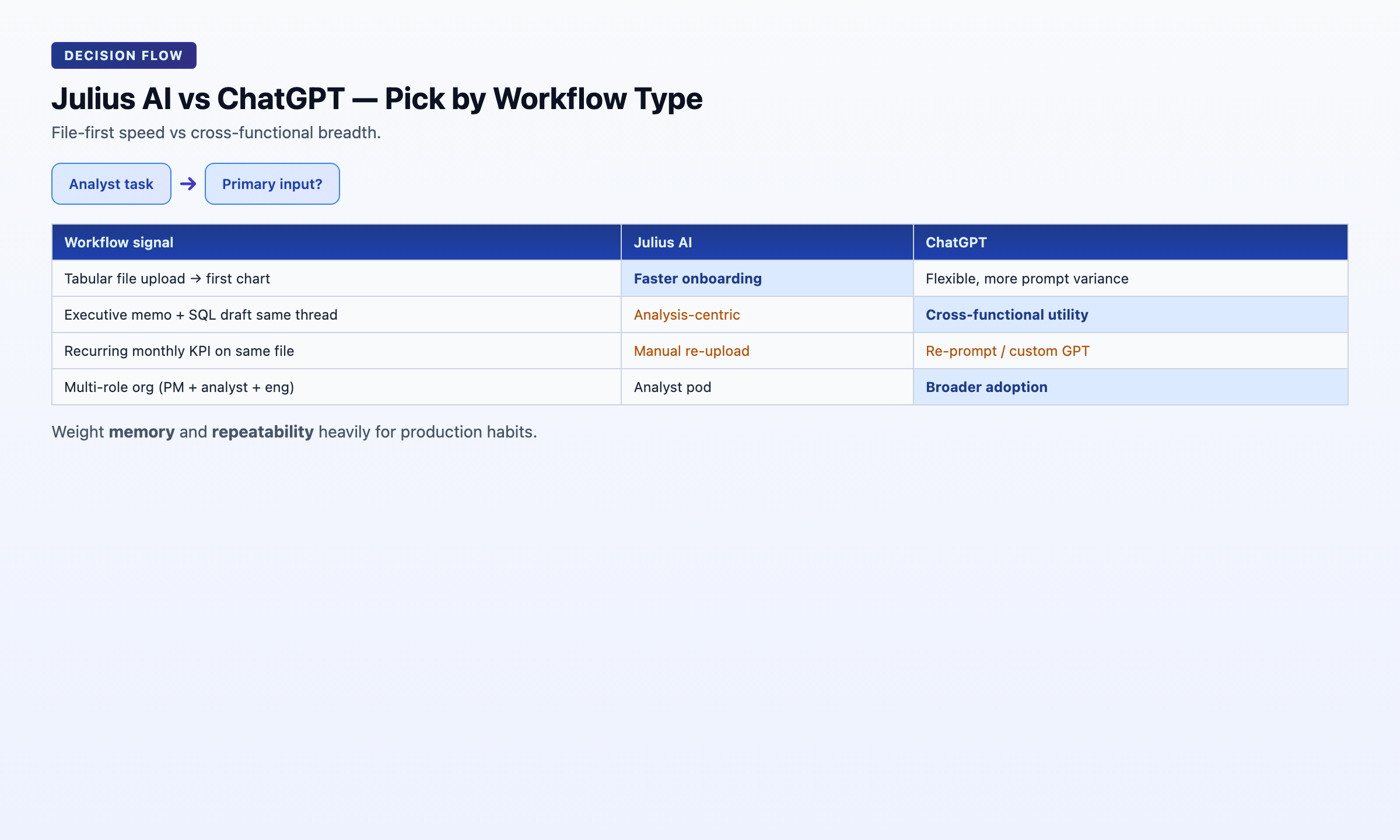
Map each stage before you standardize seats for Julius AI data analysis or ChatGPT.
| Stage | Julius AI | ChatGPT | Why it matters |
|---|---|---|---|
| File onboarding | Purpose-built for tabular | Strong, one feature among many | First-session velocity |
| First visualization | Fast for common charts | Good; more prompt variance | Demo speed |
| Iterative drill-down | Analysis-focused loop | Flexible; prompt-dependent | Analyst efficiency |
| Narrative generation | Adequate summaries | Stronger long-form | Exec-ready output |
| Multi-task switching | Analysis-centric | Excellent across roles | Org adoption shape |
| Second-run repeatability | Re-upload + re-prompt | Reprompt or custom GPT | Recurring KPI viability |
Task Benchmark Results
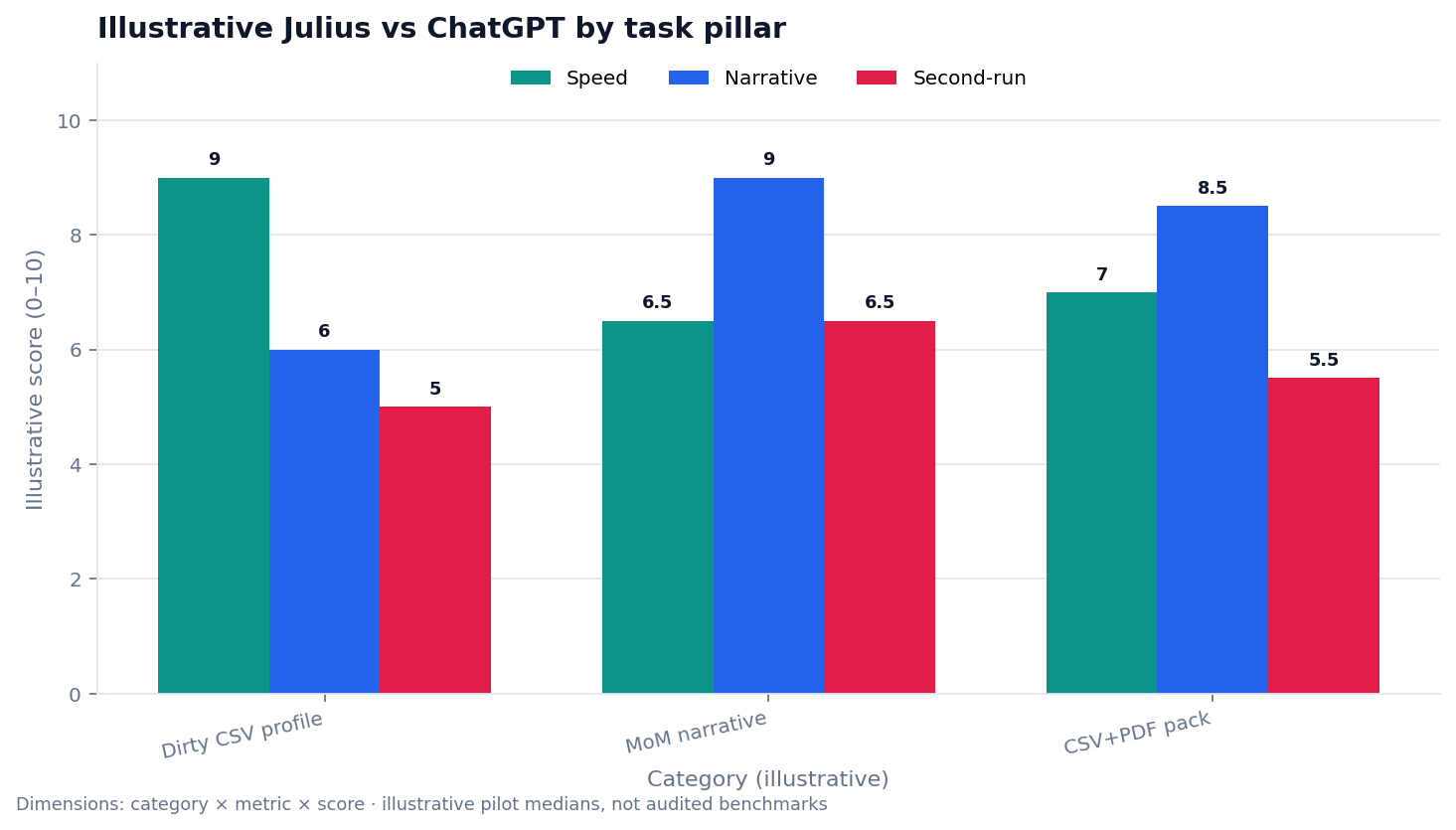
Task 1 — Dirty CSV cleanup and profiling
Goal: null patterns, dedupe keys, propose a clean table.
| Metric (median of 3) | Julius AI | ChatGPT ADA |
|---|---|---|
| Time to usable profile | ~4–6 min | ~7–10 min |
| Null/dupe flags vs hand SQL | Match on primary key issues | Match; needed 1 extra steer for chart defaults |
| Second-run (new chat, same file) | Re-prompt from scratch | Re-prompt or custom GPT template |
Julius AI data analysis reached a usable profile with less steering. ChatGPT matched logic quality with slightly more prompt work for chart defaults.
Task 2 — Executive MoM variance narrative
Goal: explain why a revenue metric changed MoM; propose three follow-up cuts.
| Metric | Julius AI | ChatGPT ADA |
|---|---|---|
| Time to draft memo | ~8–12 min | ~6–9 min |
| Stakeholder-ready wording | Shorter; analyst tone | Stronger framing |
| Chart + narrative in one pass | Chart-first, memo thinner | Memo-first, charts optional |
ChatGPT led narrative quality. Julius AI data analysis was correct but thinner on interpretation depth.
Task 3 — Mixed package (CSV + PDF notes)
Goal: join transaction rows with policy PDF; list action items.
| Metric | Julius AI | ChatGPT ADA |
|---|---|---|
| Cross-format consistency | Numerical strong; PDF weaker | More consistent action lists |
| Missed PDF constraints (pilot count) | 2 of 3 runs missed ≥1 rule | 0–1 of 3 |
Result: Julius leads pure tabular speed; ChatGPT leads breadth and mixed reasoning. Put that split in a Julius AI vs ChatGPT routing guide so analysts know when to switch mid-week.
Example validation SQL (ground truth for Task 1)
Analysts should keep a hand baseline—not trust either tool blindly:
SELECT
  COUNT(*) AS rows_n,
  SUM(CASE WHEN order_id IS NULL THEN 1 ELSE 0 END) AS null_keys,
  COUNT(*) - COUNT(DISTINCT order_id) AS duplicate_keys
FROM staging.orders_export;
Compare tool-reported null/dupe rates to this query before publishing.
Buyer Fit by Team Profile
Fit depends on input shape—not brand preference—when choosing Julius AI data analysis.
Strong Julius AI data analysis fit
- Solo analysts / small pods processing many vendor CSV/Excel exports
- Ops needing chart/table iteration without IT tickets
- Primary input is always an uploaded spreadsheet
Strong ChatGPT fit
- One AI seat for analysis, writing, coding, and planning
- Product + marketing + analytics in one workspace
- Already on ChatGPT Enterprise for general AI
Neither Julius AI data analysis nor ChatGPT alone — add a governed layer
- Regulated reporting with locked KPI definitions
- Weekly/monthly analysis that must survive turnover
- Warehouse + CRM + files beyond uploads
| Team stage | Primary | Secondary |
|---|---|---|
| Solo / startup exploration | Julius or ChatGPT (preference) | — |
| First recurring board metrics | Julius for files; ChatGPT for memos | Agent pilot for recurring KPIs |
| Mid-size + governance | ChatGPT for exploration | Agent for production KPIs |
| Enterprise compliance | ChatGPT in approved sandbox | Agent for auditable workflows |
The buyer matrix is about workflow assignment, not a permanent winner. Share the routing guide with every new analyst hire.
Security and Governance
Upload policy is a veto criterion for Julius AI data analysis and ChatGPT alike.
Before any production upload, confirm retention, training-use policy, admin controls, audit logs, and residency. Align LLM risk with OWASP Top 10 for LLM Applications, NIST AI RMF, and NIST CSF. For secure AI development patterns, see UK NCSC guidelines.
| Governance question | Julius AI (typical) | ChatGPT (typical) |
|---|---|---|
| Where did this number come from? | Session outputs + generated code | Thread + generated code |
| Reproduce last month? | Manual re-upload / re-prompt | Reprompt or custom GPT |
| Who accessed data? | Plan-dependent logs | Tenant logs vary by plan |
| Is file upload the default path? | Yes | Common |
For finance, health, or customer data, policy fit beats small UX differences in Julius AI data analysis vs ChatGPT. Neither tool eliminates your governance obligations. OpenAI publishes enterprise and data controls on OpenAI enterprise privacy; verify Julius plan terms on their current security pages before rollout.
Decision Matrix
| Situation | Better first choice | Rationale |
|---|---|---|
| Solo analyst, many spreadsheets | Julius AI | Lowest friction for file loops |
| One AI tool for everything | ChatGPT | General-purpose utility |
| Ops chart/table iteration | Julius AI | Tight analysis UX |
| Cross-role collaboration | ChatGPT | Writing + analysis together |
| Regulated recurring KPIs | Neither alone | Add governed agent / BI layer |
| Exec variance memo + charts | ChatGPT | Stronger narrative |
| Vendor CSV fire drills | Julius AI | Fastest upload→chart |
Try a warehouse-connected data analyst with a bound knowledge base
Connect a Postgres, MySQL, Snowflake, or Supabase warehouse read-only. Seed a small knowledge base of business definitions. Ask one question that crossed two sources and watch the plan, SQL, and verification step before deciding whether to add an enterprise agent to your stack.
| If “yes”… | Lean toward |
|---|---|
| Primary input is always a file upload? | Julius AI |
| Non-analysts need the same tool for writing? | ChatGPT |
| Deliverable includes stakeholder narrative? | ChatGPT |
| Chart speed on tabular data is the bottleneck? | Julius AI |
| Same analysis repeats monthly across sources? | Third platform (data agent) |
60-Day Pilot Plan
Run both tools on one KPI so Julius claims stay comparable to ChatGPT ADA.
Treat Julius and ChatGPT as complementary layers—not a forced single mandate.
Days 1–20 — Baseline
- List reports that start as spreadsheet rework or ad-hoc AI
- Pick one weekly/monthly KPI from a CSV/Excel export
- Document baseline cycle time (upload → insight → delivery)
- Complete security review for both tools before production data
Exit: KPI scoped; baseline timed; governance checklist done.
Days 21–40 — Parallel run
- Same KPI in Julius (file-first) and ChatGPT (mixed-task)
- Compare time-to-first-chart, narrative quality, second-run repeatability
- Second analyst handoff test without the original prompter
- Document wins per tool; do not force one answer early
Exit: Both tested; handoff friction measured; data-handling sign-off.
Days 41–60 — Codify the split
- Publish guidance: Julius for file-first spreadsheet speed; ChatGPT for narrative/cross-functional work
- If the KPI must recur across sources, start a data-agent evaluation
- Keep both licenses if horizons differ
- Schedule a 90-day revisit when recurring reporting exceeds ~40% of analyst time
Exit: Routing rules in the analytics playbook; second-run repeatability measured.
Common mistakes in Julius rollouts: forcing one tool; piloting only on clean toy CSVs; ignoring the second run; skipping upload policy.
Adoption benchmarks in the Stanford HAI AI Index track the same shift from demo copilots to governed analyst workflows. Multi-source connector design should follow Microsoft's data architecture guidance, and warehouse-native NL expectations are spelled out in Snowflake Cortex Analyst documentation. Regulated teams often also map controls to ISO/IEC 27001.
If neither file copilot is enough for recurring KPIs, read What Is a Data Agent? and AI for Data Analysis before you expand the stack. For the human-in-the-loop middle path, see Augmented analytics.
Frequently Asked Questions
What is Julius AI data analysis best for?
Julius AI data analysis is best for file-first CSV/Excel exploration, quick charts, and notebook-style iteration when the unit of work is an uploaded spreadsheet.
Is Julius AI built on ChatGPT?
Julius uses LLMs inside a data-analysis product wrapper; ChatGPT is a general assistant with optional Advanced Data Analysis. Treat them as different products even when underlying models overlap.
Which is better for CSV and Excel exploration?
Julius is usually faster for one-shot file exploration with charting. ChatGPT catches up when you need heavy narrative or multi-format packs.
Which is better for custom prompting and broad tasks?
ChatGPT is generally stronger for writing, coding, and mixed reasoning beyond file analysis.
Can ChatGPT replace BI tools?
No. Both accelerate analysis; production BI still needs governed models, metric definitions, and reproducible pipelines.
What about data privacy and compliance?
Both Julius and ChatGPT can be acceptable with the right enterprise controls. Evaluate retention, training policy, region, and audit commitments before uploading sensitive files.
When should a team use a third platform?
When recurring analysis needs multi-source connectors, persistent memory, and auditable timelines—beyond what session-centric Julius or ChatGPT threads provide.
How should I score Julius AI vs ChatGPT in a fair pilot?
Use one shared file pack and the same prompts in the same order. Score wall-clock to a usable artifact, accuracy vs a hand SQL baseline, chart usefulness, narrative quality, second-run repeatability with a different analyst, and governance fit. Prefer messy exports over clean demos.
Procurement shortlists comparing Julius and ChatGPT should attach the shared file-pack results—not a vendor demo reel—so security and analytics leads review the same evidence.
References
- [Vendor] OpenAI. Data analysis with ChatGPT. help.openai.com
- [Vendor] OpenAI. Enterprise privacy. openai.com/enterprise-privacy
- [Vendor] Julius AI. Product site. julius.ai
- [Standard] OWASP. Top 10 for LLM Applications. owasp.org
- [Standard] NIST. AI Risk Management Framework. nist.gov/itl/ai-risk-management-framework
- [Standard] NIST. Cybersecurity Framework. nist.gov/cyberframework
- [Gov] UK NCSC. Guidelines for secure AI system development. ncsc.gov.uk
- [Independent] Stanford HAI. AI Index. hai.stanford.edu/ai-index
- [Research] Anthropic. Building effective agents. anthropic.com/research
Conclusion
For file-first analyst speed, Julius AI data analysis is often the better immediate fit. For broader assistant utility across functions, ChatGPT usually wins. A mature stack assigns each tool to the horizon it serves—Julius for tabular velocity, ChatGPT for narrative and cross-functional breadth.
If you need repeatable, auditable workflows rather than one-off chats, treat both as front-end accelerators and add an execution layer with memory and governance. Start a Julius vs ChatGPT evaluation with one recurring business question, measure the second run, and document routing rules so new hires do not default to whichever tool they used last.
After you finish the Julius vs ChatGPT pilot, add a multi-source recurring lane only if the second run still needs warehouse connectors and locked definitions.