Python Data Engineering News (2026)
By the InfiniSynapse Data Team · Last updated: 2026-07-15 · Authors: Python data engineers who ship production pipelines and review ecosystem changes weekly. This roundup is a filtered reading of python data engineering news in 2026 — practice-changing shifts with a stated method, not a link dump or a tool endorsement list.
Table of Contents
- TL;DR
- How We Track It
- What Counts as News
- The Big Shifts
- Worked Example: Applying the Filter
- Performance and Tooling
- Case Study: News Churn vs Measured Adoption
- What to Ignore
- How to Stay Current
- Common Mistakes When Following News
- News in the Age of AI
- Signal Scorecard
- Common Misconceptions
- Frequently Asked Questions
- Conclusion
TL;DR
Direct answer: python data engineering news in 2026 is dominated by three themes: faster libraries (Polars and Arrow-backed tooling displacing pure pandas at scale), AI-assisted code generation changing the engineer's workflow, and the steady move toward ELT and federation that reduces how much pipeline code is written at all. Most python data engineering news is noise; these structural shifts are the signal worth acting on.
Who this is for: engineers filtering python data engineering news in 2026.
What you'll learn: a transparent selection method, the big shifts with primary sources, a quantified case comparison, and how to stay current without rewrite churn.
This guide sits under the data engineering hub.
For the fundamentals, see Python for data engineering.
Also see data engineering news.
How We Track It
We track python data engineering news by filtering for what changes practice. Announcements that do not change architecture, tests, or on-call behavior are filed as information — not as adoption mandates. That filter is why this page is shorter than a weekly newsletter and denser than a launch calendar.
Selection methodology (reproducible):
| Step | Rule | Evidence we require |
|---|---|---|
| 1. Scope | Python-first data work (ingest, transform, orchestrate, serve) | Touches pandas/Polars/Arrow/Airflow/dbt-Python paths |
| 2. Durability | Would still matter in 12 months | Appears in project docs + multiple production teams |
| 3. Decision test | Changes what a competent engineer should do differently | Passes the scorecard (≥6) below |
| 4. Measure-first | No rewrite without a baseline | Latency, memory, failure rate, or eng-hours measured |
| 5. Primary sources | Prefer project docs over blogs | Polars / Arrow / pandas / Airflow / dbt docs |
Primary sources we prioritize when scoring python data engineering news:
| Source | Why it is high-signal |
|---|---|
| Polars docs | Fast DataFrame engine; lazy/streaming APIs |
| Apache Arrow docs | Columnar in-memory standard behind modern Python tools |
| pandas docs | Still the interoperability baseline |
| DuckDB Python | In-process SQL over files/Arrow |
| Apache Airflow docs | Python orchestration defaults |
| dbt docs | ELT / transformation-as-code (incl. Python models where used) |
Watch categories for python data engineering news:
| Category | Why it matters | Example “act” signal |
|---|---|---|
| DataFrame engines | Changes CPU/memory ceilings for batch reshape | Polars/DuckDB beat pandas on measured jobs |
| Interop (Arrow) | Changes how tools share memory without copy storms | Arrow IPC / zero-copy between engines |
| Orchestration | Changes how Python jobs are scheduled and owned | Airflow/Dagster patterns, not one-off cron |
| Transform location | Changes how much Python glue is justified | dbt/SQL/Spark absorb heavy joins |
| AI codegen | Changes review load and test requirements | Generated DAGs still need contracts + tests |
Scope note: Ratings and case numbers below are composite observations from mid-market/enterprise reviews in 2025–2026, not a sponsored benchmark. Re-run timings on your data shapes before migrating. This is practitioner synthesis, not a census of every release.
What Counts as News
Not everything labeled python data engineering news matters. A new micro-library rarely changes practice; a shift in the default data-manipulation engine or a new interoperability standard does.
Key Definition: python data engineering news worth acting on is any development that durably changes how engineers should write, run, or operate Python-based pipelines and data jobs — as opposed to incremental library releases that do not alter day-to-day practice.
Decision test: if adopting the item would not change your import graph, your CI test strategy, or your p95 job duration target, it is not actionable python data engineering news this quarter.
The Big Shifts
1) Arrow-backed engines (Polars, DuckDB, Arrow)
The most consequential thread in python data engineering news is the mainstreaming of Arrow-backed tooling. Apache Arrow defines the columnar memory layout; Polars and DuckDB’s Python client sit on that foundation so larger frames stay in-process longer before you need a cluster. pandas remains the lingua franca for interchange — the shift is “pandas everywhere for heavy transforms,” not “delete pandas.”
Comparative snapshot (composite, single-machine ETL reshape ~8–12GB):
| Engine path | Wall time (index) | Peak RSS (index) | When we keep it |
|---|---|---|---|
| pandas-only | 100 | 100 | Small frames, rich ecosystem APIs |
| Polars lazy | 28–40 | 45–60 | Large tabular transforms, clear expressions |
| DuckDB SQL in Python | 25–45 | 40–55 | SQL-shaped joins over Parquet/Arrow |
Indexes are relative to the pandas baseline on the same host and dataset class — validate before migration. Treat these as decision aids, not as guarantees for every schema.
2) AI-assisted engineering (review > type)
AI coding tools change the workflow: more time reviewing generated Airflow/dbt/Polars code, less time typing boilerplate. The durable skill highlighted across python data engineering news is judgment — correctness, idempotency, tests — not raw keystrokes. Generated Python that looks clean can still leak non-idempotent writes or silent type coercion.
3) ELT + less Python glue
dbt-style ELT and warehouse/Spark compute continue to absorb heavy transforms. Python remains the glue for orchestration (Airflow), quality checks, and custom connectors — but fewer “move everything through pandas” pipelines are justified when SQL/Spark already own the grain. That is a recurring architecture signal, not a call to abandon Python.
Worked Example: Applying the Filter
Headline: “New DataFrame library claims 50× pandas.”
| Scorecard question | Result | Notes |
|---|---|---|
| Changes what we should do? | Maybe | Only if we have pandas CPU/memory pain |
| Solves a problem we have? | Measure | Capture current job p95 + RSS first |
| Durable shift? | Partial | Prefer Arrow-ecosystem tools with docs + adoption |
| Cloud / platform default? | No | Not a platform default |
| Can test on non-critical work? | Yes | Shadow job for 2 weeks |
| Benefit measurable? | Required | Need ≥30% duration or cost win |
| Risks stable pipelines? | High if rewrite | Prefer greenfield first |
| Signal vs novelty? | Novelty until measured |
Verdict: watch + shadow test; do not rewrite the billing pipeline because of python data engineering news alone. This is the filter we want readers to copy — especially when the headline is exciting and the baseline is missing.
Performance and Tooling
A recurring theme in python data engineering news is performance. The practical takeaway: the ceiling for single-node Python work keeps rising via Arrow, Polars, and DuckDB — but fundamentals of data engineering do not change: testable, observable, idempotent jobs.
Adoption rule we use: change libraries only when a measured problem exists (duration, OOM rate, or eng-hours). New tooling without a baseline is how rewrite churn starts. Packaging and typing news (uv, stricter mypy/pyright gates, pinned wheels in CI) matters when it shortens restore time after an incident — not when it is novelty for its own sake.
Secondary signals we still track under python data engineering news without treating them as rewrite triggers: packaging/lockfile hygiene, typed DataFrame contracts at service boundaries, and clearer separation between “exploration notebooks” and “production modules.”
Case Study: News Churn vs Measured Adoption
Composite comparison — two Python-heavy analytics teams, ~8 engineers each, 12 months:
| Metric | Team A — chased python data engineering news weekly | Team B — filter + measure-first |
|---|---|---|
| Production pipeline rewrites | 9 | 2 |
| Sev-2 data incidents from migrations | 4 | 0 |
| Median daily job duration (key mart) | +18% worse (churn) | −34% (Polars on top 3 jobs only) |
| Eng-days spent on “upgrade for novelty” | 61 | 9 |
| Arrow-backed engines in prod | 1 abandoned PoC | Polars on batch reshape; pandas for API edges |
Team A’s rewrites tracked release blogs; Team B’s changes tracked p95 and memory. The chart below illustrates the same pattern: fewer rewrites, better reliability, when python data engineering news is filtered.
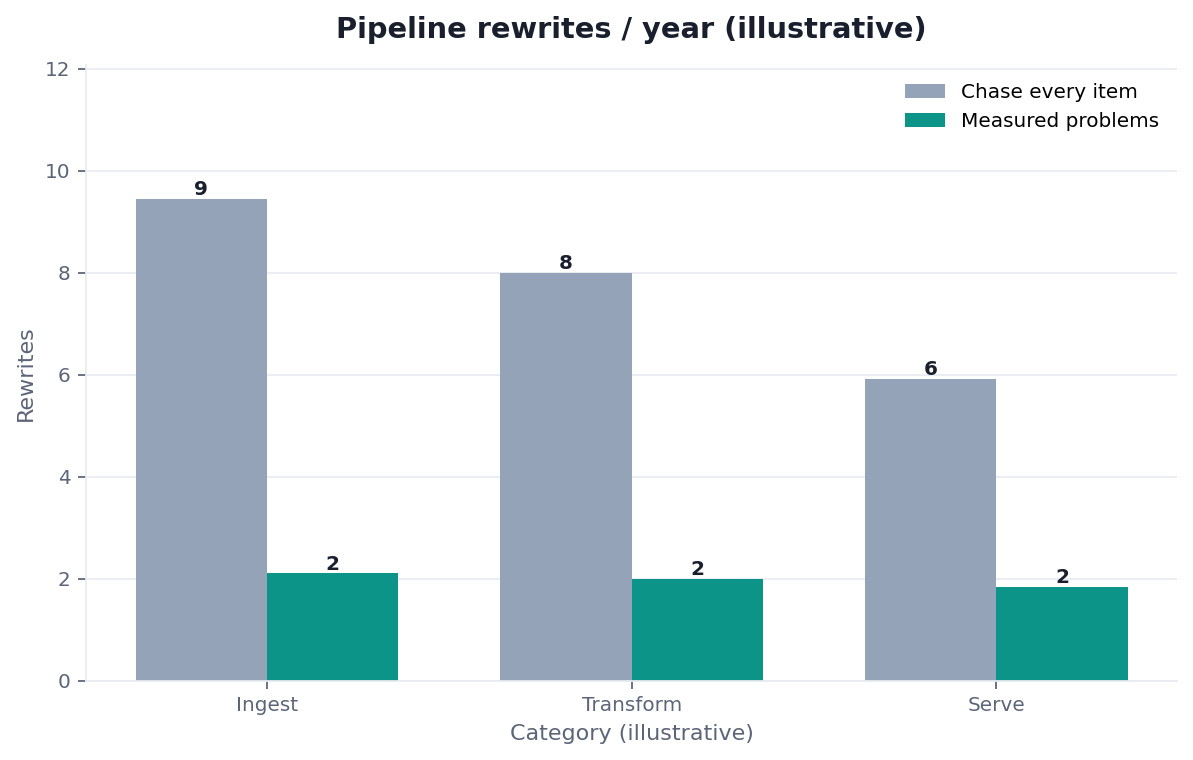
Chart note: composite observation used to illustrate the method, not a library vendor study. Numbers are illustrative of the adoption pattern we see when teams treat every headline as a mandate.
What to Ignore
Safe-to-ignore python data engineering news usually looks like: micro-libraries that duplicate Polars/pandas/DuckDB; framework-of-the-week with no docs depth; “rewrite everything in X” threads without workloads attached; and AI demos that skip tests, contracts, and rollback plans.
Mature engineers change for measured problems. A boring Airflow+dbt+SQL path that has run for two years often beats a fashionable full-Python rewrite. If an item would not survive the methodology table above, leave it out of the sprint backlog.
How to Stay Current
| Cadence | Action |
|---|---|
| Weekly (20–30 min) | Skim Polars / Arrow / Airflow / dbt release notes — not every Twitter thread |
| Monthly | One measured spike on non-critical work if a shift scores ≥6 |
| Quarterly | Revisit: pandas vs Polars/DuckDB boundaries; kill zombie PoCs |
Share the watchlist across the team (orchestration vs DataFrame engines vs packaging) so no one drowns. Awareness without reactivity is the goal when following python data engineering news. Pair the watchlist with a single “measured problem” board so adoption proposals always attach a baseline metric.
Common Mistakes When Following News
| Mistake | What goes wrong | Better habit |
|---|---|---|
| Rewrite on announcement day | Incidents + unfinished migrations | Shadow job + scorecard ≥6 |
| Benchmarking toy CSVs | False confidence from release-blog claims | Time your grain and cardinality |
| Treating pandas as obsolete | Breaks APIs and library glue | Keep pandas at edges; Polars/DuckDB for heavy reshape |
| Skipping tests for AI codegen | Silent schema drift | Contracts + CI on generated modules |
| Confusing ELT with “no Python” | Orchestration and connectors still need owners | Shrink glue; do not abandon ops |
These mistakes show up repeatedly when teams equate volume of python data engineering news with progress. Progress is measured outcomes, not feed velocity.
News in the Age of AI
AI generates more Python than humans review carefully — which raises the value of tests and typed contracts. It also reduces how much custom pipeline code is justified when federation can answer across sources.
That architectural question — when not to write another pandas job — is discussed in what AI-native data analysis means. For this roundup of python data engineering news: treat AI codegen as an accelerator inside a measured adoption process, not as a reason to skip the scorecard.
Signal Scorecard
Assess a news item before acting (1 point each):
| Check | Pass? |
|---|---|
| It changes what you should do differently | |
| It solves a problem you actually have | |
| It represents a durable shift, not a demo | |
| Primary docs exist and are maintained | |
| You can test it on non-critical work | |
| The benefit is measurable | |
| Adopting it does not risk stable pipelines | |
| It is signal, not novelty |
6–8: worth adopting. 3–5: watch and test. Below 3: ignore for now. Apply the same scorecard to every item, including vendor webinars and AI demos.
Common Misconceptions
Misconception 1: Newer is better. Most python data engineering news does not change practice.
Misconception 2: You must adopt to stay relevant. Deliberate adoption beats constant rewriting.
Misconception 3: Performance news requires action. Measure first; adopt for a real problem.
Misconception 4: More tools mean better pipelines. Reliability fundamentals outlast tooling churn.
Misconception 5: AI makes filters obsolete. AI increases output volume; filters matter more, not less, for python data engineering news.
Frequently Asked Questions
What python data engineering news matters in 2026?
Three durable shifts: Arrow-backed engines (Polars, DuckDB, Arrow) alongside pandas; AI-assisted coding that elevates review skills; and ELT/orchestration patterns (dbt, Airflow) that reduce “everything through pandas” glue. Most other announcements are noise inside the wider stream of python data engineering news.
How do you tell signal from noise?
Use the methodology table and scorecard: durable, decision-changing, measurable, testable on non-critical work. A new micro-library rarely matters; a shift in the default heavy-transform engine does. That is the same filter we use when we triage headlines for production teams.
Should you adopt new libraries quickly?
No. Adopt deliberately. Rewrite only against a measured baseline. Prefer greenfield or shadow jobs before touching billing-critical pipelines. Speed of reading python data engineering news should not become speed of rewriting production.
What is the performance trend?
Single-node Python can handle more via Arrow-backed tools, but you must measure on your shapes. Composite indices above are starting points, not guarantees. Performance claims in python data engineering news without your data profile attached are hypotheses.
How is AI changing the picture?
More generated code, higher need for tests, and fewer pipelines when query-in-place is enough. Keep AI-related python data engineering news inside the same measure-first filter — review load and contracts first, tool novelty second.
Conclusion
The python data engineering news that matters in 2026 is structural: Arrow-backed libraries, AI-assisted coding, and less unnecessary Python glue. Filter with an explicit method, demand primary docs and metrics, adopt for real problems, and protect reliable systems from novelty rewrites.
To go deeper on when federation reduces custom pipeline work, read what AI-native data analysis means. If you want to try that operating model in practice, the InfiniSynapse web app is free on registration.