Secondary Data Analysis Explained (2026)
By the InfiniSynapse Data Team · Last updated: 2026-07-09 · We build an AI-native data analysis platform and connect teams to warehouse and public datasets daily; this guide reflects how analysts reuse existing data effectively and responsibly.
Table of Contents
- TL;DR
- How We Evaluated
- What Secondary Analysis Is
- Advantages and Limits
- U.S. Census vs Eurostat vs ICPSR vs Data.gov
- Finding Datasets
- Evaluating a Dataset Before Committing
- Analyzing Secondary Data
- Ethical Considerations
- Combining Primary and Secondary Sources
- Secondary Analysis Scorecard
- Practical Next Steps
- Frequently Asked Questions
- Conclusion
TL;DR
Direct answer: secondary data analysis is analyzing data that someone else collected for a different purpose. It offers speed and low cost by reusing existing datasets—government statistics, prior research, public data—but requires careful evaluation of the data's quality, relevance, and limitations, since you did not control how it was collected.
Who this is for: researchers and analysts considering secondary data analysis using existing datasets.
What you'll learn: how we evaluated reuse workflows, major public data sources compared, finding and evaluating datasets, ethical constraints, and how to combine secondary with primary collection.
This guide sits within the advanced methods hub; for the general process, see the data analysis process. For related depth in this pillar, see Survey Data Analysis and Financial Data Analysis: Techniques and Tools.
How We Evaluated
We assessed secondary data analysis workflows against what produces trustworthy conclusions in 2026—not dataset size alone. Each stage was validated against ICPSR's data reuse guidance, federal open-data policy from Data.gov, and the process described in the Wikipedia data analysis overview. We attempted to answer the same regional employment question using U.S. Census Bureau tables, Eurostat microdata documentation, an ICPSR archived survey, and a Data.gov municipal open-data export to compare documentation depth, variable fit, and time-to-first-chart.
Provenance standards from the American Statistical Association's ethical guidelines informed how we treat metadata, license terms, and honest scope statements as non-negotiable. Adoption patterns in IBM's augmented analytics overview and agent maturity trends in the Stanford HAI AI Index shaped how we position AI-assisted profiling: faster evaluation and cleaning, not a bypass of fit and ethics checks.
How We Evaluated: In Practice
The strongest secondary data analysis starts with a written fit assessment before any modeling. Teams that connect first and read the codebook second routinely discover variable mismatches weeks into a project.## What Secondary Analysis Is
Secondary data analysis is the analysis of data originally collected by someone else, for some other purpose, repurposed to answer your question. This contrasts with primary analysis, where you analyze data you collected yourself. Sources for secondary data analysis include government statistics, academic datasets, public data repositories, and internal records gathered for operational rather than analytical reasons.
The defining feature of the approach is that you inherit the data rather than generate it. This shapes both its advantages and its challenges: you gain speed and scale but lose control over how the data was collected. Understanding this trade-off is central to secondary data analysis, and the general analytical process, described in the Wikipedia overview of data analysis, applies—with the crucial addition that you must first understand data you did not create.
State your research question and inclusion criteria before browsing repositories. Secondary data analysis goes wrong when analysts fall in love with a large dataset and retrofit a question to match its columns.
Advantages and Limits
Secondary data analysis offers real advantages. It is fast and inexpensive, since the costly data-collection stage is already done, letting you begin analysis immediately. It can provide access to large-scale or hard-to-collect data—such as national statistics—that you could never gather yourself. For many questions, secondary data analysis is the only practical option.
The limits stem from not controlling collection. The data may not perfectly fit your question, since it was gathered for another purpose. Its quality and methods may be unclear, and it may lack variables you need or contain definitions that differ from yours. These limits mean secondary data analysis requires careful evaluation before you trust the data, and sometimes the data simply cannot answer your question well—in which case primary collection is necessary despite its cost.
U.S. Census vs Eurostat vs ICPSR vs Data.gov
Analysts beginning secondary data analysis routinely compare four gateway sources. Use the matrix below to match repositories to geographic scope, documentation depth, and access requirements.
| Dimension | U.S. Census Bureau | Eurostat | ICPSR | Data.gov |
|---|---|---|---|---|
| Best for | U.S. demographic, economic, and housing statistics | EU-wide economic, social, and regional indicators | Academic survey and social science microdata archives | U.S. federal, state, and local open-data catalog |
| Coverage | National to tract level; decennial and ACS programs | EU member states; harmonized cross-country tables | Thousands of study-level datasets with codebooks | 300k+ datasets across federal agencies |
| Documentation | Extensive technical documentation and errata notes | Metadata with methodology footnotes per table | Codebooks, sampling notes, and study-level README files | Variable; agency-dependent quality |
| Access | Public tables; restricted microdata via CES | Mostly open; some microdata requires application | Free account; some restricted-use contracts | Open licenses common; terms vary by dataset |
| Typical use in analysis | Population trends, market sizing, policy baselines | Cross-country comparisons within EU | Replicating or extending published research | Agency-specific operational and environmental data |
| Fit risk | Definitions change across census cycles | Harmonization hides national methodology differences | Original study purpose may not match your question | Heterogeneous quality across publishers |
No repository removes the evaluation step. Secondary data analysis still fails when teams treat public availability as proof of fitness for their specific question.
Finding Datasets
Effective secondary data analysis starts with finding suitable datasets. Government agencies publish extensive statistics, academic repositories share research data, and many organizations release open data. Knowing where to look—official statistics portals, data repositories, and domain-specific archives—is a practical skill for secondary data analysis.
The goal in finding data is relevance to your question, not just availability. A large, well-documented dataset that does not address your question is useless, while a smaller one that fits precisely is valuable. Assessing relevance early saves effort, since discovering a mismatch after extensive work is costly. Cast a wide net across sources, then narrow to datasets whose content, coverage, and timeframe genuinely match what your question requires.
Practical example: a policy analyst studies remote-work adoption by metro area without budget for a new survey. For secondary data analysis, she pulls American Community Survey commute tables from the U.S. Census Bureau, joins Bureau of Labor Statistics industry employment series, and documents variable definitions and survey changes across years before charting. She states plainly that ACS measures reported commute mode, not employer policy. That provenance-aware framing mirrors what Harvard Business Review's skills-based hiring research describes as decisive: analysts who show their reasoning, not just a chart.
Evaluating a Dataset Before Committing
Evaluating a dataset before committing is the most important discipline in secondary data analysis. Because you did not collect the data, you must scrutinize how it was collected: who gathered it, when, using what methods, and for what original purpose. Documentation—often called metadata or a codebook—is essential to this evaluation.
Key evaluation questions include: does the data cover the right population and timeframe, are the variable definitions compatible with your question, what is the data quality, and are there known limitations or biases? A dataset that fails these checks may mislead your secondary data analysis no matter how carefully you then analyze it. This evaluation stage—understanding provenance and fit—is what separates rigorous reuse from naively analyzing inherited data as if you had collected it yourself.
Write a one-page fit memo: question, source, population, timeframe, key variables, known gaps, and license terms. Reviewers and future-you will thank you when the secondary data analysis is questioned months later.
Analyzing Secondary Data
Once a suitable dataset is evaluated, the analysis stage proceeds much like any analysis, with one caveat: you must work within the data's constraints. You cannot add variables that were not collected or fix collection problems after the fact, so secondary data analysis adapts the question to what the data can actually support.
Analyzing still requires cleaning, since inherited data has its own quality issues, and then applying appropriate techniques to answer the question. The interpretation must stay honest about the data's origins, acknowledging that conclusions rest on data collected for another purpose. This constraint-awareness is what distinguishes skilled secondary data analysis: rather than forcing the data to answer questions it cannot, the analyst frames questions the data can genuinely address and interprets results with provenance clearly in mind.
Ethical Considerations
Secondary data analysis carries ethical considerations that primary collection handles at the source. When reusing data about people, you must respect the terms under which it was collected and shared, including any consent limitations and privacy protections. Just because data is available does not mean any use is permitted—a key ethical principle in this approach.
Responsible secondary data analysis also means respecting data licenses, citing sources appropriately, and being careful not to re-identify individuals in ostensibly anonymized data. Public availability does not remove these obligations. Attending to ethics protects both the individuals represented in the data and the integrity of your work. Treating inherited data with the same ethical care you would apply to data you collected yourself is a hallmark of responsible reuse, and it is increasingly scrutinized as data sharing grows.
Combining Primary and Secondary Sources
Some of the strongest research combines reused data with data you collect yourself, playing to the strengths of each. Existing datasets can provide broad context, historical baselines, or large-scale patterns, while a targeted primary collection fills the specific gaps that inherited data cannot cover. This combination often yields a richer picture than either source alone, blending scale with precision.
A common pattern uses a large existing dataset to establish the general landscape, then a focused primary study to probe a particular question in depth. For example, national statistics might reveal a broad trend, and a small survey you run explains why it is happening in your specific context. The reused data supplies breadth and the primary data supplies depth, and together they answer questions neither could resolve on its own.
Combining sources requires care to ensure they are compatible—that definitions, timeframes, and populations align well enough to be used together. When they do, the combination is powerful; when they do not, forcing them together misleads. Thinking deliberately about how reused and freshly collected data complement each other opens analytical possibilities that a single-source mindset misses.
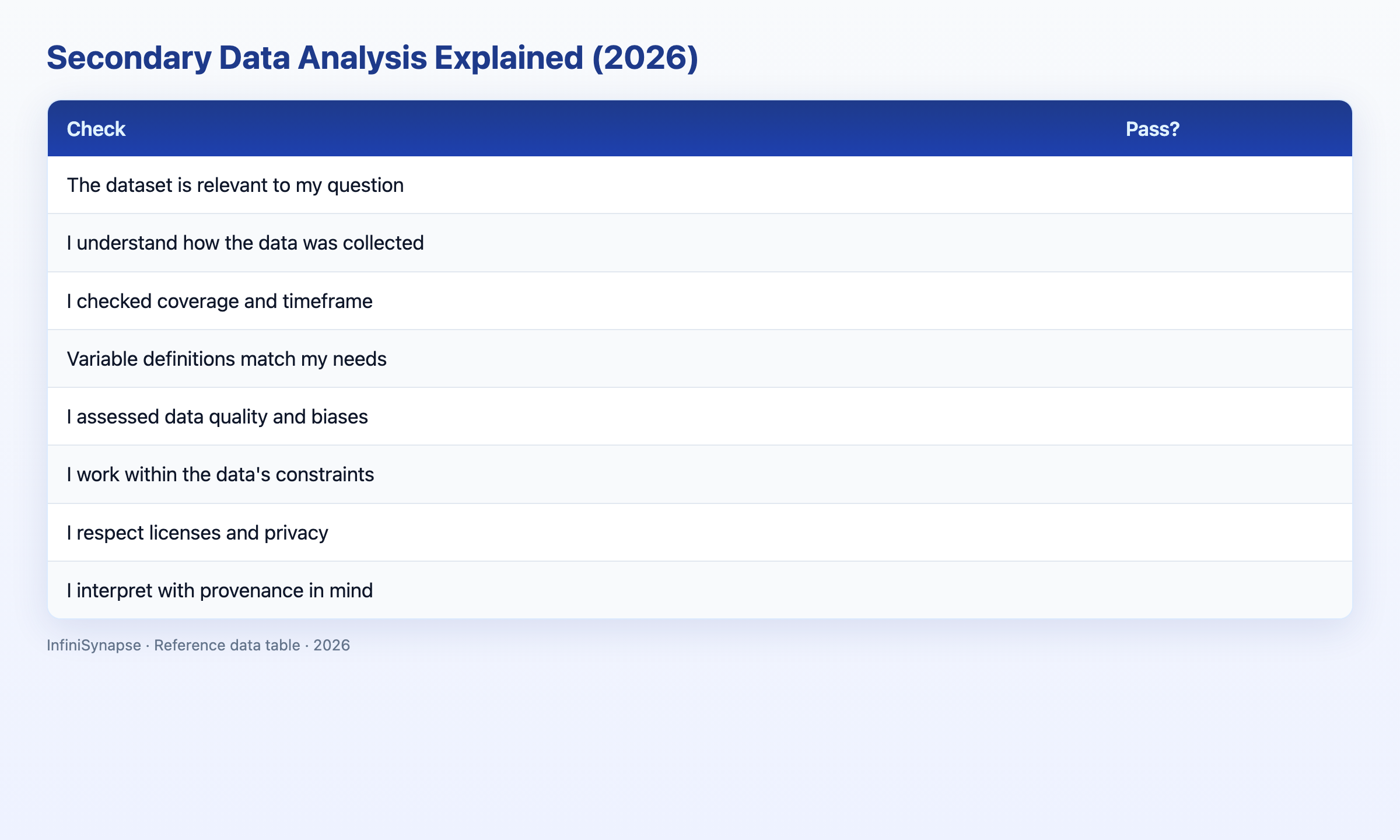
Secondary Analysis Scorecard
Assess your secondary analysis (1 point each):
| Check | Pass? |
|---|---|
| The dataset is relevant to my question | |
| I understand how the data was collected | |
| I checked coverage and timeframe | |
| Variable definitions match my needs | |
| I assessed data quality and biases | |
| I work within the data's constraints | |
| I respect licenses and privacy | |
| I interpret with provenance in mind |
6–8: rigorous secondary analysis. 3–5: strengthen evaluation. Below 3: re-evaluate the dataset.
Practical Next Steps
Verify against real job postings
Before committing time or budget, pull five recent job postings in your target market and list the SQL, visualization, and communication skills each repeats. Align your learning plan to those patterns rather than a generic syllabus.
Frequently Asked Questions
What does reusing existing datasets mean?
Secondary data analysis is analyzing data that someone else collected for a different purpose, such as government statistics, academic datasets, or public data. It contrasts with primary analysis of data you collected yourself. It offers speed and scale by reusing existing data but requires careful evaluation since you did not control the collection.
What are the main advantages of this approach?
Secondary data analysis is fast and inexpensive because the costly collection stage is already done, and it can provide access to large-scale or hard-to-collect data like national statistics that you could never gather yourself. For many questions, it is the only practical option, letting you begin analysis immediately.
What limitations should you expect?
The limitations stem from not controlling collection: the data may not perfectly fit your question, its quality and methods may be unclear, and it may lack needed variables or use different definitions. These require careful evaluation, and sometimes the data simply cannot answer your question well.
How do you evaluate a dataset before using it?
Evaluate data for secondary data analysis by scrutinizing how it was collected—who gathered it, when, how, and why—using its documentation or codebook. Check whether it covers the right population and timeframe, whether variable definitions match your question, its quality, and any known biases. This evaluation determines whether the data can be trusted.
Is reusing public data always ethical?
Secondary data analysis is ethical when it respects the terms under which data was collected, including consent limitations and privacy protections, honors data licenses, cites sources, and avoids re-identifying individuals. Public availability does not remove these obligations, so responsible reuse treats inherited data with the same ethical care as data you collected yourself.
Conclusion
Secondary data analysis reuses existing datasets for speed and scale, but its success hinges on carefully evaluating data you did not collect—its provenance, fit, quality, and limitations—and working honestly within its constraints. In 2026, AI-native tools accelerate evaluation, cleaning, and analysis while the analyst supplies judgment about fit and ethics.
To see fast connection and profiling of existing datasets, read what AI-native data analysis means and try the InfiniSynapse web app free on registration, no credit card required.