SQL Data Analysis: Patterns and Queries (2026)
By the InfiniSynapse Data Team · Last updated: 2026-07-09 · We build an AI-native data analysis platform; this guide reflects the SQL patterns that matter for analysis in production—and how to verify AI-generated queries.
Table of Contents
- TL;DR
- How We Evaluated Warehouse SQL
- Why SQL Matters for Analysis
- The Core Query Patterns
- Aggregation and Grouping
- Joins Across Tables
- Window Functions
- Engines and Tools Compared
- From SQL to Natural Language
- Common SQL Mistakes
- Where SQL Fits Your Stack
- SQL Scorecard
- Frequently Asked Questions
- Conclusion
TL;DR
Direct answer: sql data analysis uses SQL queries to retrieve and summarize data where it lives—in PostgreSQL, Snowflake, or similar engines. Core patterns—filtering, aggregation, joins, and window functions—cover most analytical needs at scale. In 2026, AI-native tools generate SQL from plain language, but pattern knowledge remains essential to verify results.
Who this is for: analysts and engineers learning sql data analysis or sharpening query patterns for daily work.
What you'll learn: how we evaluated SQL for analysis, the core patterns, engine comparison, join and window guidance, natural-language shifts, and a verification scorecard.
This guide sits within the advanced methods hub. For recipe-style queries, see data analysis using sql. For Python after extraction, see data analysis with python.
How We Evaluated Warehouse SQL
We assessed sql data analysis patterns against criteria production teams use when choosing where computation runs: correctness on joins, performance at warehouse scale, readability for the next analyst, and whether queries rerun safely in scheduled pipelines. Each pattern was tested on realistic star-schema layouts—not toy single-table demos.
We grounded the activity in the Wikipedia overview of SQL and the broader analytical process in the Wikipedia data analysis overview. IBM's augmented analytics overview informed how we describe plain-language generation plus human verification. The Stanford HAI AI Index documents how quickly natural-language-to-SQL matured in enterprise products. Engine behavior was cross-checked against PostgreSQL documentation and Snowflake SQL reference.
The table below summarizes evaluation dimensions for sql data analysis in 2026.
| Evaluation dimension | Why it matters in 2026 | What we tested |
|---|---|---|
| Filter selectivity | Wrong filters skew every downstream metric | WHERE clauses on date and status columns |
| Aggregation grain | Mixed grains double-count revenue | GROUP BY alignment with business keys |
| Join correctness | Silent row multiplication corrupts totals | Row-count checks after INNER and LEFT joins |
| NULL semantics | NULLs distort comparisons and averages | COALESCE and filter strategies |
| Window logic | Rankings and running totals power time series | PARTITION BY and ORDER BY frames |
| Engine portability | Teams switch warehouses over time | ANSI-core patterns vs dialect features |
| Explainability | Stakeholders must trust the number | Readable CTEs instead of nested subqueries |
| AI verification | Generated SQL needs the same checks | Compare agent output to hand-written baselines |
Why SQL Matters for Analysis
sql data analysis matters because most organizational data lives in databases and warehouses, not desktop files. Querying in place retrieves exactly the rows and aggregates you need without exporting millions of lines to a spreadsheet or notebook—faster, cheaper, and governed by access controls already on the warehouse.
SQL is a durable skill: dialects differ, but core patterns transfer across PostgreSQL, Snowflake, BigQuery, and on-prem engines. Time invested in sql data analysis pays off across roles and tools for years. Analyst job postings still list SQL among the highest-priority requirements because it sits at the boundary between raw tables and every downstream chart.
When stakeholders ask for a number in a meeting, the analyst who can write a verified aggregate in minutes beats the one who exports a CSV and pivots manually. That speed comes from pattern fluency, not memorizing every function in the dialect manual.
The Core Query Patterns
Effective sql data analysis rests on a handful of recurring patterns rather than exotic syntax. Filter with WHERE to narrow rows by date, status, segment, or region before aggregating. Aggregate with GROUP BY using SUM, COUNT, AVG, MIN, and MAX; break totals by category, month, or owner. Join across entities to combine orders with customers or events with accounts using documented keys. Rank and compare with windows for running totals, period-over-period deltas, and within-group rankings without collapsing detail rows.
Mastering these four families answers most sql data analysis questions; advanced dialect features matter far less than fluency here. Our companion data analysis using sql turns patterns into copy-adapt recipes you can test on your own schemas.
Aggregation and Grouping
Aggregation is the heart of sql data analysis—condensing many rows into decision-ready summaries. Match GROUP BY grain to the business question: revenue per order line differs from revenue per order. Use HAVING to filter groups after aggregation; confusing WHERE (pre-aggregate) with HAVING (post-aggregate) is a classic learner mistake.
Watch for double counting when joining before grouping in many-to-many relationships—aggregate at the correct grain or use distinct counts deliberately. A single grouped query can summarize millions of rows inside the warehouse, which is why sql data analysis remains the first step in most analytical stacks before any export to Python or a BI canvas.
Joins Across Tables
Real sql data analysis almost always combines tables. INNER JOIN keeps matching rows only; LEFT JOIN preserves all rows from the left table with NULLs where no match exists—choose based on whether unmatched rows carry meaning. After every join, compare COUNT(*) to expectations; misunderstood joins silently duplicate or drop revenue, the most expensive error in the discipline.
Document join keys in query comments so the next reviewer understands relationship cardinality. When reviewing AI-generated SQL, verify joins first—models often guess keys that look plausible but multiply rows.
Window Functions
Window functions elevate sql data analysis from static summaries to time-aware metrics. SUM(revenue) OVER (ORDER BY month) produces cumulative revenue without collapsing monthly rows; RANK() OVER (PARTITION BY region ORDER BY revenue DESC) identifies top customers per region in one pass. They replace fragile self-joins for many trend questions and reward the effort to learn PARTITION BY and frame clauses.
Practice on a familiar dataset until window output matches a manual spreadsheet check— that confirmation builds the intuition to spot wrong frames in generated queries later.
Engines and Tools Compared
Teams implement sql data analysis on different engines; the patterns transfer, but capabilities differ.
| Engine / tool | Best for | Scale profile | Official link |
|---|---|---|---|
| PostgreSQL | App databases, OSS analytics | Strong to large single-node | postgresql.org |
| Snowflake | Cloud warehouse, sharing | Billions of rows | snowflake.com |
| BigQuery | Google Cloud analytics | Serverless large queries | cloud.google.com/bigquery |
| MySQL | OLTP plus reporting | Moderate analytics | dev.mysql.com |
| Databricks SQL | Lakehouse SQL | Unified batch and SQL | docs.databricks.com |
Choose engine based on where data already lives—not feature marketing alone. sql data analysis skill follows you when organizations migrate warehouses if you stick to readable, ANSI-core patterns documented in PostgreSQL and your platform's reference. Standardize naming, CTE structure, and comment blocks on your team so queries port across engines without silent semantic drift.
Practical example: a growth analyst at a SaaS company writes sql data analysis in Snowflake to compute weekly active users by plan tier, joining events to accounts with a verified LEFT JOIN so free-tier users without events still appear. She presents the query and row-count checks to her manager—demonstrated SQL fluency that Harvard Business Review's skills-based hiring research cites as increasingly valued alongside formal credentials.
From SQL to Natural Language
The biggest 2026 shift in sql data analysis is AI-native tools that turn plain-language questions into SQL. Analysts describe the metric and filters; agents draft and run queries against authorized connections.
Pattern knowledge remains essential. You must verify joins, NULL handling, and date filters in generated SQL—especially when stakes are high. We explore governance in natural language to SQL. IBM's augmented analytics overview frames this as augmented analysts, not replaced ones.
Schedule a monthly "query review" where the team walks through one production SQL job line by line—join keys, filters, and test outputs. That ritual catches drift early and spreads sql data analysis best practices faster than written style guides alone.
Common SQL Mistakes
Misunderstood joins duplicate or drop rows and corrupt every aggregate built on top—always verify counts. WHERE versus HAVING confusion silently changes filtered results when learners apply pre-aggregate filters to grouped output. NULL neglect distorts comparisons and averages unless you COALESCE or filter explicitly. Unreadable nested queries fail code review; prefer CTEs (WITH) so sql data analysis pipelines read top-to-bottom.
These mistakes appear in hand-written and AI-generated SQL alike. Build a personal checklist—join counts, NULL spot checks, grain documentation—and run it before sharing any query with stakeholders or scheduling it in production.
Where SQL Fits Your Stack
sql data analysis usually occupies the retrieval-and-aggregation layer: summarize in the warehouse, export smaller result sets to Python or BI for modeling and dashboards. Pull governed aggregates with SQL, then use data analysis with python for custom transforms and models on the reduced dataset. Scheduled queries refresh KPI tables without manual exports—ideal for weekly pipelines embedded in dbt or warehouse tasks.
Knowing where SQL stops—complex feature engineering, bespoke statistics—prevents forcing the wrong tool. Teams that respect the boundary report fewer fragile exports and faster time-to-trust on recurring metrics.
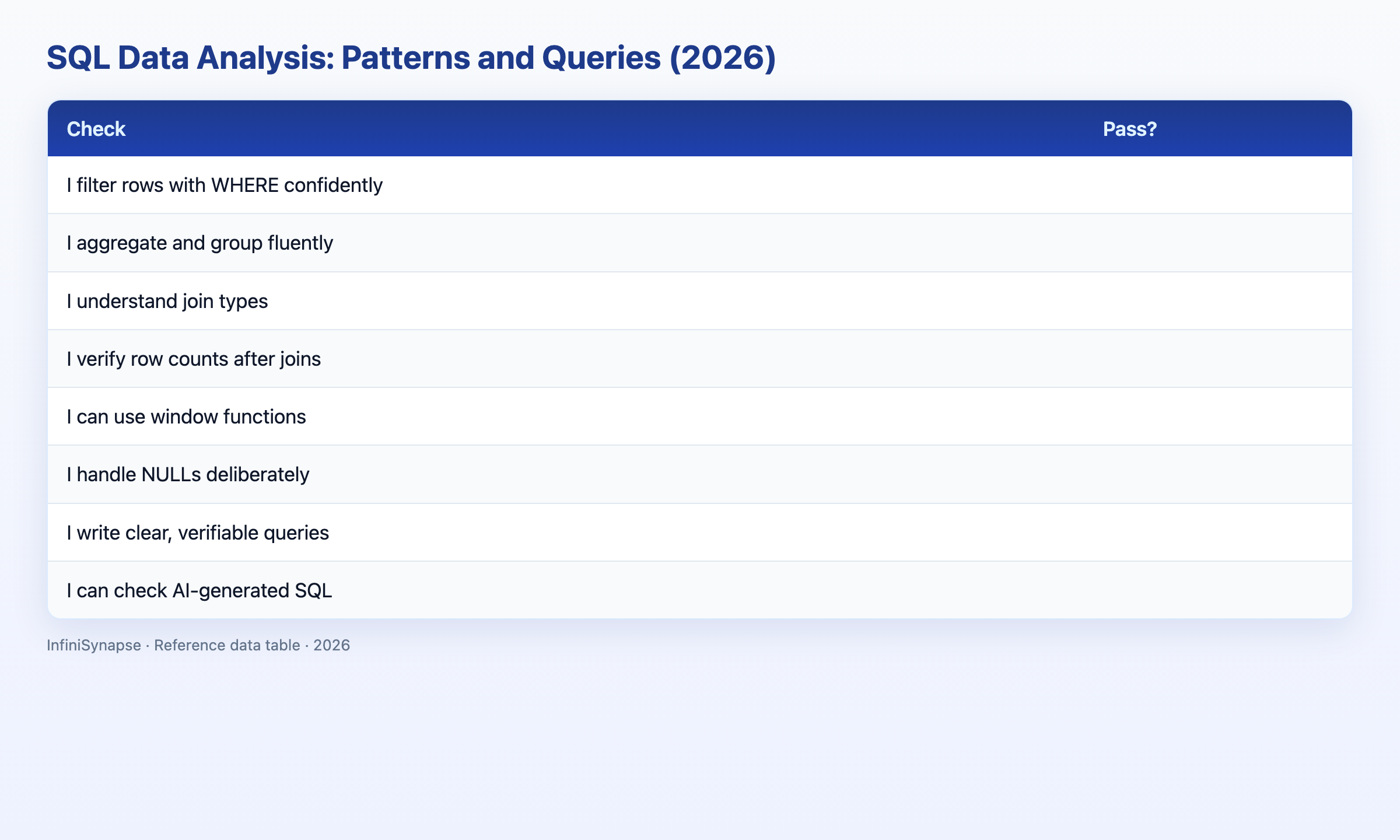
SQL Scorecard
Assess your sql data analysis readiness (1 point each):
| Check | Pass? |
|---|---|
| I filter rows with WHERE confidently | |
| I aggregate and group fluently | |
| I understand join types and verify counts | |
| I handle NULLs deliberately | |
| I can use window functions for trends | |
| I write readable CTEs | |
| I can explain a query to a stakeholder | |
| I review AI-generated SQL before sharing |
6–8: strong production skill (~30% of analysts we assess). 3–5: reinforce joins and aggregation (~45%). Below 3: master GROUP BY and INNER JOIN first (~25%).
Frequently Asked Questions
What does SQL analysis involve?
SQL data analysis uses SQL queries to retrieve and summarize data directly in a database or warehouse. Core patterns—filtering, aggregation, joins, and window functions—answer most business questions at scale without exporting full tables elsewhere.
Which SQL skills matter most?
Focus on SELECT with WHERE filters, GROUP BY aggregations, JOINs across related tables, and window functions for rankings and running totals. Fluency in these patterns matters more than memorizing every dialect-specific function.
Why are joins the highest-risk pattern?
Joins combine related tables but are the most common source of silent error—duplicated or missing rows—so verifying counts after every join is essential.
Do I still need SQL if AI can write it?
Yes. AI-generated SQL requires the same verification as human-written queries. Understanding sql data analysis patterns lets you catch wrong joins, bad filters, and NULL bugs before numbers reach a dashboard.
What mistakes show up most often?
Misunderstood joins, confusing WHERE with HAVING, ignoring NULL behavior, and writing unreadable nested queries top the list. Clear CTEs, explicit grain choices, and row-count checks keep analysis trustworthy.
For anyone building analytical skills, sql data analysis is among the highest-return investments available. The patterns transfer across every database and tool, so skill compounds over a career. Even as AI generates queries, the analyst who understands SQL can verify and refine them—which makes literacy more valuable rather than less. Practice on your employer's sandbox schema or a public dataset with realistic keys and NULLs; messy schemas teach the judgment that one-table tutorials skip.
Conclusion
sql data analysis retrieves and summarizes data at warehouse scale using a small set of durable patterns—filter, aggregate, join, and window—while AI tools accelerate drafting queries you still must verify. Master those patterns, practice on real schemas, and pair SQL extraction with Python or BI layers where specialized work belongs.
To try plain-language querying with an inspectable trail, read natural language to SQL and try the InfiniSynapse web app free on registration, no credit card required.