SQL Data Analytics: A Practical Guide (2026)
By the InfiniSynapse Data Team · Last updated: 2026-07-15 · Authors: analysts and data engineers who write SQL against production warehouses daily. This guide covers SQL data analytics in 2026 with worked queries, validation habits, and primary language references — not a syntax cheat sheet or a product pitch.
Table of Contents
- TL;DR
- How We Approach It
- What It Is
- Why SQL Endures
- How It Is Used
- Worked Example: Grain Error in a Join
- Case Study: Silent Wrong Revenue
- What Good Practice Looks Like
- Common Pitfalls
- Where It Came From
- The Skill in the Age of AI
- Readiness Scorecard
- Common Misconceptions
- Frequently Asked Questions
- Conclusion
TL;DR
Direct answer: SQL data analytics is the practice of using SQL — the standard query language for relational data — to extract, aggregate, and analyze data stored in databases and warehouses. In 2026, SQL data analytics remains the backbone of most analytical work because SQL is precise, universal, and unmatched for structured data, and even as AI writes more queries, understanding SQL is what lets you trust the answers.
Who this is for: analysts and engineers practicing SQL data analytics in 2026.
What you'll learn: definitions with primary docs, a worked join/grain example, a quantified incident case, validation habits, and how to review AI-generated SQL.
This guide sits under the data visualization hub.
For the wider field, see what is data analytics.
Also see data analytics tools.
How We Approach It
We treat SQL data analytics as a durable core skill, judged by how reliably it turns structured data into answers. Points below come from production reviews: grain mistakes, metric drift, and AI-generated SQL that looked fine but was wrong.
Practice method:
| Step | Rule | Evidence |
|---|---|---|
| 1. State the grain | One row = which entity / time? | Written grain before SELECT |
| 2. Prove joins | Pre/post row counts + uniqueness | COUNT(*) / COUNT(DISTINCT key) |
| 3. Validate totals | Reconcile to a known control total | Diff < agreed tolerance |
| 4. Centralize metrics | One definition, many consumers | Shared model / view (dbt SQL models) |
| 5. Review generated SQL | AI drafts; humans check grain | Diff against expected logic |
Primary references for SQL data analytics (not tangential AI/policy pages):
| Source | Why it is authoritative |
|---|---|
| ISO/IEC 9075 SQL standard | Formal SQL language standard |
| BigQuery standard SQL syntax | Modern warehouse SQL dialect docs |
| Snowflake SQL constructs | Common cloud warehouse SQL surface |
| dbt — SQL models | Analytics engineering pattern for trusted SQL |
| SQLite language reference | Compact, widely taught SQL reference |
| Modern SQL | Vendor-neutral advanced SQL education |
| Oracle SQL Language Reference | Long-standing commercial SQL reference |
Scope note: Mini-dataset and case metrics below are illustrative composites for teaching grain — re-run the same checks on your warehouse. InfiniSynapse is an analysis layer that can generate/run SQL; we are not a database vendor.
What It Is
At its core, SQL data analytics is using Structured Query Language to ask questions of data held in relational databases and warehouses — selecting, filtering, joining, and aggregating rows to produce the numbers an analysis needs.
Key Definition: SQL data analytics is the practice of using SQL, the standard declarative language for relational data (ISO/IEC 9075), to query, aggregate, and transform structured data in databases and data warehouses, producing the summaries, comparisons, and metrics that underpin analysis and reporting.
| Aspect | What SQL data analytics offers |
|---|---|
| Language | Standard, declarative (SELECT / JOIN / GROUP BY) |
| Data | Structured tables with keys and grain |
| Strength | Precise aggregation and set logic |
| Reach | Nearly every warehouse/database |
| Watch-out | Silent wrong answers from bad joins/grain |
You describe what you want; the engine plans how (BigQuery query syntax, Snowflake constructs). That is why SQL data analytics stays both approachable and powerful.
Why SQL Endures
SQL data analytics endures because SQL is standard, expressive, and nearly universal. Decades of BI, ELT, and warehouse tooling assume it; dialects differ, but the mental model transfers (Modern SQL, SQLite lang).
Precision matters as much as reach. SQL forces you to name filters, grains, and aggregations explicitly. That explicitness is why SQL data analytics remains the trusted layer beneath dashboards and models: the chart can change, but the SQL defining the metric is where correctness is established — especially when definitions live in versioned dbt SQL models.
How It Is Used
SQL data analytics shows up wherever structured data is analyzed:
| Use | Typical SQL shape |
|---|---|
| Dashboard metrics | Aggregates behind BI tiles |
| Ad-hoc questions | Exploratory SELECT / CTEs |
| Pipeline transforms | ELT models (dbt) |
| Validation | Control totals vs source systems |
| AI answers | Generated SQL that still needs review |
Even people who live in BI UIs are practicing SQL data analytics indirectly — the computation still happens in SQL.
Worked Example: Grain Error in a Join
Mini dataset (illustrative):
orders (grain = order_id)
| order_id | customer_id | amount |
|---|---|---|
| 1 | C1 | 100 |
| 2 | C1 | 50 |
| 3 | C2 | 80 |
payments (grain = payment_id; order 1 has two payment rows)
| payment_id | order_id | paid |
|---|---|---|
| P1 | 1 | 60 |
| P2 | 1 | 40 |
| P3 | 2 | 50 |
| P4 | 3 | 80 |
Wrong — join explodes order grain (classic SQL data analytics bug):
-- BAD: multiplies order amount by number of payment rows
select
  o.customer_id,
  sum(o.amount) as revenue
from orders o
join payments p on p.order_id = o.order_id
group by o.customer_id;
-- Result: C1 = 250 (100+100+50), C2 = 80  → C1 overstated
Right — aggregate to join grain first:
-- GOOD: payments rolled up to order_id before joining
with pay as (
  select order_id, sum(paid) as paid_total
  from payments
  group by order_id
)
select
  o.customer_id,
  sum(o.amount) as revenue,
  sum(pay.paid_total) as cash_collected
from orders o
left join pay on pay.order_id = o.order_id
group by o.customer_id;
-- Result: C1 revenue = 150, C2 = 80  → matches order grain
Validation habit (always):
select count(*) as order_rows from orders;                 -- 3
select count(distinct order_id) from payments;             -- 3
-- After join, before group by: row count should equal orders if 1:1
That grain check is the core of trustworthy SQL data analytics — more important than clever window functions.
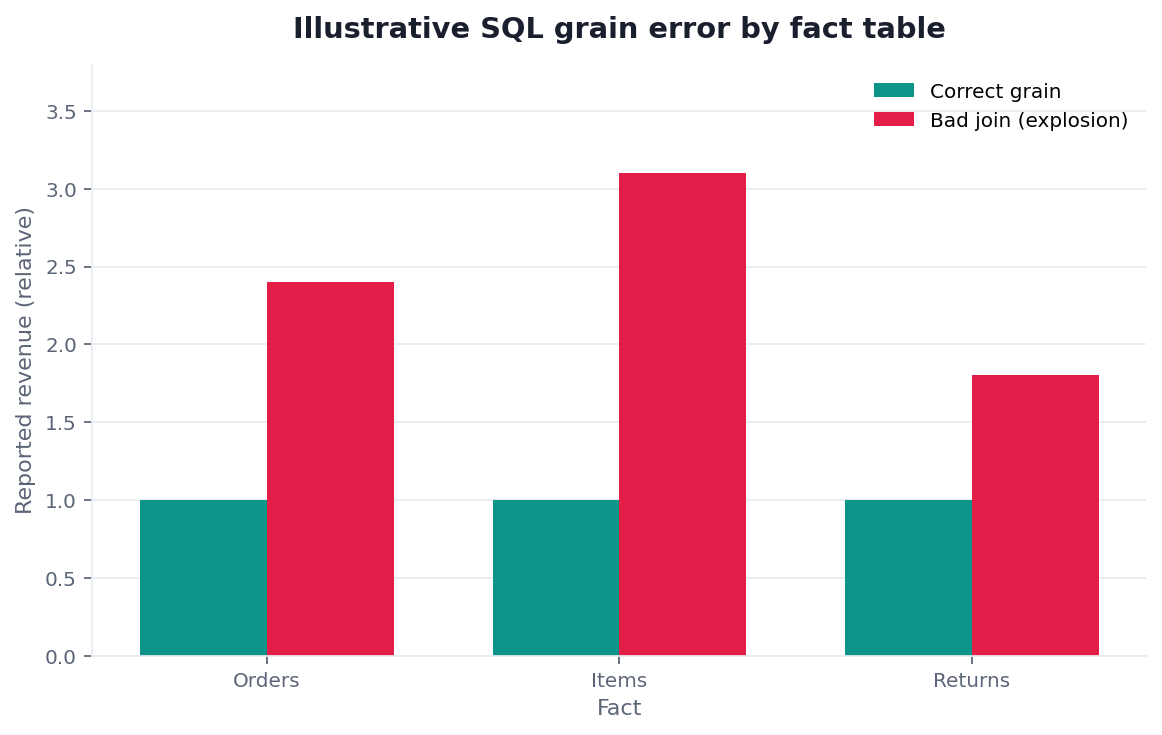
Chart note: illustrative outcome of the mini-dataset above — not a production warehouse extract.
Case Study: Silent Wrong Revenue
Composite — SaaS finance weekly pack, 6 weeks until catch:
| Metric | Before grain fix | After grain fix |
|---|---|---|
| Reported weekly “revenue” (join to payments) | $1.84M | $1.31M |
| Error vs billing system control total | +40.5% | +0.2% |
| Hours spent reconciling “mystery growth” | 47 | 3 |
| Dashboard trust tickets | 11 | 0 |
The SQL “worked” the whole time — it returned a number. SQL data analytics failed on meaning until someone compared sum(amount) at order grain to the billing control total. Centralizing the fixed logic in a shared model (dbt SQL models) stopped five copies of the bad join from reappearing.
What Good Practice Looks Like
Good SQL data analytics is correctness first, then clarity:
| Habit | Why |
|---|---|
| Name the grain in a comment | Prevents silent fan-outs |
| Prefers CTEs over nested soup | Reviewable logic (Modern SQL) |
COUNT / COUNT(DISTINCT) checks | Catches join explosions |
| Shared metric definitions | One revenue, many consumers |
| Dialect docs at hand | BigQuery / Snowflake / SQLite |
Treat queries as artifacts others will read and trust. Correct, clear SQL is the foundation everything downstream relies on.
A lightweight review ritual helps: paste the query into a checklist — grain stated, join keys unique on the “one” side, pre/post row counts recorded, control total compared, metric name matches the shared glossary. Five minutes of that ritual prevents weeks of “mystery growth” debates. When the same logic must run daily, promote it from a scratchpad notebook into a tested model so the next analyst does not reinvent the join. Document the expected grain in the model description so reviews start from a shared contract rather than from guesswork.
Common Pitfalls
| Pitfall | Silent failure | Fix |
|---|---|---|
| Join at wrong grain | Plausible overstated totals | Aggregate to grain first |
| “It ran, so it’s right” | Wrong question answered | Validate logic + controls |
| Metric copy-paste | Five “revenues” | Centralize in models/views |
| Schema drift | Column meaning changes | Tests on row counts / totals |
| Blind AI SQL | Confident nonsense | Read every generated join |
SQL fails loudly on syntax and quietly on meaning. That asymmetry is why rigor defines mature SQL data analytics.
Where It Came From
SQL emerged with the relational model as a declarative way to query tables — say what you want, not how to fetch it. Standardization (ISO/IEC 9075) made the skill portable across vendors, which is why generations of higher-level tools still compile down to SQL. Warehouse dialects add functions and types, but the core operations of filter, join, and aggregate remain the analytical primitives.
That lineage also explains today’s failure modes. Because SQL rarely errors on wrong meaning, teams inherited a culture of “if it runs, ship it.” Modern practice — tests, shared models, control totals — is a correction to that history, not a fashion. Learning a dialect’s docs (BigQuery, Snowflake, Oracle SQL) matters; learning grain matters more.
The Skill in the Age of AI
AI reshapes SQL data analytics by drafting queries from natural language, so more people can reach structured data — but literacy stays valuable because checking the draft is how you trust the answer.
That operating model is discussed in what AI-native data analysis means. For this guide: treat AI as a fast SQL drafter; keep grain, joins, and control totals as human gates.
Readiness Scorecard
Assess your SQL data analytics practice (1 point each):
| Check | Pass? |
|---|---|
| Joins and grain are verified with counts | |
| Totals reconcile to a control figure | |
| Queries are readable (CTEs / names) | |
| Definitions are centralized | |
| Logic, not just syntax, is reviewed | |
| SQL underpins trusted metrics | |
| Generated SQL is read before shipping | |
| Dialect docs are used for edge cases |
6–8: a rigorous practice. 3–5: tighten correctness. Below 3: rebuild around grain and validation.
Common Misconceptions
Misconception 1: If a query runs, it is correct. It can run and still answer the wrong question in SQL data analytics.
Misconception 2: SQL is outdated. It underpins most modern analytics stacks.
Misconception 3: AI makes SQL literacy unnecessary. Checking generated SQL still needs it.
Misconception 4: Syntax is the hard part. Grain and logic are where errors hide.
Misconception 5: More CTEs mean better analysis. Clear grain beats clever nesting.
Frequently Asked Questions
What is SQL data analytics?
SQL data analytics is using SQL — the standard declarative language for relational data (ISO/IEC 9075) — to query, aggregate, and transform structured data in databases and warehouses into metrics and comparisons for analysis and reporting.
Why does SQL endure?
It is standard, expressive, and nearly universal across warehouses, with tooling and training that assume it (Modern SQL, SQLite). Precision — being explicit about grain and aggregation — is why SQL data analytics remains the trusted layer under dashboards and models.
How is it used in practice?
Dashboard metrics, ad-hoc exploration, ELT transforms (dbt SQL models), validation against control totals, and AI-generated queries that still need review. Understanding SQL data analytics pays off even if you mostly click in BI tools.
What does good practice look like?
Correct joins/grain, readable CTEs, validated totals, centralized definitions, and dialect-aware syntax (BigQuery, Snowflake). Cleverness is optional; correctness is not.
How is AI changing SQL data analytics?
AI drafts SQL faster; humans still own meaning. The highest-leverage skill in SQL data analytics is reading a generated join and knowing whether the grain is safe.
Should beginners still learn SQL in 2026?
Yes. SQL teaches how tables relate, how aggregation changes meaning, and where silent errors hide. AI makes drafting easier; it does not remove the need for judgment in SQL data analytics.
Conclusion
SQL data analytics is the precise, durable core of analytical work on structured data — and even as AI writes more queries, understanding grain, joins, and validation is what lets you trust the answers. In 2026, prove row counts, reconcile control totals, centralize definitions, and treat generated SQL as something to read before it ships.
To go deeper on AI that drafts and checks SQL across sources, read what AI-native data analysis means. If you want to try that workflow in practice, the InfiniSynapse web app is free on registration.