Tableau Public Data Analysis: A 2026 How-To
By the InfiniSynapse Data Team · Last updated: 2026-07-09 · We build an AI-native data analysis platform and use Tableau Public alongside it on real projects; this how-to reflects hands-on use of the free product, not a vendor pitch.
Table of Contents
- TL;DR
- How We Evaluated Tableau Public
- What Tableau Public Is
- Named Tools Compared for Open Data
- How to Do Tableau Public Data Analysis
- What Tableau Public Does Well
- The Limits You Should Know
- Tableau Public vs Paid Tableau
- Where AI-Native Agents Complement It
- Building a Portfolio That Gets You Hired
- Selection Scorecard
- Practical Next Steps
- Frequently Asked Questions
- Conclusion
TL;DR
Direct answer: Tableau Public data analysis means using the free edition of Tableau to build and share interactive visualizations of openly publishable data. It is excellent for learning visualization and building a portfolio, but its work saves publicly and it does not connect to private databases, so it complements rather than replaces a full analysis stack.
Who this is for: learners, job seekers, and analysts evaluating Tableau Public data analysis for visualization and portfolio work.
What you'll learn: how we evaluated the free tool, what it is, a named comparison with Power BI and Looker, a step-by-step workflow, strengths and limits, and where an AI-native agent fills the gaps.
This how-to sits within the data analysis tools hub. For Tableau's role as a general tool, see Tableau as a data analysis tool. For related depth in this pillar, see Data Analysis Tools Tableau: Where It Fits in 2026.
How We Evaluated Tableau Public
We assessed Tableau Public data analysis against criteria that predict whether the free tool survives real learner and portfolio workflows, not demo conditions alone. Each dimension was tested on open datasets: visualization quality and interactivity, time to first published dashboard, data-preparation expectations, connection limits to private sources, and whether the output demonstrates skills hiring managers list in 2026 postings. We cross-referenced those skills with the Bureau of Labor Statistics occupational profile for data analysts, which lists communication and technical visualization among core competencies, and hiring-trend data from LinkedIn's 2025 Future of Recruiting report, which notes that portfolio evidence increasingly influences hiring alongside formal credentials.
How We Evaluated Tableau: In Practice
The defining constraint—public-only saving—was treated as a feature boundary, not a defect. Tableau Public data analysis suits open datasets, learning exercises, journalism, and portfolio pieces meant to be shared. It is not built for confidential business data, since anything you publish becomes visible to anyone. Understanding this boundary first prevents the most common and most serious mistake newcomers make with the tool. As a category, it belongs to the visualization tier described in IBM's augmented analytics overview, and its underlying purpose is the communication stage of the process outlined in the Wikipedia data analysis overview.## What Tableau Public Is
Tableau Public data analysis is built on the free edition of Tableau, the widely used visualization platform now part of Salesforce. The free edition gives you most of Tableau's drag-and-drop charting power with one defining constraint: everything you create is saved to a public profile on the web rather than to a private file or server. That single design choice shapes every appropriate use of the product.
Because the work is public, Tableau Public data analysis suits open datasets, learning exercises, journalism, and portfolio pieces meant to be shared. It is not built for confidential business data. The official getting-started guide is at Tableau Public help, and the product page at tableau.com/products/public confirms the public-save requirement.
Named Tools Compared for Open Data
When your data can be published openly, several free BI tools compete with Tableau Public data analysis. The table below compares the options we most often recommend for learners and portfolio builders.
| Tool | Free tier | Public save required | Strength | Official docs |
|---|---|---|---|---|
| Tableau Public | Yes | Yes | Best-in-class interactivity, large gallery | Tableau Public help |
| Power BI Desktop | Yes | No (local save; publish needs license) | Microsoft integration, DAX | Power BI documentation |
| Looker Studio | Yes | Depends on sharing settings | Google-ecosystem dashboards | Looker Studio help |
Tableau Public leads on visual polish and the discoverability of its public gallery. Power BI Desktop saves locally, which suits private practice work but requires a paid license to publish to a workspace. Looker Studio fits teams already in Google Workspace. For confidential business dashboards, none of these free tiers is sufficient on its own—see top data analysis platforms for paid alternatives.
Practical example: a job seeker who publishes three Tableau Public dashboards on open transit, weather, and retail datasets—each answering one clear question with a short written interpretation in the profile description—can link the public profile directly in applications. Recruiters explore the work interactively rather than reading static screenshots, which is the kind of portfolio evidence Harvard Business Review's skills-based hiring research describes as increasingly decisive in hiring decisions.
How to Do Tableau Public Data Analysis
A first project in Tableau Public data analysis follows a predictable arc. Begin by downloading Tableau Public from tableau.com/products/public and preparing a dataset you are comfortable publishing—open government data, a public survey, or a sample file. Clean the data in a spreadsheet first, because Tableau Public expects reasonably tidy input and does limited preparation of its own.
Next, connect the file and start building a view. Drag a dimension such as a category onto columns and a measure such as a total onto rows, and Tableau renders a chart instantly. Iterate by adding filters, colors, and a second measure until the view answers a clear question. Then assemble one or more views into a dashboard, add a title and a short annotation so the story is self-explanatory, and publish to your public profile. The published dashboard is interactive and shareable by link, which is why Tableau Public data analysis is such a strong medium for portfolios: a hiring manager can explore your work rather than just read about it. Throughout, keep the question in front of you, because a beautiful chart that answers nothing is a common trap for beginners.
What Tableau Public Does Well
The free tool earns its popularity on three fronts. First, the visualization power is genuine: Tableau Public data analysis produces polished, interactive charts that rival anything from paid tools, so the output quality is not compromised by the price. Second, the learning value is high, because the drag-and-drop model teaches visualization principles quickly and the enormous public gallery offers thousands of examples to study and reverse-engineer.
Third, it is a portfolio engine. For someone breaking into analytics, a public profile of thoughtful dashboards is concrete, explorable proof of skill, and it is free to build. These strengths make Tableau Public data analysis a near-default recommendation for learners, and they explain why so many analyst portfolios live on the platform. The Stanford HAI AI Index notes how visualization literacy has become a baseline expectation, and a public Tableau profile demonstrates exactly that literacy.
The Limits You Should Know
The public-save requirement is the defining limit of Tableau Public data analysis: you cannot keep work private, which rules out confidential or proprietary data entirely. This is not a bug but the price of the free edition, and treating it casually is how people accidentally publish sensitive information.
Beyond privacy, the free edition does not connect to live private databases the way paid Tableau and other platforms do, so it works from static files rather than governed, refreshing sources. It also does little data preparation, expecting clean input, and it offers none of the collaboration and governance features a team needs. These limits mean Tableau Public data analysis is a visualization and learning tool, not a complete analysis platform, and pretending otherwise leads to frustration once real business requirements appear.
Tableau Public vs Paid Tableau
The distinction is simple to state. Paid Tableau connects to private databases, saves work privately, refreshes from live sources, and adds governance and collaboration; Tableau Public data analysis trades all of that away in exchange for being free and public. For learning and portfolios, the free edition is ideal. For confidential business dashboards viewed by a team, paid Tableau or another platform is required.
Choosing between them is really a question of data sensitivity and workflow maturity. If your data can be public and your goal is to learn or showcase, start with the free edition. If your data is private and your goal is recurring team reporting, the free edition is the wrong tool. Paid Tableau documentation lives at help.tableau.com, and our comparison of top data analysis platforms covers the paid alternatives in detail.
Where AI-Native Agents Complement It
Tableau Public data analysis handles the communication stage beautifully but leaves the earlier stages—connecting to private sources, cleaning, and multi-step analysis—largely to you. This is exactly where an AI-native agent complements it. For warehouse-scale or multi-source work, supplement spreadsheets or BI tools with hands-on AI practice. We explain the paradigm in what AI-native data analysis means, and the Stanford HAI AI Index tracks how quickly agent-assisted analysis matured. The agent handles the private, heavy work the free edition cannot touch; Tableau handles the polished public presentation. Governance-minded users should validate lineage the way Databricks' documentation recommends.
Building a Portfolio That Gets You Hired
For job seekers, the strongest use of the free tool is a portfolio. Hiring managers in analytics increasingly ask for evidence of skill rather than a list of courses, and a public profile of well-crafted dashboards is exactly that evidence. A handful of projects that each answer a clear question, use real open data, and include a short written interpretation will do more for a job search than another certificate.
Curate rather than accumulate. Three polished, thoughtful dashboards beat a dozen half-finished ones, because a reviewer judges the ceiling of your work, not the count. Choose datasets that show range—one time series, one geographic map, one comparison—and annotate each so the reasoning is visible. This turns a profile from a gallery of charts into a demonstration of analytical thinking, which is what actually persuades an interviewer that you can be trusted with real questions.
Treat the profile as a living document. Revisit older pieces as your skills grow, retire the weakest, and add new work that reflects your current ceiling. A portfolio built through steady curation signals not only competence but the professional habit of iterating on your own work, and that habit reads clearly to anyone who reviews it.
Selection Scorecard
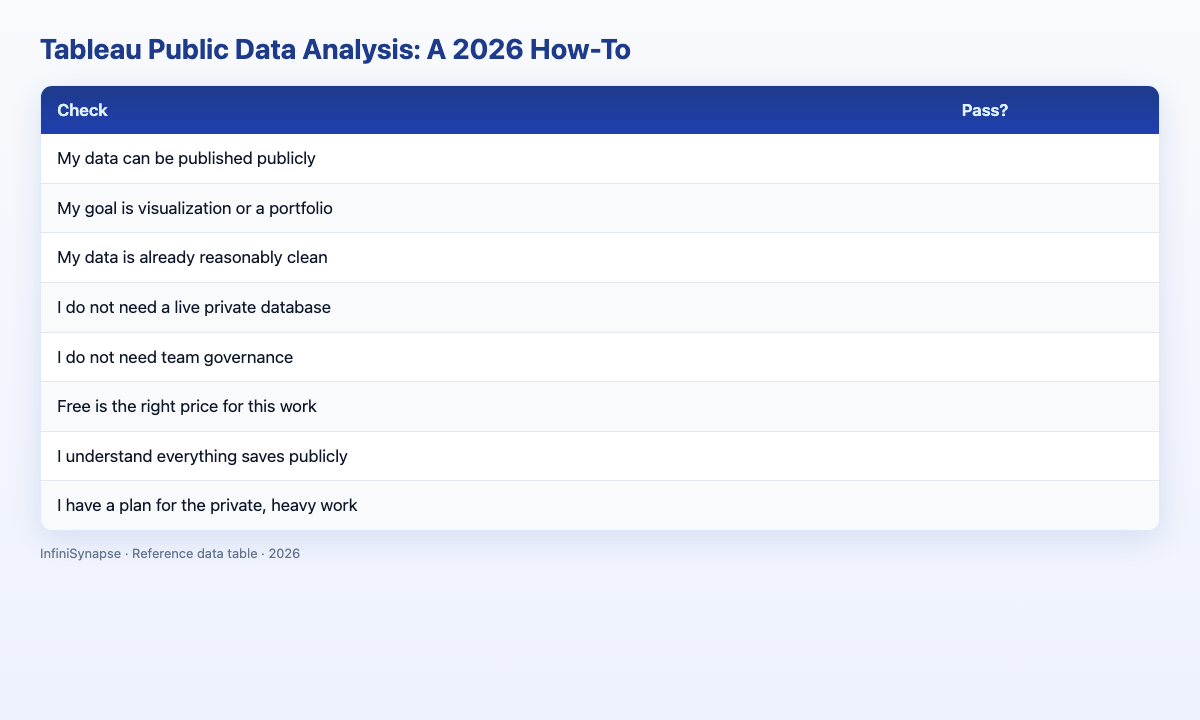
Decide whether Tableau Public data analysis fits your need (1 point each):
| Check | Pass? |
|---|---|
| My data can be published publicly | |
| My goal is visualization or a portfolio | |
| My data is already reasonably clean | |
| I do not need a live private database | |
| I do not need team governance | |
| Free is the right price for this work | |
| I understand everything saves publicly | |
| I have a plan for the private, heavy work |
6–8: a great fit. 3–5: fine with caveats. Below 3: use a private tool instead.
Practical Next Steps
Verify against real job postings
Before committing time or budget, pull five recent job postings in your target market and list the SQL, visualization, and communication skills each repeats. Align your learning plan to those patterns rather than a generic syllabus.
Frequently Asked Questions
What is Tableau Public data analysis?
Tableau Public data analysis means using the free edition of Tableau to build and share interactive visualizations of data you can publish openly. It offers most of Tableau's charting power, but every workbook saves to a public profile, so it suits open data, learning, and portfolios rather than confidential business work.
Is Tableau Public free for data analysis?
Yes, Tableau Public is completely free. The trade-off is that all work saves publicly to your online profile and the tool cannot connect to private live databases, so Tableau Public data analysis is best for open datasets, learning visualization, and building a shareable portfolio.
What are the alternatives to Tableau Public for data analysis?
Power BI Desktop and Looker Studio are the main free alternatives for dashboard building. Power BI saves locally but requires a license to publish; Looker Studio fits Google Workspace users. For confidential data, paid Tableau, Power BI Pro, or Looker (Google Cloud) are required instead of Tableau Public data analysis.
Tableau Public vs paid Tableau: which do I need?
Use Tableau Public data analysis for learning, open data, and portfolios where public sharing is fine. Choose paid Tableau when you need private database connections, private saving, live refresh, and governance for team reporting. The deciding factor is whether your data can be public.
How can I use Tableau Public with an AI-native agent?
Use an AI-native agent to connect private sources, clean, and run multi-step analysis, then export a clean dataset into Tableau Public for a shareable visualization. The agent handles the private, heavy work that Tableau Public data analysis cannot, while Tableau handles the public presentation.
Conclusion
Tableau Public data analysis is a superb free tool for learning visualization and building a portfolio, as long as you respect its defining constraint: everything saves publicly and it will not touch private databases. Match it to open data and presentation work, and pair it with a private analysis tool for everything else.
For the private, multi-step analysis the free edition cannot do, an AI-native agent is the natural partner. See how AI-native data analysis works and try the InfiniSynapse web app free on registration, no credit card required.