What Does a Data Analyst Do? A Day-in-the-Life Guide
By the InfiniSynapse Data Team · Last updated: 2026-07-09 · We build an AI-native data analysis platform and work beside analysts daily; this guide reflects the real workday, not a job posting.

Table of Contents
- TL;DR
- How We Evaluated This Guide
- The Core Answer
- A Typical Day
- The Four Recurring Tasks
- The Tools Involved
- What the Role Is Not
- How AI Changes the Workday
- Skills That Make the Work Easier
- Readiness Scorecard
- A Note on Expectations
- Failure Modes
- Frequently Asked Questions
- Conclusion
TL;DR
Direct answer: what does a data analyst do? They gather, clean, analyze, and communicate data to help an organization make decisions — splitting their time between technical work (querying and preparing data) and human work (interpreting and explaining it). The communication half is as important as the technical half.
Who this is for: anyone asking what does a data analyst do before entering the field or working with analysts.
What you'll learn: how we evaluated the role, the core answer, a realistic day, the four recurring tasks, the tools involved, common misconceptions, and how AI is reshaping the workday.
This guide sits under the data analyst career hub; for the plural framing by industry, see what do data analysts do.
For related depth in this pillar, see What Is a Data Analyst? The Role Defined for 2026.
How We Evaluated This Guide
We built this answer to what does a data analyst do from occupational research and day-to-day observations rather than generic job-posting copy. We cross-referenced role definitions and core competencies from the Bureau of Labor Statistics occupational profile for data analysts, which lists analytical, communication, and technical skills as central to the occupation. We aligned task expectations with LinkedIn's 2025 Future of Recruiting report, which notes that skills assessments and portfolio evidence increasingly influence hiring alongside formal credentials — reflecting the same gather-analyze-communicate cycle we see in actual analyst workflows.
The table below breaks down what does a data analyst do by time allocation and output type. Percentages vary by company and seniority, but the pattern holds across most analyst roles we observe.
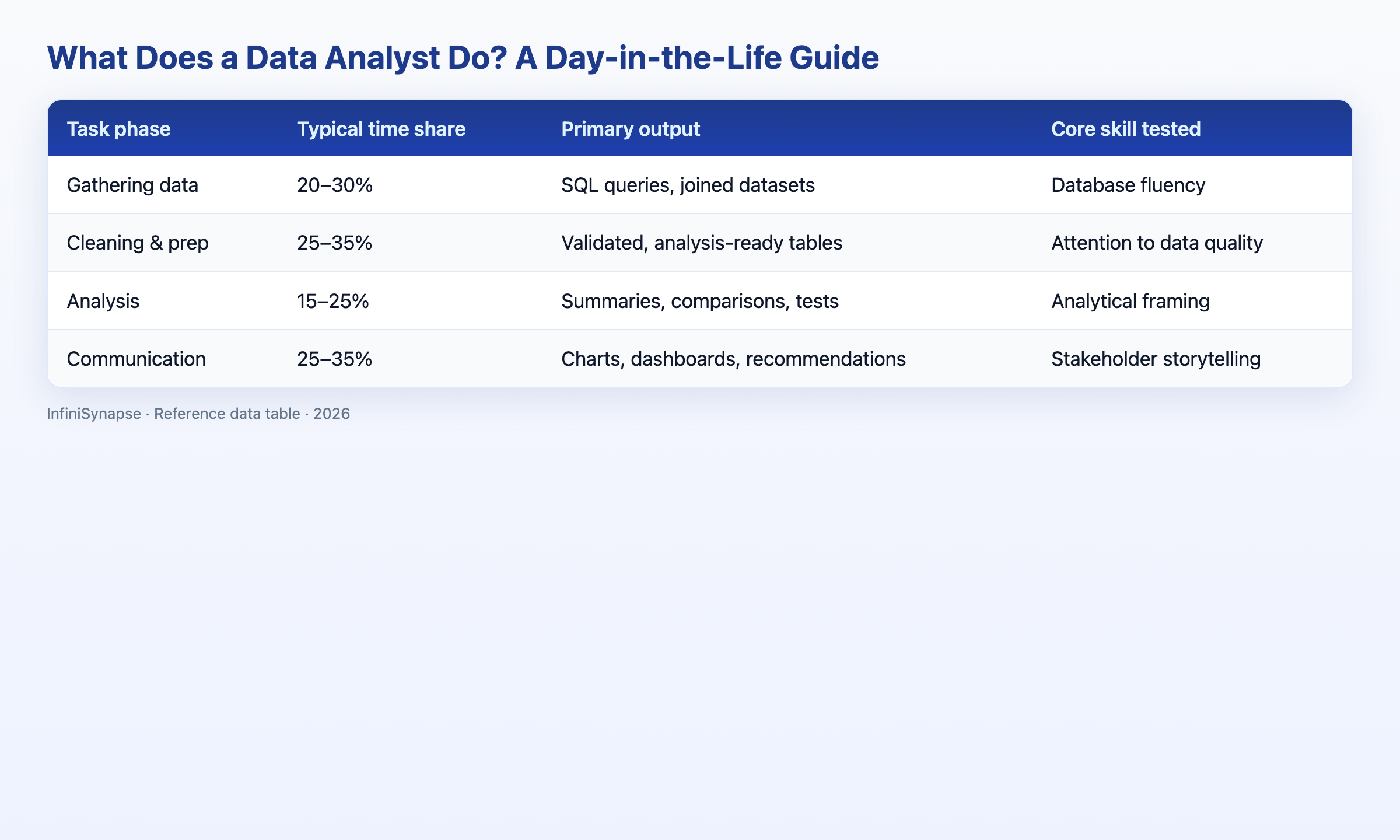
| Task phase | Typical time share | Primary output | Core skill tested |
|---|---|---|---|
| Gathering data | 20–30% | SQL queries, joined datasets | Database fluency |
| Cleaning & prep | 25–35% | Validated, analysis-ready tables | Attention to data quality |
| Analysis | 15–25% | Summaries, comparisons, tests | Analytical framing |
| Communication | 25–35% | Charts, dashboards, recommendations | Stakeholder storytelling |
Practical example: when a product manager asks why checkout conversion dropped, an analyst answering what does a data analyst do in practice spends the morning pulling funnel data with SQL, the early afternoon reconciling a duplicate-user bug in the event stream, and the late afternoon presenting a two-slide summary with a recommended A/B test — not a 50-page report. Recruiters evaluating that workflow look for the same evidence of execution that Harvard Business Review's skills-based hiring research describes as increasingly decisive in hiring decisions.
The Core Answer
The short answer to what does a data analyst do is this: they turn raw data into decisions. An organization collects more data than it can interpret, and the analyst is the person who examines it, finds what matters, and communicates it to those who will act. Every task in the role serves that single purpose.
Key Definition: what does a data analyst do, precisely? A data analyst collects, cleans, analyzes, and communicates data so an organization can make better-informed decisions, translating messy numbers into clear, actionable insight.
Understanding the role requires seeing both halves of the job. The technical half — querying databases, cleaning data, building charts — is what most people picture. The human half — framing the right question and explaining the answer — is what actually creates value, and it is the half newcomers most often underestimate when they imagine the role. The underlying activity follows the disciplined process described in the Wikipedia data analysis overview.
A Typical Day
To make the role concrete, picture a realistic day. It often begins with a stakeholder request — a product manager wants to understand why a metric dropped. The analyst clarifies the question, then pulls the relevant data with SQL, which frequently surfaces the first surprise: the data is messier than expected and needs cleaning before any analysis.
By midday, having cleaned and joined the data, the analyst runs the actual analysis, testing hypotheses about the metric drop. The afternoon shifts to communication: building a clear chart and writing a short explanation of what happened and what to do about it. This rhythm captures the role more honestly than any list of skills, because it shows how much of the day is spent preparing and explaining rather than on the analysis itself. Some days add recurring reports, meetings, and stakeholder education to the mix.
The Four Recurring Tasks
Beneath the daily variation, the role reduces to four recurring tasks. The first is gathering data — pulling it from databases, files, and applications, often across several sources that must be combined. The second is cleaning — resolving duplicates, inconsistent formats, and missing values so the analysis rests on trustworthy input.
The third recurring task is the analysis itself — summarizing, comparing, and testing to answer the question at hand. The fourth, and most underrated, is communication — turning the result into a chart and a recommendation that a non-technical stakeholder can act on. These four tasks recur regardless of industry or seniority, which is why mastering all four, not just the analysis, is what defines competence in the role. We detail the formal scope in the data analyst job description.
The Tools Involved
The tools reveal another dimension of the analyst's daily work. SQL is the foundational tool for pulling data, spreadsheets handle quick manipulation, and a visualization tool such as Tableau or Power BI builds the dashboards stakeholders consume. Increasingly, an AI-native analysis agent joins the toolkit, handling multi-step work from a plain-language goal.
Knowing the tools helps at a practical level, but tools are means, not ends. The best analysts choose the simplest tool that answers the question and never confuse tool proficiency with analytical skill. We map the full toolkit in data analyst skills, and the broader tool landscape in the data analysis tools guide. What matters is not how many tools an analyst knows but whether they can turn data into a decision with them.
What the Role Is Not
Clarifying what does a data analyst do also means dispelling what it is not. It is not pure programming — while SQL and sometimes Python are involved, the job is not software engineering. It is not building predictive models at scale, which leans toward data science, a distinction we draw in data analyst vs data scientist. The move toward augmented workflows, outlined in IBM's augmented analytics overview, frames how teams evaluate modern tooling.
Nor is what does a data analyst do a purely solitary technical task. Much of the role involves collaborating with stakeholders, clarifying vague requests, and educating others on what the data can and cannot say. Newcomers who expect to sit alone with a dataset all day are often surprised by how social and communicative the work actually is. Understanding these boundaries sets realistic expectations for anyone entering the field.
How AI Changes the Workday
The most significant 2026 shift in what does a data analyst do is the arrival of AI-native tools that automate the mechanical tasks. Cleaning and routine querying — historically the biggest time sinks — can now be delegated to an agent, which changes the shape of the workday toward the judgment and communication that create value.
In practice, what does a data analyst do now includes directing an AI agent, validating its output against independent SQL, and deciding when automated summaries are trustworthy versus when to drill down manually. We explore the paradigm in what AI-native data analysis means, and the Stanford HAI AI Index tracks how rapidly these skills have become standard. The answer to what does a data analyst do is evolving toward more judgment, not less relevance.
Skills That Make the Work Easier
Once you understand what does a data analyst do, the natural next question is which skills make the daily work smoother. SQL fluency comes first, because so much of the day begins with pulling data, and an analyst who writes queries confidently spends less time fighting the tool and more time thinking about the question. Spreadsheet mastery follows closely, since quick manipulation and pivots handle a surprising share of everyday tasks without any heavier machinery.
Beyond the technical basics, the skills that most ease what does a data analyst do are analytical framing and communication. Framing is the ability to turn a vague stakeholder request into a precise, answerable question, which prevents hours of wasted work on the wrong problem. Communication is the ability to translate a finished analysis into a recommendation a non-technical colleague can act on, and it is repeatedly cited by employers as the skill that separates a good analyst from a merely competent one.
A third cluster of skills concerns judgment and validation. A capable analyst constantly asks whether a result makes sense, checks it against intuition and independent cuts of the data, and resists the temptation to present a surprising number without verifying it. This skepticism is central to what does a data analyst do responsibly, because a confident wrong answer is worse than an admitted uncertainty. Developing the habit of validating before presenting protects both the analyst's credibility and the decisions that rest on their work.
Readiness Scorecard
Assess your fit for what a data analyst does (1 point each):
| Check | Pass? |
|---|---|
| I enjoy turning questions into answers | |
| I am comfortable with SQL and spreadsheets | |
| I can clean messy data patiently | |
| I can explain findings clearly | |
| I like collaborating with stakeholders | |
| I can judge whether a result makes sense | |
| I can use a visualization tool | |
| I am open to AI-native tools |
6–8: strong fit. 3–5: build a skill or two. Below 3: explore the fundamentals first.
A Note on Expectations
Anyone entering the field should hold realistic expectations about the rhythm of the role. Some stretches are genuinely exciting — the moment a pattern emerges from messy data, or a recommendation visibly changes a decision. Other stretches are patient and unglamorous, spent reconciling inconsistent columns or waiting on a slow query. Newcomers who expect constant discovery are sometimes surprised by how much careful preparation the work requires, and those who embrace that preparation as the foundation of trustworthy insight tend to be the most satisfied.
Equally, expect the role to involve people as much as numbers. Clarifying vague requests, managing stakeholder expectations, and explaining limitations diplomatically are daily realities, not occasional interruptions. The analysts who thrive treat these human interactions as part of the craft rather than a distraction from it, because an analysis nobody understands or trusts creates no value regardless of its technical elegance. The honest summary of what does a data analyst do is a blend of patient preparation, careful analytical judgment, and clear human communication in roughly equal measure.
Failure Modes
Failure 1: Underestimating communication. Answering what does a data analyst do as purely technical misses half the job.
Failure 2: Skipping data cleaning. Analysis on dirty data produces confident-looking errors.
Failure 3: Tool obsession. Collecting tools without practicing real questions builds no analytical skill.
Failure 4: Working in isolation. Ignoring stakeholders produces technically correct but useless answers.
Frequently Asked Questions
What does a data analyst do day to day?
Day to day, what does a data analyst do involves gathering data with SQL, cleaning and reconciling messy sources, running the analysis to answer a question, and communicating the result as a chart and recommendation. The day splits between technical preparation and human communication, with the latter often taking more time than newcomers expect.
What does a data analyst do that a data scientist does not?
What does a data analyst do focuses on descriptive and diagnostic questions — what happened and why — and on communicating findings, while a data scientist leans toward predictive modeling and machine learning. The analyst sits closer to the immediate business question and spends more time translating data into decisions than building models.
What tools does a data analyst use?
A data analyst typically uses SQL to pull data, spreadsheets for quick work, and a visualization tool like Tableau or Power BI for dashboards. Increasingly, an AI-native analysis agent joins the toolkit to handle multi-step work from a plain-language goal, freeing time for interpretation — a shift the Stanford HAI AI Index documents across knowledge work.
Is being a data analyst a technical job?
Being a data analyst is partly technical — SQL, spreadsheets, and sometimes Python — but what does a data analyst do is equally a communication job. Much of the role involves clarifying vague requests, collaborating with stakeholders, and explaining findings clearly, so the role rewards both technical and interpersonal skill.
How is AI changing what a data analyst does?
AI is automating the mechanical parts of what does a data analyst do, such as cleaning and routine querying, which shifts the workday toward framing questions, validating results, and communicating insight. Analysts who direct AI-native tools effectively spend more time on judgment and less on preparation.
Conclusion
So what does a data analyst do? They turn raw data into decisions through four recurring tasks — gather, clean, analyze, communicate — with the communication half mattering as much as the technical. In 2026, AI-native tools are shifting the balance toward judgment and away from mechanical work.
To see the tools reshaping the role, read what AI-native data analysis means and try the InfiniSynapse web app free on registration, no credit card required.