What Is Meant by Data Analysis in Business (2026)
By the InfiniSynapse Data Team · Last updated: 2026-07-09 · We advise teams on analytical maturity and see the same business confusion repeatedly; this guide addresses what is meant by data analysis in commercial settings, grounded in real decision workflows.
Table of Contents
- TL;DR
- How We Evaluated the Business Meaning
- The Business Meaning in Practice
- Its Role in Commercial Decisions
- The Value It Creates for Organizations
- Common Business Applications
- Analysis Versus Reporting Versus Dashboards
- How AI Changes Delivery in 2026
- Building an Analytical Culture
- Business Maturity Scorecard
- Practical Next Steps
- Frequently Asked Questions
- Conclusion
TL;DR
Direct answer: what is meant by data analysis in business is using the organization's data to answer questions and guide decisions. It turns sales, customer, and operational records into insights that improve choices, replacing guesswork with evidence. Its value is measured by the quality of the decisions it enables—not by how many charts were produced.
Who this is for: managers, founders, and professionals asking what is meant by data analysis in a business context.
What you'll learn: how we evaluated the business framing, the commercial meaning, its role in decisions, the value it creates, how it differs from reporting, and how delivery is changing in 2026.
For the plain-English meaning, see data analysis meaning; for the full discipline, see the complete data analysis guide.
For related depth in this pillar, see Data Analysis Definition: Formal and Practical.
How We Evaluated the Business Meaning
We assessed this guide using criteria that mirror how executives judge analytical work—not how textbooks define the field. Each claim was checked against four dimensions: whether the explanation ties analysis to a specific decision, whether value is measured by outcomes rather than activity, whether the distinction from reporting is clear, and whether examples span functions beyond a single analytics team.
How We Evaluated The: What To Verify
We cross-referenced the underlying discipline with the Wikipedia overview of data analysis, which frames analysis as inspecting, cleaning, transforming, and modeling data to surface useful information. We aligned autonomy and delivery expectations with IBM's augmented analytics overview, which tracks how AI-assisted workflows reshape what business users expect from analytical tooling. The Stanford HAI AI Index documents how quickly agent-assisted analysis moved from pilots into production roles. For governance and sharing models we referenced Microsoft Learn for Power BI and the Wikipedia business intelligence overview, which describe how dashboards scale visibility without replacing investigative work.
How We Evaluated The: In Practice
The table below summarizes the evaluation dimensions we apply when explaining what is meant by data analysis to a commercial audience.
| Evaluation dimension | Why it matters in business | What we tested |
|---|---|---|
| Decision linkage | Analysis without a decision is activity | Does each example name the choice it informs? |
| Outcome measurement | Budgets follow impact | Is value stated in decisions improved, not reports? |
| Investigative depth | Dashboards show what, not why | Does the work explain causes and recommendations? |
| Cross-functional reach | Analysis is not one department | Do examples span marketing, ops, finance, product? |
| Trust and auditability | Stakeholders must verify | Is the trail from data to conclusion inspectable? |
| Speed to answer | Bottlenecks hide in queues | Can business users get answers without waiting weeks? |
| Honest limitations | Overconfidence erodes trust | Are uncertainty and scope stated plainly? |
| Competitive edge | Evidence beats intuition at scale | Is analytical capability framed as advantage? |
In a business context, what is meant by data analysis is the practice of examining company data to answer questions that inform decisions. When a leader asks why sales dipped, which customers are most valuable, or where costs are rising, what is meant by data analysis is the work of turning relevant records into a trustworthy answer.
This business framing emphasizes purpose over technique. A company does not analyze data for its own sake; it analyzes to decide better. The practice in business is inseparable from the decisions it serves—an orientation consistent with the Wikipedia data analysis overview but sharpened by commercial stakes. The meaning centers on converting data into decisions that improve outcomes, which is why businesses invest in analytical capability even when dashboards already exist.
Understanding what is meant by data analysis commercially means asking "what decision does this inform?" before any query runs. That single discipline separates productive analytical cultures from organizations that produce impressive charts nobody acts on. When executives ask what is meant by data analysis, they are usually really asking whether their teams turn data into better choices—not whether someone can build another dashboard.
Its Role in Commercial Decisions
To understand what is meant by data analysis in business, focus on its role in decision-making. Every significant commercial decision—from pricing to hiring to product direction—can be informed by data. What is meant by data analysis is the bridge between the raw records a company collects and the choices its leaders must make, converting overwhelming information into clear guidance.
This decision-supporting role is what gives the practice its business importance. Companies that analyze well decide better and outcompete those that guess, which is why analytical capability has become a competitive advantage. Understanding what is meant by data analysis as decision support—rather than as a technical exercise—keeps focus where it belongs: on improving the choices that drive results. An analysis that produces impressive visuals but changes no decision has missed the point entirely.
Enterprise adoption patterns in Google Cloud's AI overview mirror the shift from isolated pilots to governed analytical workflows embedded in everyday operations—a pattern we see when teams move from occasional reports to evidence-backed routines.
The Value It Creates for Organizations
What is meant by data analysis in business is ultimately measured by the value it creates through better decisions. A pricing analysis that lifts margin, a churn analysis that informs a retention campaign, or an operational analysis that cuts waste each create tangible value. This outcome orientation defines what is meant by data analysis in a commercial setting.
Recognizing that the practice is value creation—not activity—reshapes how businesses should evaluate it. The right question is not how many reports were produced but how many decisions improved and what those improvements were worth. The most valuable analysts connect their work explicitly to business outcomes. When a team analyzes millions of records to inform a board decision, the value lies entirely in the better decision that follows.
Practical example: a mid-size SaaS company faced rising churn among annual subscribers. A product analyst segmented cancellation reasons from support tickets and usage logs, compared retained versus churned cohorts, and found that customers who never adopted two collaboration features within thirty days churned at 3.2× the baseline rate. Leadership redirected onboarding to surface those features in week one; ninety-day retention improved eleven points within two quarters. That demonstrated-outcome evidence aligns with Harvard Business Review's skills-based hiring research, which notes that teams increasingly justify analytical investment by decisions improved—not dashboards shipped.
Common Business Applications
Concrete applications clarify what is meant by data analysis in business. In marketing, it identifies which campaigns and channels perform best. In sales, it surfaces which segments and behaviors predict conversion. In operations, it reveals bottlenecks and inefficiencies. In finance, it examines costs, margins, and forecasts. Each applies the same core meaning to a different business function.
These applications show that the practice is not confined to a single department but permeates the whole organization. Any function that makes decisions can use analysis to make them better, which is why analytical skills are valued across business roles. Understanding what is meant by data analysis as a general decision-support capability—applicable everywhere—explains why it has become central to modern operations rather than the concern of a specialized team working in isolation.
For industry-specific illustrations, see data analysis examples in this pillar. The examples article shows the same commercial meaning expressed across e-commerce, healthcare, finance, and operations contexts.
Analysis Versus Reporting Versus Dashboards
A crucial part of understanding what is meant by data analysis in business is distinguishing it from adjacent activities. The table below compares three capabilities leaders often conflate.
| Capability | Primary output | Answers | Typical user | Limitation |
|---|---|---|---|---|
| Reporting | Scheduled tables and KPIs | What happened? | Operations, finance | Describes past state |
| Dashboards | Interactive visuals | What is happening now? | Managers, executives | Surfaces metrics, rarely investigates |
| Analysis | Investigated insight + recommendation | Why, and what should we do? | Analysts, domain experts | Requires time and judgment |
Reporting displays what happened, presenting numbers on a schedule. Dashboards make metrics visible in near real time. What is meant by data analysis goes further: investigating why patterns occurred and recommending what to do about them. A report shows that sales fell; analysis explains the cause and suggests a response.
This distinction matters because businesses sometimes mistake reporting for what is meant by data analysis and wonder why their dashboards do not drive better decisions. Dashboards inform; they do not investigate or recommend. Genuine analysis digs into causes and connects findings to action. Recognizing this difference helps businesses invest in real analytical capability rather than assuming a proliferation of dashboards constitutes analysis.
How AI Changes Delivery in 2026
In 2026, what is meant by data analysis in business increasingly involves AI-native tools that deliver insight faster and more accessibly. Rather than waiting in a queue for an analyst, a business user can ask a question in plain language and receive an analyzed answer with an inspectable trail—democratizing what is meant by data analysis across the organization while preserving trust.
For warehouse-scale or multi-source work, governed AI-assisted analysis supplements fundamentals without replacing judgment. IBM's augmented analytics overview describes this as augmented rather than replaced human decision-making. The Stanford HAI AI Index tracks how quickly that pattern became normal in production teams.
The human still frames the question, interprets the result, and owns the decision. The mechanical middle—connecting sources, cleaning, standard aggregations—can be automated, dramatically speeding recurring work. What is meant by data analysis in a modern business is therefore both a capability and a delivery model: evidence on demand, with governance, not a bottleneck queue.
Building an Analytical Culture
Understanding the meaning is one thing; building an organization that lives by it is another. An analytical culture is one where decisions are routinely informed by evidence rather than by the loudest voice or the most senior opinion. Building it requires leadership that asks for the data behind a proposal, teams that feel safe surfacing inconvenient findings, and a shared habit of connecting every investigation to a decision it is meant to inform.
The obstacles are rarely technical. More often they are organizational: fear of numbers that contradict a favored plan, commissioning analysis only to justify decisions already made, or a gap between those who produce insight and those who make choices. Overcoming these requires treating analysis as a genuine input to decisions, not a ritual performed for appearances. When leaders visibly change course based on evidence, they signal that what is meant by data analysis matters—and the culture shifts accordingly.
Technology can accelerate this shift when it lowers the barrier to getting answers. When any team member can pose a question and receive a trustworthy, auditable analysis quickly, evidence becomes part of everyday conversation rather than a scarce resource rationed by a small team. The tools matter less than the mindset, but the right tools make the mindset far easier to sustain. Clarifying what is meant by data analysis for each function—marketing, finance, operations—helps every team use the same decision-first standard instead of inventing incompatible definitions.
Business Maturity Scorecard
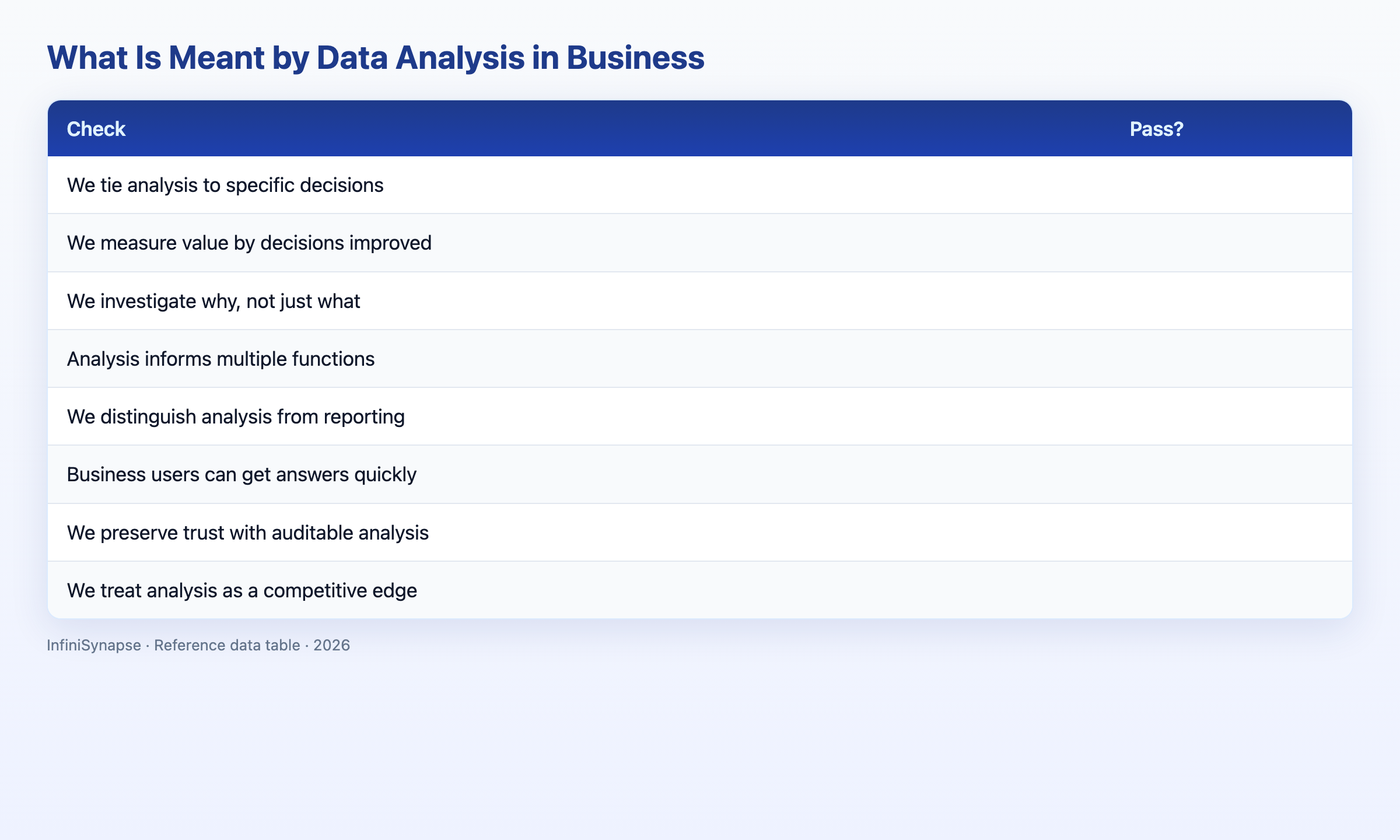
Assess your business analysis maturity (1 point each):
| Check | Pass? |
|---|---|
| We tie analysis to specific decisions | |
| We measure value by decisions improved | |
| We investigate why, not just what | |
| Analysis informs multiple functions | |
| We distinguish analysis from reporting | |
| Business users can get answers quickly | |
| We preserve trust with auditable analysis | |
| We treat analysis as a competitive edge |
6–8: mature analytical business. 3–5: strengthen one dimension from the comparison table. Below 3: shift from reporting volume to investigative depth.
Practical Next Steps
Verify against real job postings
Before committing time or budget, pull five recent job postings in your target market and list the SQL, visualization, and communication skills each repeats. If you are clarifying what is meant by data analysis in your target role, map those posting skills to one practice project.
Ship one portfolio artifact this month
Employers hire on demonstrated ability. Publish one short write-up that explains what is meant by data analysis for a real business question — with data, a chart, and a plain-language recommendation.
Frequently Asked Questions
What does the term mean in a business setting?
In business, it means using the organization's data to answer questions and guide decisions. Sales, customer, and operations records become decision-ready insights that replace guesswork with evidence. Value is measured by the quality and outcomes of the decisions it enables, not by activity counts.
How does it support commercial decisions?
It bridges the raw data a company collects and the choices its leaders must make. It converts overwhelming information into clear guidance on questions like pricing, customer value, and cost control. Companies that analyze well decide better and outcompete those that guess.
How is it different from reporting?
Reporting displays what happened by presenting numbers on a schedule or dashboard. Analysis goes further to investigate why patterns occurred and recommend what to do. A report shows sales fell; analysis explains the cause and suggests a response.
What value does it create for a company?
It creates value through better decisions: pricing work that lifts margin, churn studies that inform retention, or operational reviews that cut waste. Value is measured by decisions improved and what those improvements are worth—not by report volume.
How are AI tools changing delivery?
AI-native tools let business users ask questions in plain language and receive analyzed answers on demand, rather than waiting for an analyst queue. This democratizes access while preserving an inspectable trail for trust, and memory of prior work speeds recurring analyses.
Conclusion
What is meant by data analysis in business is using company data to answer questions and guide decisions, with value measured by the decisions it improves. It goes beyond reporting to investigate and recommend, applies across every function, and in 2026 is delivered on demand by AI-native tools that make it a capability rather than a bottleneck.
The bottom line for any business is to judge analytical work by the decisions it improves. Reports that no one acts on create no value, while a single insight that changes pricing, retention, or investment can pay for an entire function. To see on-demand business analysis in action, read the complete data analysis guide and what AI-native data analysis means, then try the InfiniSynapse web app free on registration.