Best Agentic Analytics Tools: L1–L3 Scorecard (2026)
By the InfiniSynapse Data Team · Last updated: 2026-07-24 · We build InfiniSynapse, an AI-native Data Agent platform included in this comparison. Scores below mix hands-on pilots with public product docs—InfiniSynapse notes are first-party and labeled as such.
Table of Contents
- TL;DR
- What Agentic Analytics Means in 2026
- How We Evaluated These Tools
- Shared Scenario Scorecard
- 6 Tools Compared
- Agentic Analytics vs Traditional BI
- Decision Matrix
- FAQ
- References
- Conclusion
TL;DR
Canonical answer: Agentic analytics is analytics software where an AI agent plans and executes multi-step analysis from a single goal—querying sources, recovering from failures, exposing an audit trail, and (in the strongest systems) distilling reusable memory. In 2026, “agentic” in marketing often means multi-step chat; in architecture it means goal-driven execution + transparency + memory.
Who this is for: analytics leaders and buyers shortlisting production agents before a budget cycle.
What you'll learn:
- L1 / L2 / L3 levels that separate copilots from production agents
- Six tools scored on the same cohort-retention scenario
- Where this class of tools stops and traditional BI starts
- A two-question filter before you buy
Conflict of interest: InfiniSynapse publishes this page and sells an L3 product in the set. Competing tools are described from public docs plus our pilots; verify connectors and limits on vendor sites.
Related reading: AI-native data platform · What Is a Data Agent? · AI for Data Analysis · Autonomous data agent.
Account for prompt-injection and data-exfiltration risks in the OWASP Top 10 for LLM Applications. Align production governance with the NIST AI Risk Management Framework.
What Agentic Analytics Means in 2026
Key Definition: Agentic analytics is a class of analytics software where an AI agent receives a business goal—not a sequence of click-instructions—and plans, executes, and iterates across data sources until it produces a defensible insight package. Mature systems add failure recovery and knowledge distillation for the next run.
“Agentic” became a vendor buzzword in 2025. By mid-2026, buyers separate three levels:
| Level | Behavior | Example |
|---|---|---|
| L1 — Copilot | One instruction → one action; user drives each next step | ChatGPT Advanced Data Analysis on an uploaded CSV |
| L2 — Multi-step agent | One prompt → several chained steps inside one session | Hex Magic drafting notebook cells; Genie on Unity Catalog |
| L3 — Production agent | One goal → phased plan, cross-source execution, self-correction, audit trail, persistent memory | Multi-source Data Agent platforms (e.g. InfiniSynapse) |
Agent-design research such as Anthropic on effective agents and ReAct reinforces the production bar: expose plans and tool traces, not only final prose.
This category is the execution behavior; an AI-native data platform is the workflow architecture (autonomy, transparency, distillation, multi-entry, self-correction) that makes that behavior trustworthy at scale. For category framing beyond tools, see Agentic analytics. For the human-in-the-loop middle path, see Augmented analytics.
How We Evaluated These Tools
Each platform was scored on eight criteria. The first three are the filter for production use; the rest are operational.
| Criterion | What we tested |
|---|---|
| Autonomy depth | L1 / L2 / L3 from one submitted goal |
| Process transparency | Can every intermediate SQL, dataset, and chart be inspected? |
| Knowledge accumulation | Does completed work distill into reusable, approved memory? |
| Multi-source execution | Warehouse + files (+ APIs) in one task |
| Self-correction | Reroute on timeout, missing column, or unavailable source |
| Governance | SSO, RLS, audit logs |
| Entry points | Chat, web app, API parity |
| Time-to-defensible-answer | Wall clock on the shared scenario |
Hands-on methodology (Q1–Q2 2026): Same scenario on every tool—“monthly cohort retention with segment breakdown” on a 12-table e-commerce schema, one natural-language goal, no step-by-step coaching. Tools that required pasting schema fragments or confirming each join scored L1/L2 regardless of homepage copy.
Shared Scenario Scorecard
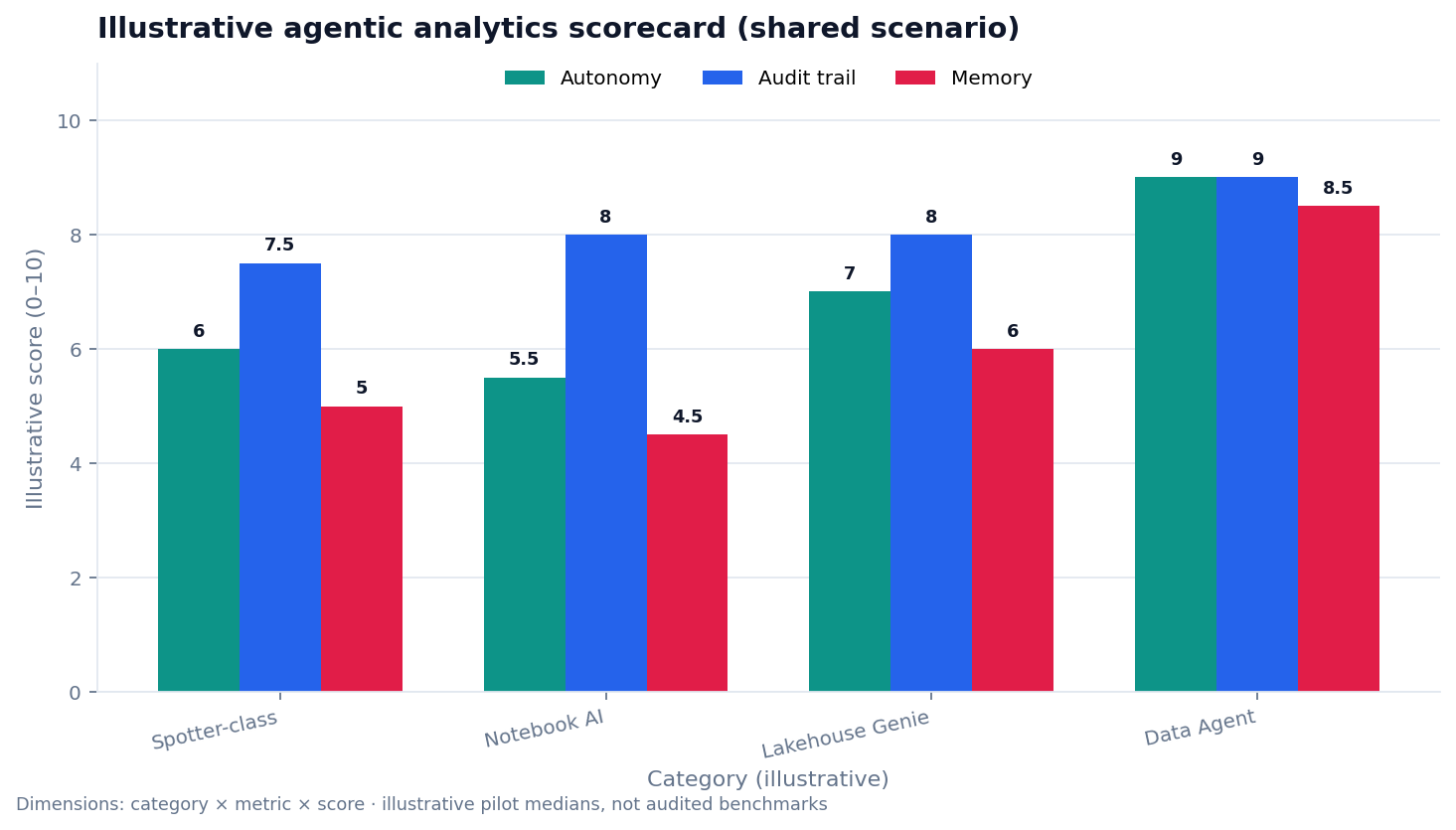
Verifiable pilot notes (not third-party audited). Use this table as a template for your POC—not as a league table carved in stone.
| Tool | Level | Shared scenario outcome (our pilots) | Memory on rerun |
|---|---|---|---|
| ThoughtSpot Spotter | L2 | Retention by channel in ~2 turns when metrics pre-mapped; blocked on unmodeled joins | Saved searches; not auto distillation |
| Hex Magic | L2 | 7-cell retention notebook in one prompt; join in cell 4 needed human edit | Project files; no metric-lock cards |
| Databricks Genie | L2 | Table resolution via Unity Catalog in 7/10 runs; 3/10 ambiguous columns | Space history; limited cross-session locks |
| Julius AI | L2 | Cohort charts from 15 MB CSV in <90s; next week required re-upload | Session-only |
| Fabric / Power BI Copilot | L1–L2 | Strong “explain this chart” / DAX assist; weak multi-phase unattended plans | Workspace context |
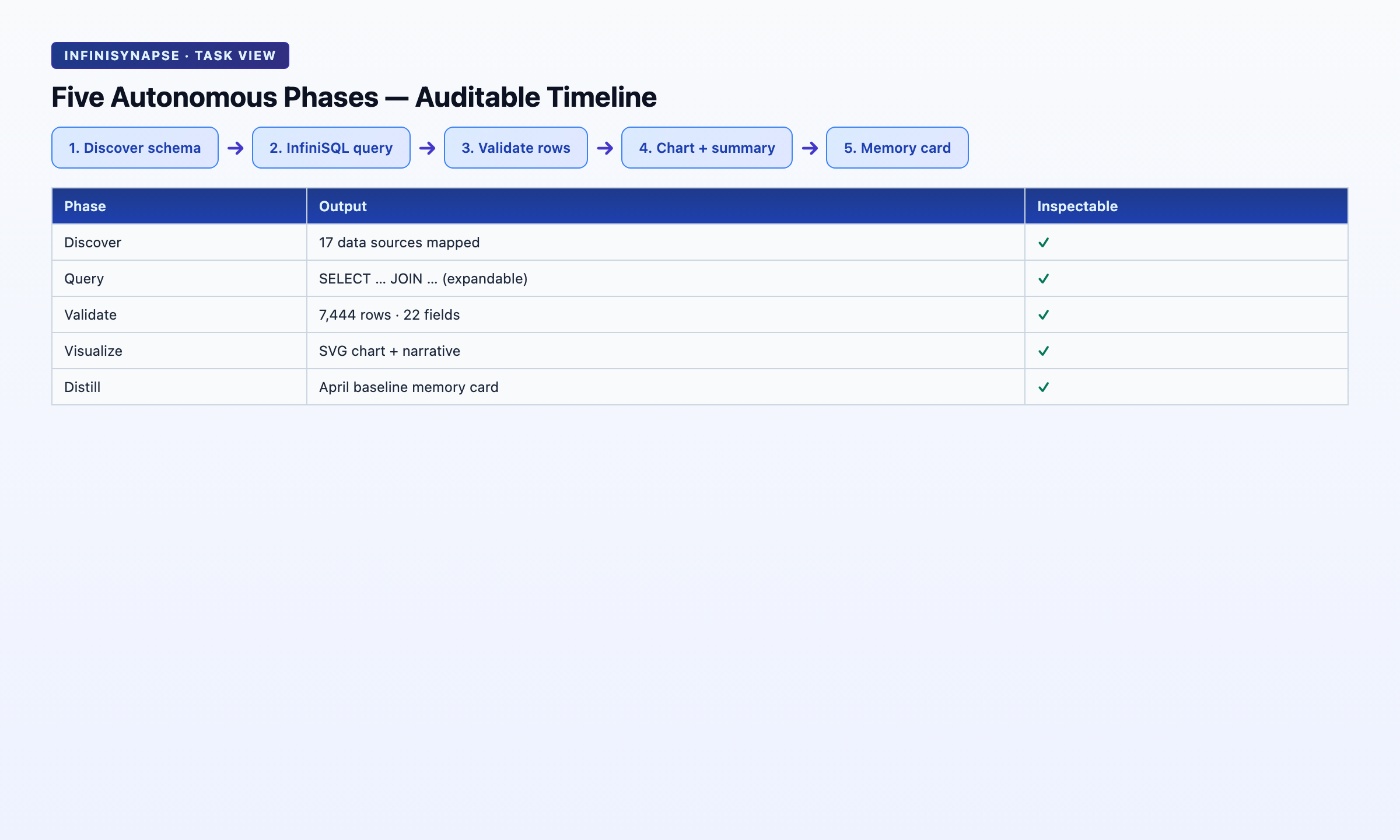
| InfiniSynapse | L3 | Five phases; MySQL + XLSX; SQL timeout reroute in phase 3; 4m 12s wall time; memory card locked retention_rate + acquisition_channel | Task memory cards (first-party) |
Warehouse-native agents are described in vendor materials such as Databricks on data agents / Genie—compare catalog grounding and audit depth to the scorecard above. For product-level Spotter behavior, see ThoughtSpot Spotter docs; for notebook-native drafting, see Hex Magic.
Run the same cohort goal on your warehouse
Connect a read-only warehouse, ask one natural-language retention question, and compare whether you get a phased plan, inspectable SQL, and a reusable definition—or a chat reply you cannot audit.
6 Tools Compared
1. ThoughtSpot Spotter / Sage
| Field | Detail |
|---|---|
| Agentic level | L2 — multi-step within a governed semantic layer |
| Best for | Enterprises already on ThoughtSpot with mature metrics |
| Limit | Weak on ad-hoc joins outside the model |
Choose ThoughtSpot when metrics are pre-defined and you want NL on governed BI. That is excellent L2 multi-step behavior, not full unattended L3.
2. Hex Magic
| Field | Detail |
|---|---|
| Agentic level | L2 — multi-step inside analyst notebooks |
| Best for | Analyst teams who want AI to draft the first ~80% of cells |
| Limit | Not designed for unattended recurring packs |
Choose Hex when humans must edit and own the notebook. Transparency is a feature.
3. Databricks Genie
| Field | Detail |
|---|---|
| Agentic level | L2 — multi-step on Unity Catalog–governed tables |
| Best for | Databricks-centric estates |
| Limit | Mixed-source / file-heavy work needs another layer |
Choose Genie when data gravity is already Databricks. Catalog metadata is the prerequisite. See also Databricks Genie vs Data Agent.
4. Julius AI
| Field | Detail |
|---|---|
| Agentic level | L2 — multi-step on uploaded datasets |
| Best for | Fast CSV/XLSX exploration with an analyst present |
| Limit | Weak recurring production memory |
Choose Julius when speed on files matters more than warehouse federation.
5. Microsoft Copilot in Fabric / Power BI
| Field | Detail |
|---|---|
| Agentic level | L1–L2 — copilot on reports and semantic models |
| Best for | Microsoft 365 shops extending Power BI |
| Limit | Accelerator, not a full autonomous analyst |
Choose Fabric Copilot when switching cost must stay near zero. See Fabric Data Agent vs Copilot.
6. InfiniSynapse (Data Agent)
| Field | Detail |
|---|---|
| Agentic level | L3 — goal-driven production agent |
| Best for | Recurring analyses, multi-source tasks, audit + memory by default |
| Limit | Value compounds after metric contracts exist (same as any serious production agent stack) |
Choose InfiniSynapse when you need plan → execute → self-correct → memory with inspectable SQL. First-party claim—re-run the shared scenario yourself at https://app.infinisynapse.com/.
Agentic Analytics vs Traditional BI
Traditional BI answers: “What does this dashboard show?” Agentic analytics answers: “Given this goal, what should we measure, from where, and what does it mean?”
| Question type | Traditional BI | Agentic analytics |
|---|---|---|
| Recurring KPI | Dashboard refresh | Agent recalls locked definitions and reruns |
| Ad-hoc exploration | Analyst builds a report | Agent plans + executes; analyst reviews the audit trail |
| Cross-source join | ETL project | In-task federation (where supported) |
| Failure | Pipeline alert to engineering | Agent reroutes and logs the workaround |
| Trust model | “Trust the dashboard” | “Trust the query chain” |
Most mature 2026 stacks run both: governed dashboards for executives and production agents for the work between refreshes. For role and workflow framing, see AI data analyst.
Decision Matrix: Which Tool for Which Job
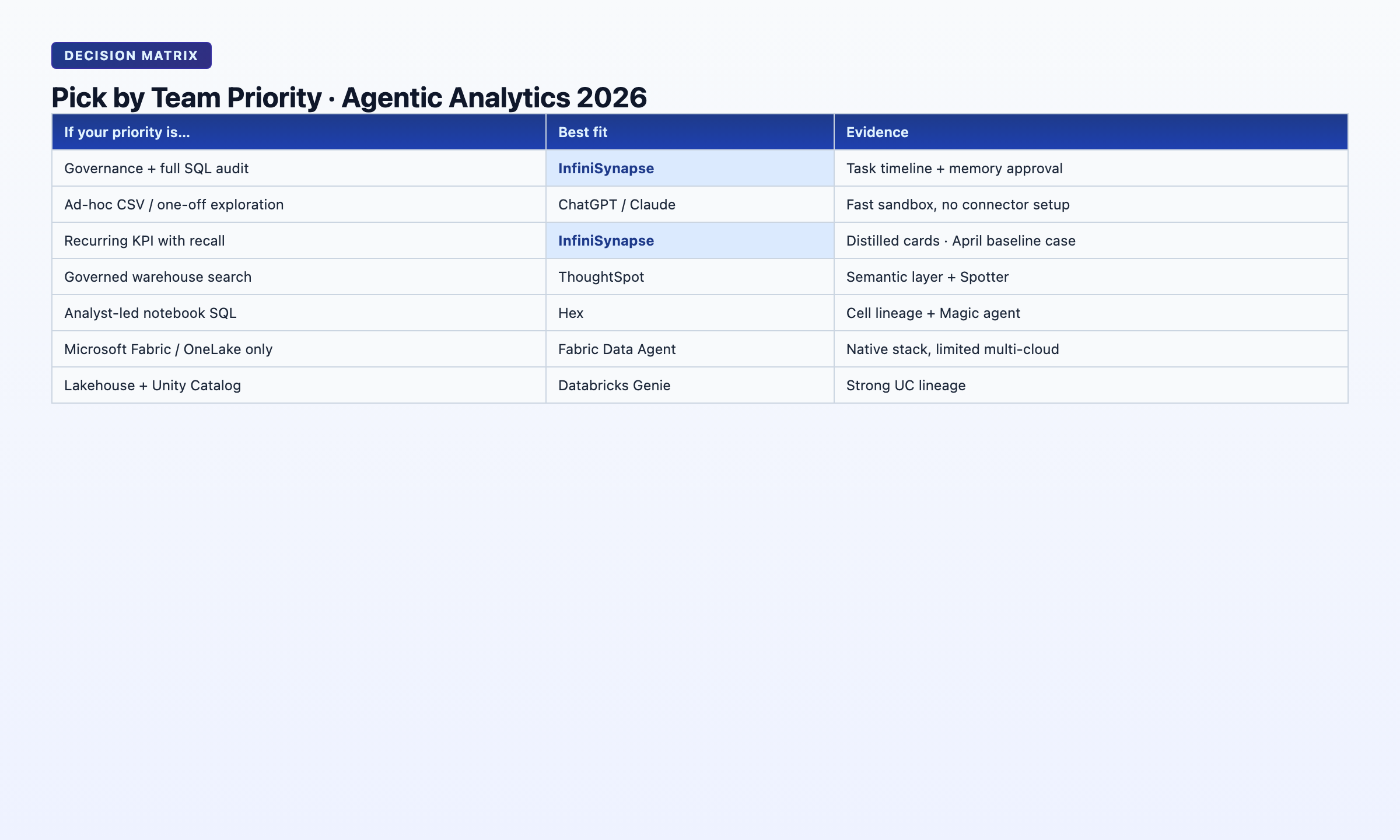
| Your priority | Best fit | Why |
|---|---|---|
| Governed metrics on an existing semantic layer | ThoughtSpot Spotter | NL on pre-modeled data |
| Analyst-owned notebooks with AI drafting | Hex Magic | Human edits preserved in cells |
| Databricks-native warehouse questions | Databricks Genie | Unity Catalog grounding |
| Fast file exploration, analyst present | Julius AI | Speed over memory |
| Microsoft stack extension | Copilot in Fabric | Lowest switching cost |
| Recurring + audit + memory + multi-source | InfiniSynapse | L3 pattern in our pilots |
Two-question filter (use before any RFP):
- Does the tool complete a multi-step analysis from one goal without confirming each step? If no → L1/L2, not production-grade autonomy.
- Can you defend every number by clicking through to the query that produced it? If no → fine for exploration, risky for exec/regulator decisions.
Procurement checklist
Regional AI policy context: OECD AI Policy Observatory · EU overview via the European approach to AI.
Try a warehouse-connected data analyst with a bound knowledge base
Connect a Postgres, MySQL, Snowflake, or Supabase warehouse read-only. Seed a small knowledge base of business definitions. Ask one question that crossed two sources and watch the plan, SQL, and verification step before deciding whether to add an enterprise agent to your stack.
Frequently Asked Questions
What is the best agentic analytics tool in 2026?
There is no universal winner. ThoughtSpot leads for governed semantic-layer NL. Hex leads for notebook-native workflows. Databricks Genie leads for Unity Catalog shops. InfiniSynapse leads in our pilots when you need L3 autonomy—goal-driven execution, self-correction, full audit trail, and memory across sources. Shortlist with the two-question filter, then POC.
How is agentic analytics different from augmented analytics?
Augmented analytics (industry category since ~2017) is the umbrella: ML-assisted prep, query, or visualization. Agentic analytics is a stricter subset: multi-step autonomous execution from a goal, plus transparency and (ideally) memory. See Augmented analytics.
Can agentic analytics replace my BI stack?
Usually no—it complements BI. Dashboards remain the executive consumption layer. Production agents cover ad-hoc cuts, cross-source investigations, and recurring analyses that need locked definitions between refreshes.
What data sources should I require?
File-first tools (Julius) handle CSV/XLSX. Warehouse agents (Genie, ThoughtSpot) need catalog or semantic models. Multi-source L3 platforms should prove DB + warehouse + files in one task during POC. “Agentic” does not mean “connects to everything.”
How do I measure ROI?
Track: (1) time from question to defensible answer, (2) rerun rate without re-explaining definitions, (3) audit incidents resolved in under five minutes. Strong L3 systems improve (2) and (3); L1/L2 tools mainly improve (1) per session.
Is agentic analytics safe for regulated industries?
Only with L3-grade transparency: every metric traceable to a query, definitions versioned. Narrative-only tools fail compliance review regardless of fluency. Align controls with NIST AI RMF and your industry DLP/SIEM standards.
What is the L1 / L2 / L3 difference in one line?
L1 needs a human for every next step; L2 chains steps inside one session; L3 takes a business goal, self-corrects across sources, exposes an audit trail, and can lock reusable memory for the next run.
How should I run a fair POC?
Use one natural-language goal (no step coaching), the same schema and sources for every vendor, and score autonomy, inspectable SQL/charts, self-correction, and whether definitions persist on rerun. Reuse the shared scorecard table above as the template.
References
- [Standard] OWASP. Top 10 for LLM Applications. owasp.org
- [Standard] NIST. AI Risk Management Framework. nist.gov
- [Research] Anthropic. Building effective agents. anthropic.com/research
- [Research] Yao et al. ReAct: Synergizing Reasoning and Acting in Language Models. arxiv.org/abs/2210.03629
- [Vendor] Databricks. Pushing the frontier of data agents with Genie. databricks.com
- [Vendor] ThoughtSpot. Spotter. docs.thoughtspot.com
- [Vendor] Hex. Magic. hex.tech
- [Policy] OECD. AI Policy Observatory. oecd.ai
- [Policy] European Commission. European approach to AI. digital-strategy.ec.europa.eu
Conclusion
The tools worth buying in 2026 are not the ones with the most “agent” mentions on the homepage. They pass the two-question filter: one goal → multi-step completion, and every output number clickable back to source queries.
L1 and L2 tools accelerate analysts; L3 systems change what “data-driven” means for recurring work. Use the shared scorecard as your POC template, then pick the fit—not a vanity #1.
Read next: Data Agent Manifesto · Data agent architecture · Fabric Data Agent vs Copilot · Best AI tools for data analysis.