Fabric Data Agent vs Copilot: Which Fits Your Stack?
By the InfiniSynapse Data Team · Last updated: 2026-07-24 · We build an AI-native data agent platform and benchmark it against Microsoft Fabric capabilities quarterly; this comparison reflects hands-on evaluation through June 2026.
Table of Contents
- TL;DR
- Two AI Layers in Microsoft Fabric
- Fabric Data Agent: What It Actually Does
- Copilot in Fabric: What It Actually Does
- Head-to-Head Comparison Table
- Decision Matrix: Which Fits Your Stack?
- When to Add a Dedicated Data Agent
- Migration Path: Copilot to Data Agent
- TCO and Licensing
- Security and Compliance
- FAQ
- Conclusion
TL;DR
Microsoft Fabric Data Agent (preview) is an autonomous, multi-step analytics agent scoped to your Fabric lakehouse and semantic models. Copilot in Fabric (Power BI, Data Factory, Data Engineering) is an AI-enabled assistant: strong at single-step help inside familiar Microsoft UIs, but session-bound without structured memory distillation.
This fabric data agent vs copilot guide helps Microsoft-centric teams choose the right layer—or both. If your estate is 100% Fabric with governed semantic models, start with Fabric Data Agent for recurring analyses. If you span non-Microsoft sources, need cross-stack memory cards, or want API/chat entry points, pair Fabric with a dedicated data agent like InfiniSynapse.
Who this is for: Microsoft-centric data teams evaluating Fabric AI options, architects planning a 2026 analytics stack, and BI leaders comparing Copilot licenses against agent platforms.
What you'll learn:
- How Fabric Data Agent and Copilot differ in trigger model, memory, and audit
- A comparison table mapped to the AI-native five pillars
- A decision matrix keyed to stack purity, governance needs, and recurrence
- When a Fabric-only strategy breaks and what to add
Evaluation basis: We build and evaluate InfiniSynapse on production customer workflows. Governance, adoption, and security context is cited inline throughout this guide—not in a standalone reference list.
Two AI Layers in Microsoft Fabric
Microsoft ships two distinct AI layers inside Fabric—and conflating them is the most common buying mistake we see in mid-market evaluations. Separate the surfaces first:
| Layer | Product surface | Paradigm |
|---|---|---|
| Copilot | Power BI, Data Factory, Data Engineering, Real-Time Intelligence | AI-enabled: assists one step at a time inside the tool you already use |
| Data Agent | Fabric Data Agent (preview) | Agentic: accepts a goal, plans multi-step work across Fabric items |
Copilot answers "help me write this query". Data Agent answers "produce the monthly churn report using our lakehouse". Both run on Azure OpenAI under the hood. The workflow contract is different—and that contract is what every shortlist slide should lead with.
For the category framing behind this split, see AI-Native vs Augmented Analytics.
Fabric Data Agent: What It Actually Does
Fabric Data Agent (public preview, 2025–2026) is Microsoft's autonomous analytics agent scoped to a Fabric workspace. In a bake-off, test Data Agent on multi-step lakehouse goals—not single DAX fixes. Regulated rollouts should align agent access reviews with the OWASP Top 10 for LLM Applications when prompts can trigger queries or exports.
| Capability | Observed behavior |
|---|---|
| Trigger | Natural-language goal → agent plans phases across lakehouse tables and semantic models |
| Execution | Multi-step: discover schema → generate SQL/notebook steps → visualize |
| Scope | Fabric items in the bound workspace; OneLake data via shortcuts |
| Transparency | Step log in agent UI; intermediate outputs visible within the run |
| Memory | Session + workspace context; evolving preferences—not yet full distillation cards |
| Governance | Inherits Fabric workspace RBAC, Purview lineage hooks |
Hands-on note (Q2 2026): We ran Fabric Data Agent against a 9-table retail lakehouse schema. A "monthly category revenue with YoY delta" goal completed in 4 autonomous phases. SQL was Fabric-native (T-SQL / Spark SQL depending on item type). Failure recovery rerouted once when a semantic model column was renamed—the agent suggested an alternative binding without user intervention. Total wall time: 11 minutes vs ~45 minutes manual.
Strengths: zero additional vendor if you are already on Fabric; native Purview lineage; no data egress from OneLake.
Gaps (June 2026): preview stability; memory is not yet structured distillation (see Data Agent Memory); limited entry points outside Fabric UI; no first-class API for embedding in non-Microsoft workflows.
Copilot in Fabric: What It Actually Does
Copilot appears across Fabric workloads. Power BI Copilot is the surface most analysts touch daily:
- Power BI Copilot — summarize reports, generate DAX, build visuals from natural language
- Data Factory Copilot — pipeline suggestions, data flow assistance
- Data Engineering Copilot — notebook code generation, Spark job help
| Capability | Observed behavior |
|---|---|
| Trigger | One instruction per copilot invocation |
| Execution | Single-step or short multi-step within the current artifact |
| Scope | The report, pipeline, or notebook you have open |
| Transparency | Shows generated code/DAX; limited cross-artifact audit |
| Memory | Session-bound within the editing session |
| Governance | Tenant-level Copilot policies; admin controls on data grounding |
Hands-on note (Q2 2026): Power BI Copilot generated a usable DAX measure for
rolling 90-day active userson the first try in 7 of 9 attempts. The two failures were ambiguous table relationships in a star schema with role-playing dimensions—Copilot returned syntactically valid DAX that referenced the wrongDatetable. Human review remained mandatory.
Strengths: lowest friction for analysts already living in Power BI; excellent for "help me fix this measure" moments; included in many Fabric SKUs.
Gaps: not designed for end-to-end autonomous analysis; no project-level memory cards; each recurring report still requires manual re-grounding.
Head-to-Head Comparison Table
Mapped to the five pillars of AI-native data analysis:
| Dimension | Fabric Data Agent | Copilot (Fabric / Power BI) | InfiniSynapse Data Agent |
|---|---|---|---|
| Pillar 1: Autonomy | Multi-phase goal execution | Single-step assistance | Multi-phase + parallel tasks |
| Pillar 2: Transparency | Step log per run | Code/DAX in context | Full task timeline + every SQL |
| Pillar 3: Memory | Workspace context (evolving) | Session-only | Distilled memory cards + InfiniRAG |
| Pillar 4: Multi-entry | Fabric UI | Power BI / Fabric UIs | Chat + web + API |
| Pillar 5: Self-correction | Limited reroute observed | Returns error to user | Cache/source reroute + log |
| Stack lock-in | Fabric-only | Fabric-only | Multi-source (Postgres, Snowflake, files, …) |
| Best for | Fabric-native recurring analysis | In-tool productivity boosts | Cross-stack agents + memory compounding |
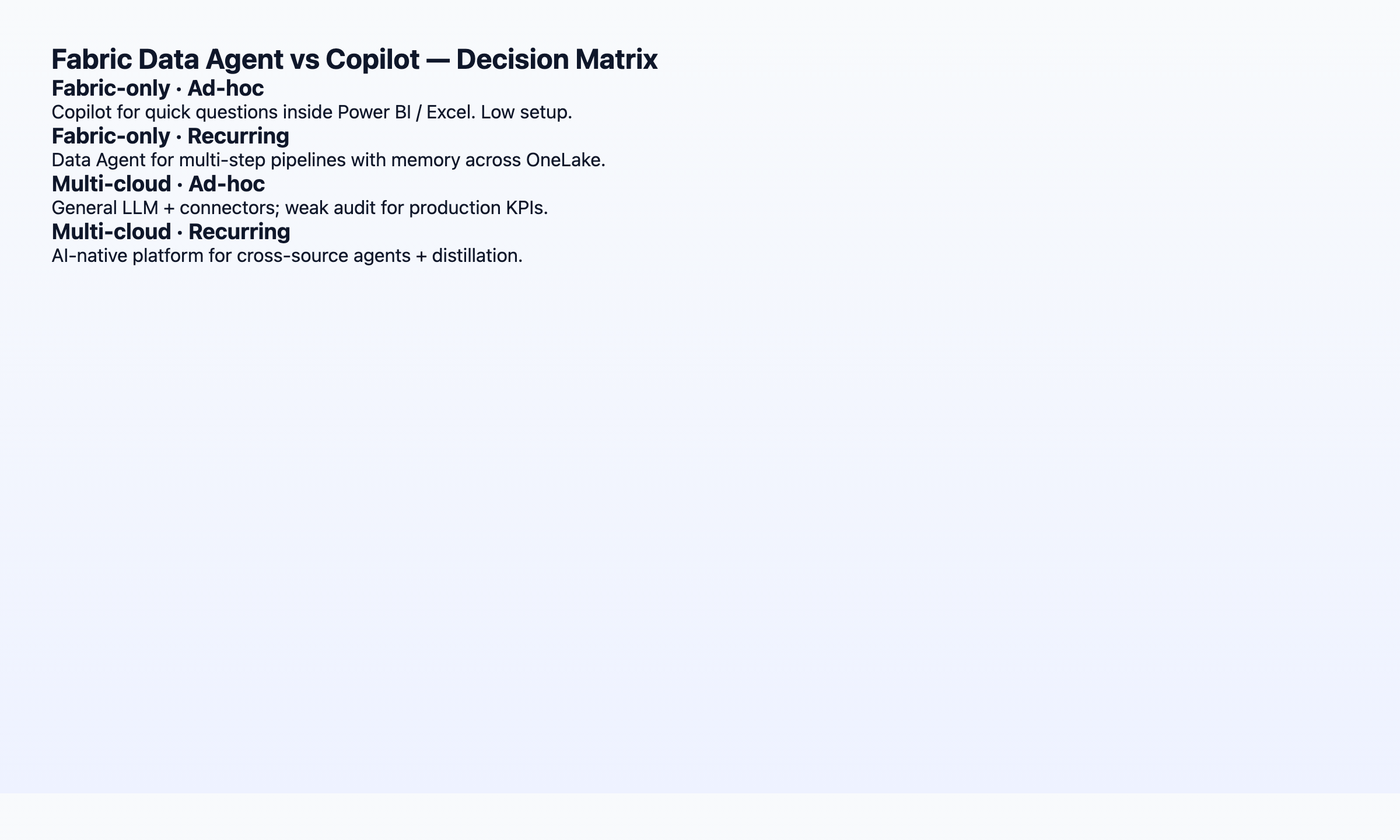
Neither option is “better” in the abstract—they optimize for different jobs inside the same Microsoft estate. Use the table when shortlisting; run the decision matrix below before procurement.
Decision Matrix: Which Fits Your Stack?
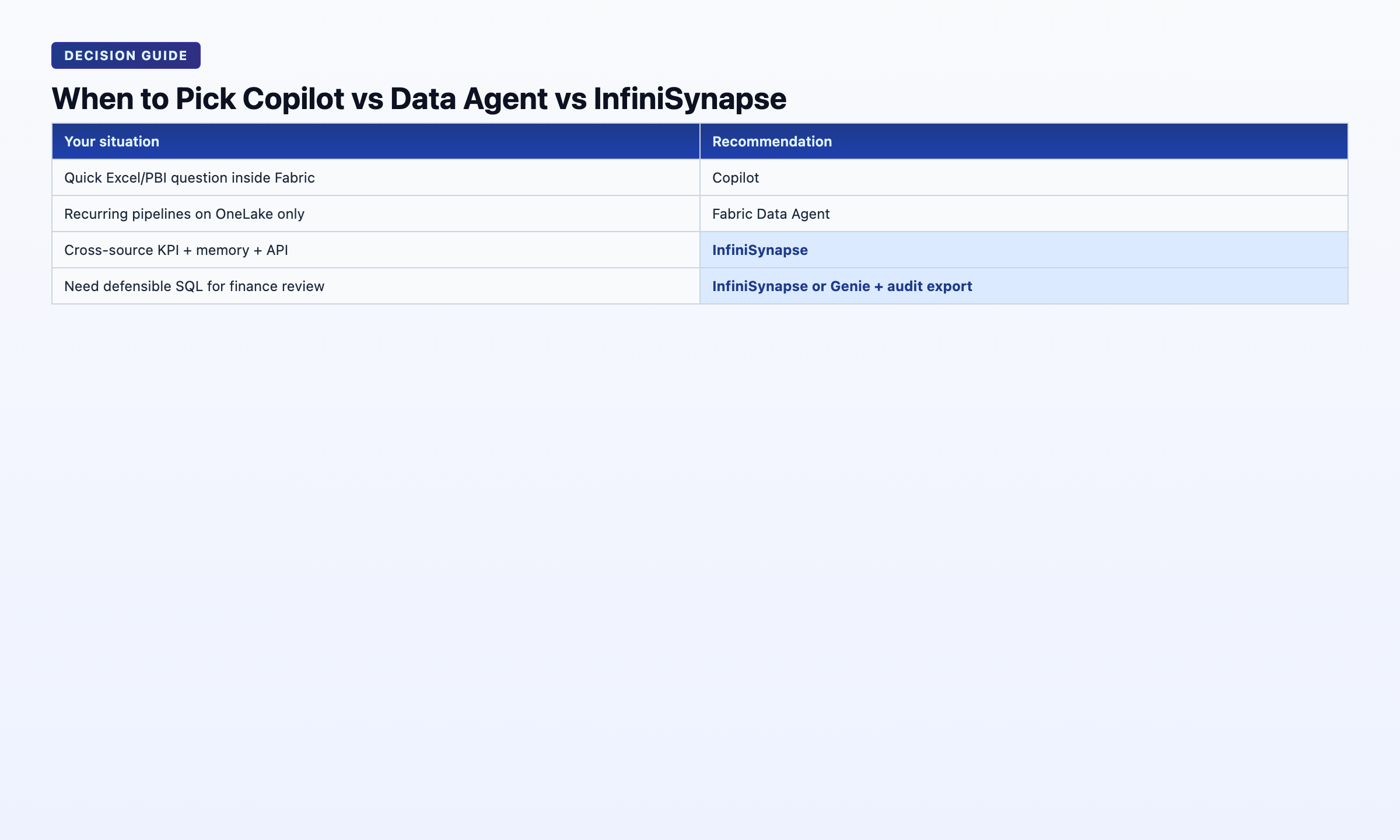
| Your situation | Recommendation |
|---|---|
| 100% Fabric + OneLake, governed semantic models, recurring lakehouse reports | Start with Fabric Data Agent for autonomous runs; keep Copilot for in-report edits |
| Power BI–centric team, mostly dashboard iteration, few cross-source joins | Copilot first — lowest change management; revisit when recurrence grows |
| Fabric + Salesforce + Postgres + ad-hoc Excel from clients | Fabric Copilot for BI artifacts + dedicated data agent for cross-source work |
| Regulated industry requiring metric-definition locking across 12 months | Evaluate memory distillation explicitly |
| Need WeChat/Slack/API triggers for KPI questions | Fabric UI alone is insufficient; add multi-entry agent |
| Pilot budget, single analyst, exploratory only | Copilot only — agent overhead not yet justified |
Two filter questions:
- Is all my analytical data already in Fabric with stable semantic models? No → plan for a cross-stack agent.
- Do I run the same analysis every month with the same definitions? Yes → prioritize memory/distillation over demo-grade autonomy.
When to Add a Dedicated Data Agent
Platform teams often read AI for Data Analysis alongside this topic. Three scenarios still push teams toward a dedicated data agent alongside Fabric:
1. Cross-stack data — Shortcuts help, but many teams have operational Postgres, MongoDB, Stripe, and client Excel files that will not land in OneLake this year. Multi-source connector design should follow Microsoft's data architecture guidance so Fabric shortcuts and external agents do not sprawl without domain boundaries.
2. Structured memory compounding — If your COO asks "why does this month's active user count differ from April?", you need locked definitions in a recallable card—not a Copilot session from April that nobody saved.
3. Multi-entry parity — Executives ask KPI questions in chat during meetings. Requiring them to open Fabric defeats the purpose.
The mature 2026 pattern: Fabric as the governed lakehouse and BI layer; a data agent as the autonomous execution and memory layer across everything Fabric does not yet own. For a broader shortlist, see Best Agentic Analytics.
Migration Path: From Copilot-Only to Fabric Data Agent
| Phase | Duration | Focus |
|---|---|---|
| 0 — Baseline | Weeks 1–2 | Document recurring reports still requiring manual DAX/SQL |
| 1 — Copilot hygiene | Weeks 3–6 | Clean semantic models — both layers fail on dirty metadata |
| 2 — Agent pilot | Weeks 7–10 | One recurring lakehouse goal via Fabric Data Agent; keep Copilot for in-report tweaks |
| 3 — Memory gap audit | Weeks 11–12 | Ask whether Fabric session context replaces distillation; if not, plan supplemental agent |
Teams that skip phase 1 blame model accuracy when the root cause is an ambiguous Date table. Invest in semantic-layer hygiene before comparing autonomy demos.
Change management tip: position Copilot as "in-artifact speed" and Fabric Data Agent as "cross-artifact execution" — not replacements.
When your evaluation committee asks for one slide, answer with two columns: trigger model (step vs goal) and memory contract (session vs workspace context).
Production readiness checklist
Before promoting a Fabric Data Agent pilot, confirm semantic-model hygiene, fallback manual rerun owners, and preview SLA sign-off.
Total Cost of Ownership
| Cost line | Copilot (Fabric / Power BI) | Fabric Data Agent | Notes |
|---|---|---|---|
| License | Often bundled or per-user Copilot SKU | Preview / capacity-dependent | Verify region availability quarterly |
| Analyst time | Low per ad-hoc edit | Lower per recurring multi-step goal | Recurrence drives agent ROI |
| Semantic modeling | Required for both | Required for both | Under-budgeted in most pilots |
| Memory rework | High — re-ground each month | Medium — workspace context evolving | Add dedicated agent if distillation required |
| Cross-stack integration | Fabric-bound | Fabric-bound | Non-Microsoft sources need second agent |
A team running 40 recurring analyses per month often recovers Fabric Data Agent onboarding in one quarter—if semantic models are clean. A team doing only exploratory dashboard edits may never justify agent capacity.
Include fallback labor: preview agents fail. Budget senior analyst hours for manual reruns until production SLA is proven.
Security and Compliance
Regulated buyers ask security before autonomy. Both layers share a tenant boundary—they inherit Azure OpenAI data-handling commitments and Fabric workspace RBAC. Differences appear in audit granularity and memory persistence.
Align production AI risk reviews with the NIST AI Risk Management Framework. When procurement requires certified AI management systems, map controls to ISO/IEC 42001. Credential and network controls should also sit inside your NIST Cybersecurity Framework program. Secure deployment patterns for agent-facing services should cross-check UK NCSC guidelines for secure AI system development, and long-running agent ops should map to the AWS Well-Architected Machine Learning Lens.
- Copilot logs sit primarily in Microsoft 365 / Fabric admin surfaces; per-measure DAX generation may not link to a cross-artifact task timeline.
- Fabric Data Agent exposes phased step logs within the agent run—better for "show me every query behind this chart" — but preview status means retention policies may change.
Purview lineage hooks help both; neither replaces metric-definition locking for month-over-month defensibility. Confirm Fabric capacity region matches contractual residency requirements before procuring either AI layer.
Try a warehouse-connected data analyst with a bound knowledge base
Connect a Postgres, MySQL, Snowflake, or Supabase source read-only alongside your Fabric estate. Seed a small knowledge base of metric definitions. Ask one recurring KPI question and inspect plan, SQL, and verification before you lock a Fabric-only AI strategy.
Frequently Asked Questions
What is fabric data agent vs copilot in one sentence?
Copilot assists single steps inside Fabric UIs; Fabric Data Agent accepts multi-step analytical goals and executes across Fabric items—different trigger models and memory contracts.
Is Fabric Data Agent the same as Copilot?
No. Different products, different jobs. That distinction is the core of any evaluation.
Do I need both licenses?
In most Fabric SKUs, Copilot capacity is included or add-on licensed separately. Data Agent preview availability depends on capacity region and tenant settings. Budget both lines when you use Copilot for edits and Data Agent for recurring goals.
How does InfiniSynapse compare to Fabric Data Agent?
InfiniSynapse is AI-native across the five pillars with memory cards and multi-source InfiniSQL. Fabric Data Agent wins on native Fabric integration. Many teams run both: Fabric for governed storage and BI; InfiniSynapse for cross-source autonomous analysis. See also What Is a Data Agent?.
Which is better for SQL generation accuracy?
Comparable on Fabric-native schemas when semantic models are clean. Accuracy degrades for both when role-playing dimensions or undocumented views pollute the schema. Invest in semantic-layer hygiene first.
Is Fabric Data Agent production-ready?
It remains in preview as of June 2026. Suitable for pilot workloads with executive sponsorship and fallback manual processes—not yet our sole recommendation for regulated production without a secondary audit path.
When should I keep Copilot-only?
When work is mostly dashboard iteration, change management budget is low, and recurrence does not yet justify agent capacity.
Can Fabric Data Agent reach Postgres or Salesforce outside OneLake?
Not as a first-class multi-source agent today. Use shortcuts where they fit, or add a dedicated cross-stack data agent for sources that will not land in OneLake this year.
Conclusion
fabric data agent vs copilot is not a winner-take-all choice—it is a layer choice. Copilot makes Microsoft analysts faster inside familiar tools. Fabric Data Agent moves toward autonomous, multi-step analysis within Fabric's boundary. Teams with heterogeneous sources should plan for a dedicated data agent alongside Fabric.
Continue in this cluster: Data agent architecture · Code agent vs data agent · Best AI tools for data analysis.